



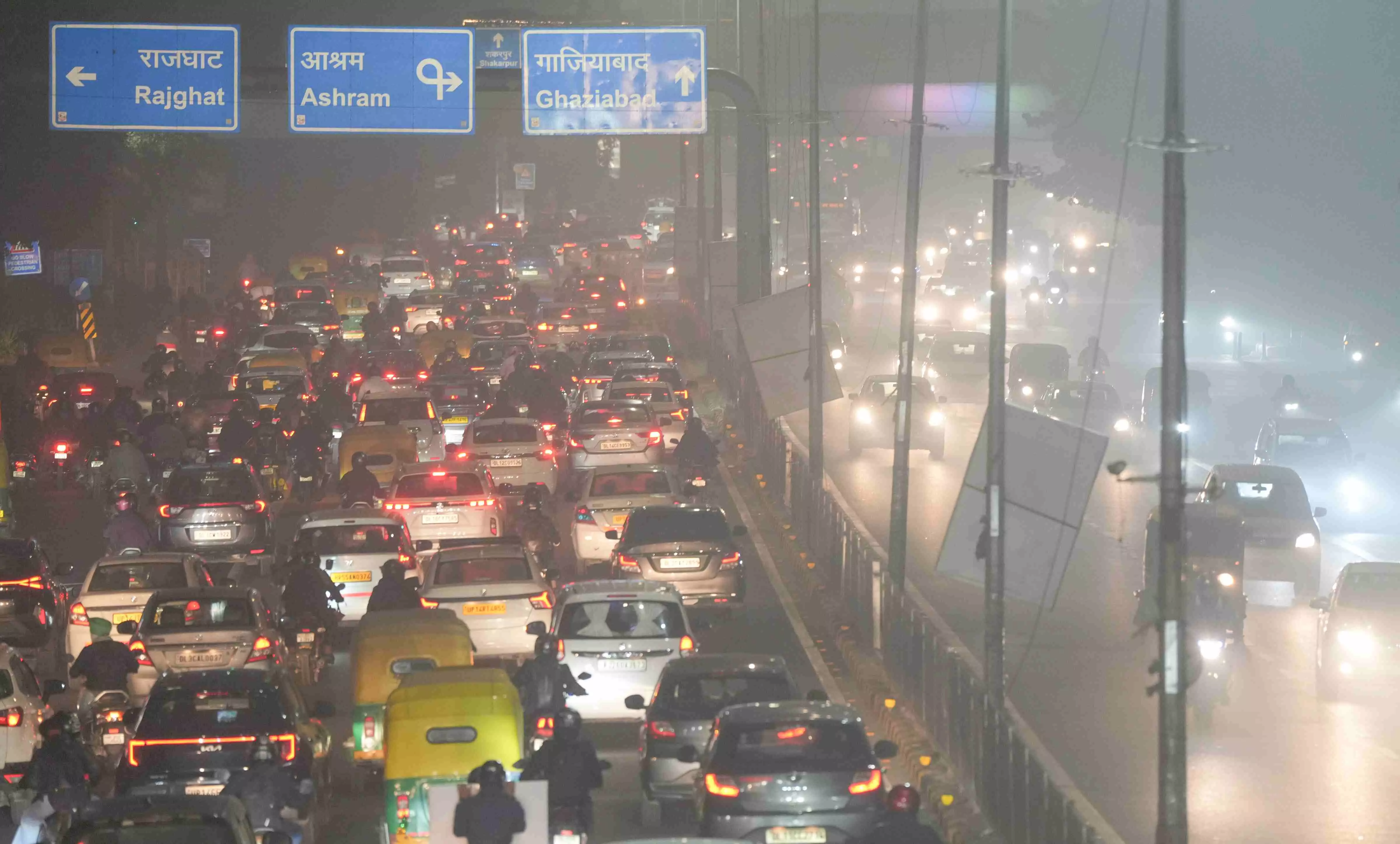
Vehicles stuck in a traffic jam as a layer of smog engulfs the city amid deterioration in the capital's air quality, in New Delhi. Photo: PTI
As Delhi chokes on smog, China shares ‘Beijing model’ to cut air pollution
China’s embassy details how Beijing reduced smog through vehicle curbs and industrial restructuring, while experts caution against direct replication

As in this winter also Delhi chokes on toxic smog despite multiple curbs in place to improve the national capital’s Air Quality Index (AQI), the Chinese embassy in India has detailed how it brought down air pollution in Beijing, which was once called the “smog capital” of the world.
‘The Beijing model’
The Chinese embassy spokesperson Yu Jing, in a series of posts on X, gave a step-by-step description of the “Beijing model” of curbing air pollution while emphasising that China has “no intention of exporting the Beijing model,” noting that “there is no one-size-fits-all formula.”
Also Read: Air purifiers to be installed in 10,000 classrooms: Delhi education minister
Highlighting shared challenges, Jing stated that “both China and India know the struggle with air pollution amid rapid urbanisation,” adding that “cleaner air doesn’t happen overnight, but it is achievable.”
The posts also compared air quality readings from December 15, showing Delhi’s AQI at a hazardous 447, while Beijing recorded a far lower 67.
Vehicle emissions control
Describing Beijing’s first line of action, Jing stated the city adopted “ultra-strict regulations” comparable to Euro VI standards, while phasing out older, high-emission vehicles.
She further stated that measures such as license-plate lotteries, odd-even and weekday driving restrictions were introduced alongside heavy investments in public transport. Beijing also pushed aggressively towards electric mobility.
Also Read: Dense fog blankets north India; red alert issued for Delhi
“These efforts were supported by coordinated emission reductions across the Beijing-Tianjin-Hebei region,” stated Jing. She stressed the importance of preventing pollution spillover from neighbouring areas.
Delhi, meanwhile, has implemented BS-VI norms for new vehicles since 2020, but enforcement gaps persist. Restrictions on non-BS VI and overage vehicles have largely been imposed only during emergency periods, with limited long-term impact.
Industrial restructuring
The second phase focused on reshaping Beijing’s industrial landscape. According to the Chinese embassy, more than 3,000 heavy industries were either shut down or relocated. “Relocating Shougang, one of China’s largest steelmakers, alone cut inhalable particles by 20%,” stated Jing.
Also Read: No conclusive link between high AQI and lung diseases: Govt
Elaborating further, she said that former industrial sites were redeveloped into parks, commercial districts and cultural hubs. The Shougang complex, for instance, was transformed into a key venue for the 2022 Winter Olympics, she added.
Beijing also eased pressure on the capital by moving wholesale markets, logistics hubs and some institutions to surrounding areas, while shifting general manufacturing to Hebei and retaining high-end research and services.
Lessons and limitations
While the embassy’s suggestions have drawn attention, experts caution that replicating Beijing’s approach in Delhi would be challenging without adaptation, reported India Today.
Also Read: Delhi air quality worsens, 'very poor' conditions likely to persist
Beijing’s turnaround followed a national action plan launched in 2013, backed by sustained enforcement and regional coordination.
The report further stated that in Delhi, recurring issues such as stubble burning in neighbouring states, inter-state coordination failures and weak compliance, including faulty pollution certification, continue to undermine efforts.
However, Jing emphasised that India would find “its own path to cleaner skies, suited to its national realities.”