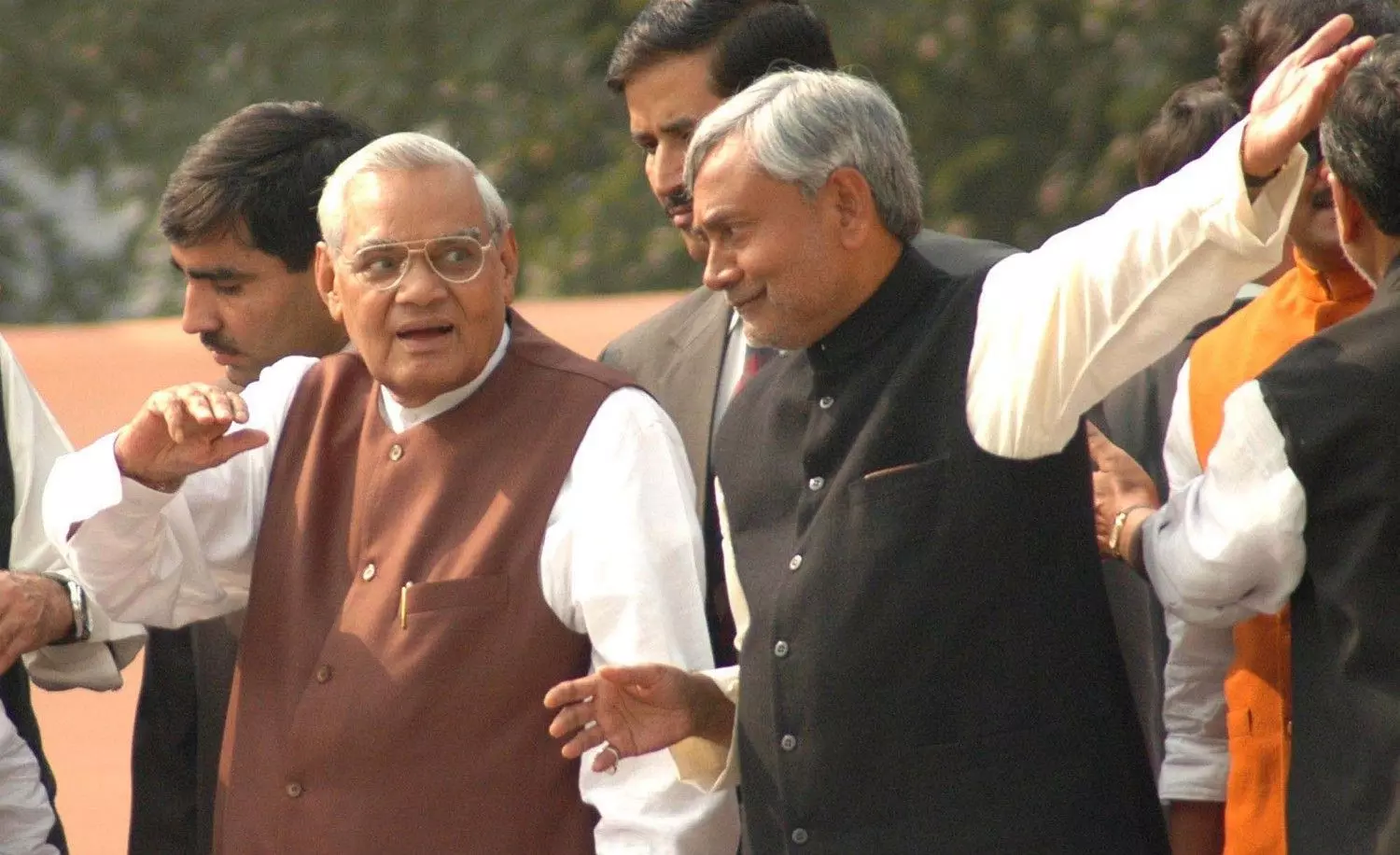
The two 'Biharis': Outgoing Bihar CM Nitish Kumar with prime minister Atal Bihari Vajypee at an event in Patna in November 2005. Photo: PTI
Why Nitish's Rajya Sabha move signals end of JP Movement era in Bihar
The BJP now faces its biggest test yet — holding together the intricate social coalition that kept Nitish in Patna's power saddle for two decades

Bihar Chief Minister Nitish Kumar's nomination to the Rajya Sabha is not merely a personal political decision — it is being read as a signal marking the end of a long chapter in Bihar's politics and the beginning of a new one.
The generation of leaders around whom the state's politics revolved for nearly five decades is now slowly receding from centre stage. The influence of leaders who emerged from the JP Movement (the late Jayaprakash Narayan's movement against Indira Gandhi’s Emergency in the 1970s), which shaped Bihar's politics from the 1980s onwards, is now all but spent.
Bihar's trio: Lalu, Nitish, Ram Vilas
Bihar's political trajectory over this period was largely steered by three dominant figures: Lalu Prasad Yadav, Nitish Kumar, and Ram Vilas Paswan. All three had their political roots in the JP movement, which gave birth to a new generation of leaders in the aftermath of the Emergency.
Also read: Does Nitish’s decision reflect BJP’s broader plan? | Talking Sense With Srini
They not only shaped Bihar's power structures but also played decisive roles in national political equations on multiple occasions. That trio, however, is no longer at the centre of active politics. Paswan has passed away, and his son Chirag Paswan now leads the Lok Janshakti Party (Ram Vilas) or LJP (R-V), which was formed after the original LJP got split.
Lalu Prasad has stepped back from active politics due to health reasons and has passed his Rashtriya Janata Dal’s (RJD) baton to his son Tejashwi Yadav.
And the Janata Dal (United)’s Nitish — one of the most influential faces in Bihar's politics for the past two decades — now appears to be moving back towards Delhi's political corridors via the Upper House. He had been a prominent face in the Centre in the past before moving to lead in Patna in 2005.
Another significant figure of this era was Sushil Kumar Modi, who for long was the face of the Bharatiya Janata Party (BJP) in Bihar and served as the deputy chief minister under Nitish. He, too, has passed away.
Also read: Nitish Kumar abandons CM throne for Rajya Sabha debut: Is this his final 'somersault'?
It is increasingly apparent, then, that Bihar's politics is moving beyond the generation that defined the state's governance and political discourse from the 1990s until now.
The caste equation challenge
With Nitish's likely departure from active state politics, the most pressing question concerns social and caste equations. After coming to power in 2005, he constructed a social coalition that became his greatest political asset.
By bringing the Extremely Backward Classes (EBCs) and the most marginalised Dalit communities to the centre of political attention, he built a vote bank that kept him in power for years. It was precisely this social arithmetic that repeatedly prevented the RJD from securing a clear majority, despite mounting strong electoral challenges.
The so-called 'Luv-Kush' equation — an alliance of Kurmi and Kushwaha communities — was another cornerstone of Nitish's politics. Though numerically a modest share of the population, this grouping has punched well above its weight politically.
Also read: After sudden Rajya Sabha move, what lies ahead for Nitish, JD(U) and Bihar?
What set Nitish apart, however, was that he never remained confined to his caste identity alone. He built a broad-based acceptability across different social groups. If the BJP now installs its own chief minister in Bihar, its biggest challenge will be how well it can maintain this delicate social balance. Caste equations have always been decisive in Bihar's politics, and managing them is no easy task for any party.
The 'good governance' narrative
At the level of political image, Nitish built a clear and compelling narrative. By branding RJD's rule as 'jungle raj' (lawless governance) and positioning his own politics around the idea of 'su-shasan' (good governance), he established himself as a credible alternative. The BJP will now need to present a leadership that can sustain that same image — one associated with law and order, administrative reform, and development.
Also read: As Bihar's liquor ban turns 10, Nitish faces pressure from allies, rivals
Nitish's support among women has also been a significant pillar of his politics. The prohibition on alcohol, the promotion of self-help groups under the Jeevika programme, and a range of welfare schemes for women made him particularly popular among female voters — a demographic that has consistently tilted in his favour during elections.
A transition, not just a move
Taken together, Nitish's move to the Rajya Sabha is not simply a change of position — it marks the beginning of a transitional period in Bihar's politics. In the times ahead, the BJP will face the challenge of managing law and order, women's empowerment, and caste balance simultaneously. If the party can hold its ground on all three fronts, it stands a good chance of consolidating its political grip on Bihar for the long term.
This article was originally published in The Federal Desh.