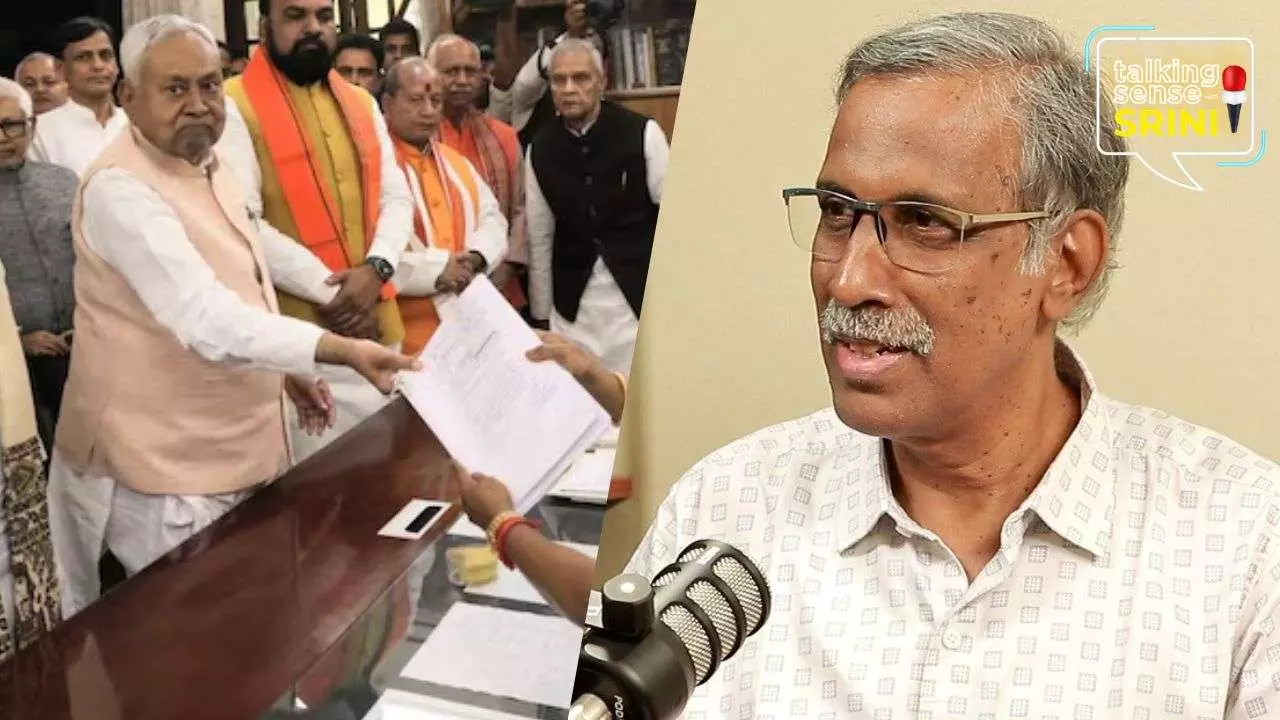
Does Nitish’s decision reflect BJP’s broader plan? | Talking Sense With Srini
Srinivasan explains how the BJP leverages alliances, party splits, and Congress decline to expand, with Bihar’s realignment set to reshape politics in the state

Nitish Kumar’s decision to step down as Bihar’s chief minister and move to the Rajya Sabha has raised questions about the political implications for the state. While the move may appear sudden, it fits into a broader pattern that has helped the BJP expand its footprint across India, The Federal’s Editor-in-Chief S Srinivasan said in the latest episode of Talking Sense With Srini.
According to Srinivasan, the development is “hardly a black swan event”. Instead, it may signal the gradual weakening of the JD(U) within the BJP-led alliance in Bihar. “Wherever the BJP cannot grow organically at a fast pace, it adopts what you may call an acquisition strategy,” he explained, comparing it to mergers and acquisitions in the corporate world. “Sometimes it is an alliance followed by absorption.”
Regional tactics, national strategy
Srinivasan pointed to Maharashtra as a prominent example. At one time, the BJP was a junior partner to Shiv Sena. But political developments between 2019 and 2022 saw the party split, with Eknath Shinde leading one faction into alliance with the BJP. A similar split occurred in the NCP when Ajit Pawar broke away from Sharad Pawar. “The result is that the BJP has emerged as the dominant political force in the state,” Srinivasan noted.
Also read | Nitish Kumar abandons CM throne for Rajya Sabha debut: Is this his final 'somersault'?
However, the strategy differs from state to state. “The overall strategy may be the same, but the execution varies,” he said. In Maharashtra, the shift resembled a hostile takeover through party splits. In Bihar, the transition appears far smoother, with Nitish Kumar’s move seen as a gradual handover rather than a confrontation.
Srinivasan also linked the BJP’s rise to broader structural changes in Indian politics. For decades after independence, the Congress dominated the political landscape. That gave way to an era of coalition politics after the 1990s. Since 2014, however, the BJP has emerged as the central pole of national politics under the leadership of Narendra Modi and Amit Shah.
Congress decline aids BJP
The decline of the Congress, Srinivasan argued, has played a crucial role in enabling this shift. “The inability of the Congress to mount a credible challenge has allowed the BJP to fill the political vacuum in many states,” he said.
Yet the expansion has not been uniform. In states such as Tamil Nadu and Kerala, regional parties and ideological politics continue to limit the BJP’s growth. Similarly, in West Bengal, Mamata Banerjee and the All India Trinamool Congress have managed to retain political dominance despite the BJP’s increasing vote share.
Political realignment in Bihar
Looking ahead, Srinivasan believes the bigger question is whether India is moving towards a one-party dominant system. While the BJP currently enjoys organisational strength, ideological cohesion and strong leadership, he cautioned against drawing definitive conclusions. “India is still a thriving democracy,” he said, adding that political fortunes in the country have historically changed over time.
Also read | After sudden Rajya Sabha move, what lies ahead for Nitish, JD(U) and Bihar?
For now, Nitish Kumar’s move may mark the beginning of another political realignment—one that could reshape the balance of power in Bihar in the years ahead.