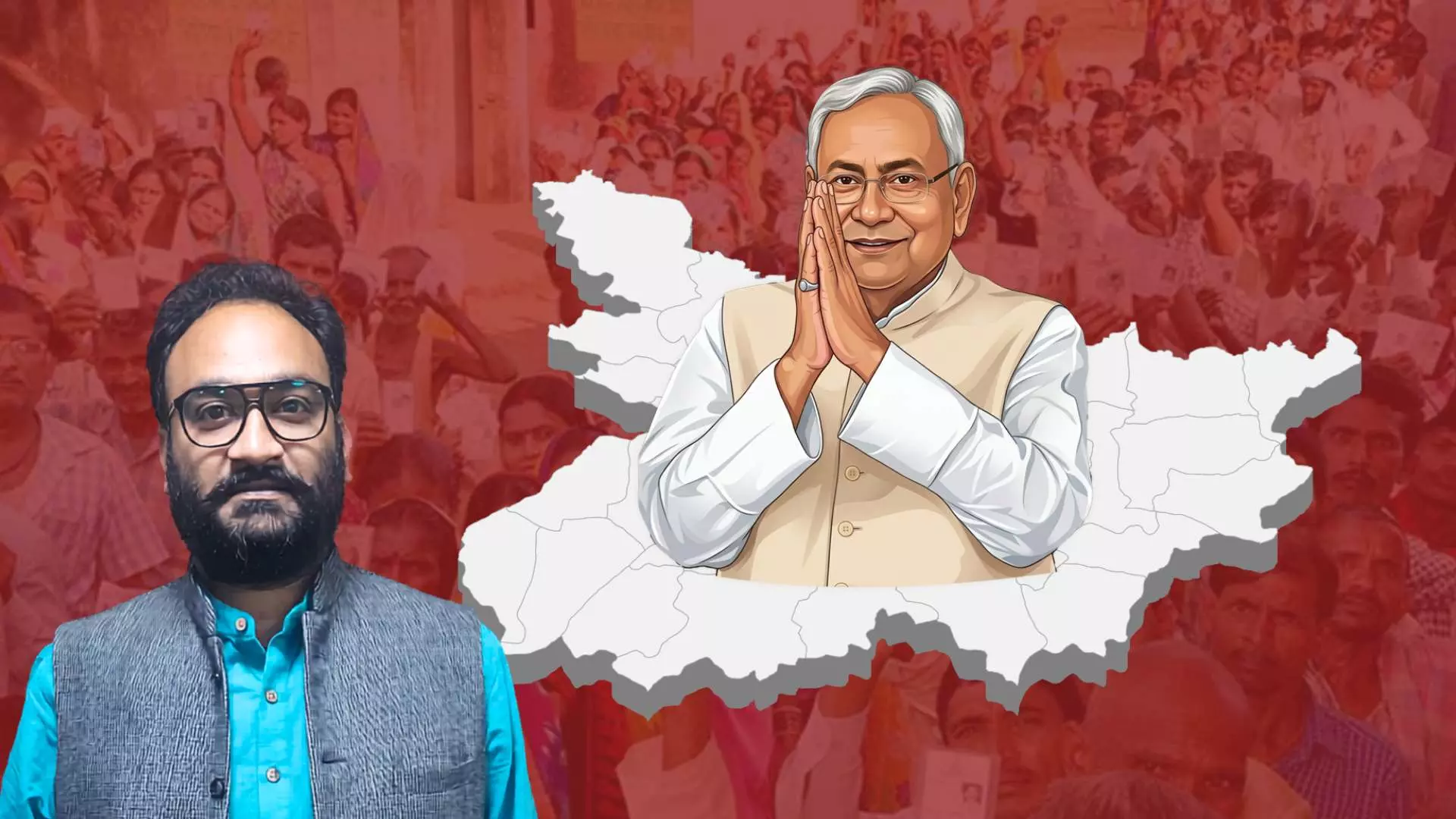
How will Bihar remember Nitish Kumar’s two-decade reign as CM?
After a two-decade run as Bihar CM, Nitish Kumar has finally stepped down, opting for a debut innings in Rajya Sabha instead; how will Bihar remember his tenure?

A tenure spanning nearly two decades has left behind what can best be described as a “chequered record” — a mix of visible governance gains and significant missed opportunities. As Bihar transitions to a new political phase, the debate around what Nitish Kumar truly achieved, and where he fell short, has come sharply into focus. The Federal's political editor Puneet Nicholas Yadav unpacks the legacy of one of Bihar’s longest-serving chief ministers.
When you step back and look at nearly 20 years in power, what do these years mean for Nitish Kumar and Bihar?
I think 20 years as a chief minister is a very long time. It is the longest tenure for a chief minister in Bihar and among the longest even when you compare across states. So, it is a very huge span of time.
But when you look at these 20 years, as would be the case with anyone who has ruled for so long, there are very clear hits and some extremely obvious misses. So, it is a chequered record.
Nitish Kumar is popularly called Sushasan Babu, the man who delivered good governance. That perhaps is a good starting point — to examine whether this aura of delivering good governance is exaggerated or actually true.
If you look at it from that viewpoint, it is again a mix of hits and misses. He inherited a state known for lawlessness. During the 15 years of Lalu Prasad and Rabri Devi, Bihar had become infamous for law-and-order problems, often described as “jungle raj”.
Also read: Bihar gets first BJP CM in Samrat Chaudhary, but will his govt be stable? | Capital Beat
Twenty years later, on that score, Nitish Kumar has delivered — and delivered brilliantly in terms of perception. Bihar today is seen as a safer state. Even if crime data may not fully support it, the perception has changed.
It is safer to travel across Bihar now, not just for men but also for women, and that is a huge achievement.
However, beyond law and order, that is where the aura begins to crack. He carried forward earlier governance models — those of Sri Krishna Sinha and Karpuri Thakur — but did not significantly build upon them.
So, what you have is a legacy of highly publicised achievements but also major gaps that have not received enough scrutiny.
Is Bihar today a distinctly safer place compared to the ‘jungle raj’ years?
Yes, I would say this is perhaps Nitish Kumar’s biggest and most visible legacy.
The period before him, especially under Lalu Prasad, saw social empowerment but also lawlessness. The dominance of certain groups created a perception that administration could not act freely.
Nitish Kumar changed that narrative.
In his tenure, Bihar saw no large-scale caste violence and no major communal violence, both of which were common earlier. That is significant.
Also read: The rise of Samrat Choudhary, from RJD roots to BJP’s first Bihar CM
He also ensured that women felt safer. I remember he once said that if he had to draw an image representing his Bihar, it would be a girl riding a bicycle to school.
That image captures his legacy — women stepping out, girls going to school, and a general sense of safety. That played a major role in sustaining his political success.
But Bihar still lags in jobs and industrial growth. How much does that define his legacy?
Exactly. This is where the other side of the story lies.
It is a legacy where achievements have been highlighted, but failures have been glossed over.
Yes, Bihar saw improvements in roads, bridges, and infrastructure. Welfare delivery also improved significantly. But these were not matched by job creation or industrial growth.
Even after 20 years, Bihar continues to have high unemployment. That cannot be ignored.
If you still have to rely on welfare doles to win elections, instead of creating employment and self-reliance, then there is something fundamentally flawed in the governance model.
Another major aspect is prohibition. While it earned him goodwill, especially among women, it also led to a thriving black market for alcohol.
Also read: Mahagathbandhan rift widens after RS poll debacle in Bihar
There have been repeated hooch tragedies. So, while prohibition is praised, it has also failed in execution.
Overall, it reflects governance through half measures. And I believe that 20 years from now, when this period is evaluated more objectively, Nitish Kumar may not be judged as kindly as he is today.
With Samrat Choudhary stepping in, how difficult will it be to match Nitish Kumar’s benchmarks?
It will be a very big challenge.
Samrat Choudhary has already made history in a way, because unlike usual BJP practice, the expected frontrunner has actually become chief minister.
But the challenges ahead are immense.
His governance will constantly be compared with Nitish Kumar’s. The key question is whether he will follow the Nitish model or introduce a new one aligned with BJP’s broader political strategy.
Nitish Kumar ensured that communal polarisation did not define Bihar politics, even while being allied with the BJP.
Whether that continues or changes under Samrat Choudhary will be closely watched.
There are also unfinished issues — unemployment, economic growth, and making welfare sustainable. These will now fall on his shoulders.
Additionally, his own political journey, including shifts across parties, raises questions about how firmly he will be positioned within the BJP’s long-term plans.
What role do you see for Nitish Kumar going forward?
That is perhaps the biggest unanswered question right now.
Nitish Kumar has said he will act as a mentor — a margdarshak. But in the BJP ecosystem, that term has not always meant an active role.
We have seen examples like Lal Krishna Advani and Murli Manohar Joshi, where such roles became largely symbolic.
Now, Nitish Kumar is not from the BJP, but the challenge remains the same — how much influence will he actually have?
Also read: Nitish Kumar's son Nishant joins JD(U), tipped for deputy CM role
He has already ceded significant ground to the BJP in the past year. He lost key portfolios, influence within the government, and leverage with the Centre.
After stepping down, his ability to influence decisions will become even more limited.
Another major challenge is keeping his party, JD(U), intact. The BJP has a history of absorbing or weakening allies over time.
His health is also a factor, and so is the question of succession, including the role of his son, Nishant Kumar.
So, his next phase will depend on whether he can retain relevance — within Bihar politics, within his party, and possibly at the national level.
(The content above has been transcribed from video using a fine-tuned AI model. To ensure accuracy, quality, and editorial integrity, we employ a Human-In-The-Loop (HITL) process. While AI assists in creating the initial draft, our experienced editorial team carefully reviews, edits, and refines the content before publication. At The Federal, we combine the efficiency of AI with the expertise of human editors to deliver reliable and insightful journalism.)