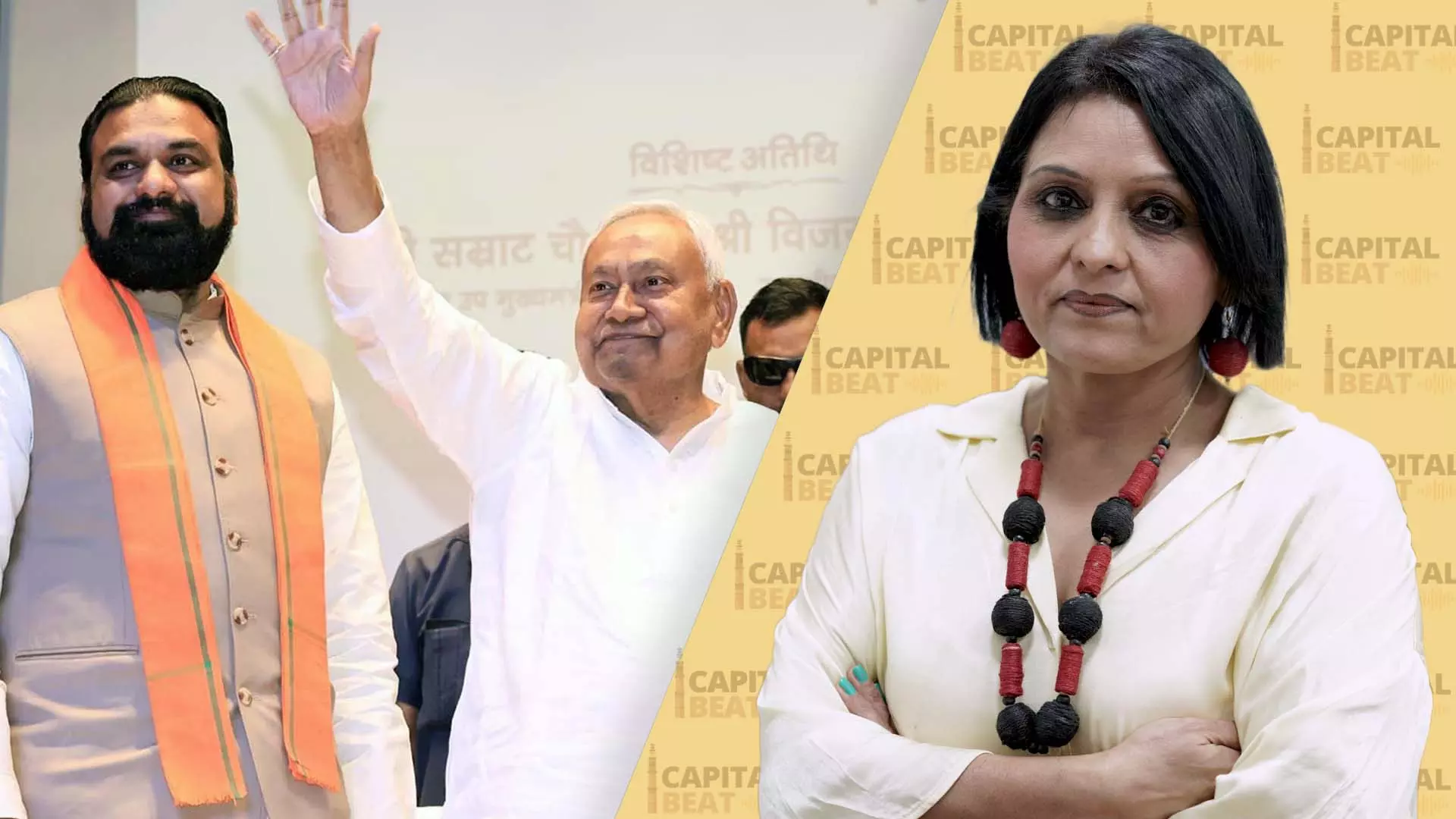
Bihar gets first BJP CM in Samrat Chaudhary, but will his govt be stable? | Capital Beat
What will be JD(U)'s political future? Will Nishant get Deputy CM's post? Will Nitish remain politically relevant? Our panel of experts discuss in Capital Beat

As Nitish Kumar resigned as the chief minister of Bihar and Samrat Chaudhary was elected as the BJP legislative party leader, paving the way for him to take the top post, senior journalists Faizan Ahmad, Deepak Kochgaway, and Gautam Sarkar discussed the leadership change in Bihar in this episode of the Capital Beat.
Nitish held his final Cabinet meeting on Tuesday (April 14), after which he dissolved the Cabinet and submitted his resignation to the Governor. The National Democratic Alliance (NDA) meeting in Patna formalised Samrat Chaudhary’s leadership, marking the first time the Bharatiya Janata Party (BJP) will have its own chief minister in Bihar.
The oath-taking ceremony is expected to be held on Wednesday, with political attention focused on the transition and its implications for governance, alliances, and party dynamics in the state.
Nitish’s role in leadership transition
Faizan Ahmad stated, “Nitish Kumar played a very crucial role in the elevation of Samrat Chaudhary as the chief minister.” He highlighted that multiple names were under consideration in the final 48 hours, and there were indications that Chaudhary was not the preferred choice within sections of the BJP.
He further noted that Nitish had publicly indicated earlier that Chaudhary would succeed him. “It was Nitish Kumar who had declared in public meetings that it will be Samrat Chaudhary who will take care of Bihar after him,” Ahmad said.
Also read: As Janata stalwarts retreat, regional titans face crisis against saffron surge
He added that Nitish expressed dissatisfaction when alternative names were discussed, and “he told everybody in the NDA that he will accept only Samrat Chaudhary,” leading to the final decision in Chaudhary’s favour.
Nitish’s message and political positioning
Nitish Kumar’s resignation statement outlined his government’s work across sectors and communities. He stated that governance focused on “development of all sections of society,” including education, health, infrastructure, and welfare initiatives.
Gautam Sarkar interpreted the development as a continuation of Nitish’s influence. “Nitish has the guts and BJP knows it very well,” Sarkar said, adding that his political relevance remains significant despite stepping down.
Sarkar further stated, “Nitish is fundamentally very effective for their survival in Bihar,” indicating that his leadership and voter base remain central to the state’s political structure.
BJP’s first CM in Bihar
Kochgaway described the development as a milestone for the BJP. “For the first time, BJP has its own chief minister in the name of Samrat Chaudhary,” he said, noting that the party had previously governed only in alliance with Nitish.
Also read: The rise of Samrat Choudhary, from RJD roots to BJP’s first Bihar CM
He added that the BJP had long sought independent leadership in Bihar, and this transition marks a structural shift in the state’s political arrangement.
However, Kochgaway pointed out that Nitish continues to hold political weight. “Without Nitish Kumar… it is very hard for the BJP to run the government freely,” he said, referencing Nitish’s influence over legislators and party dynamics.
Questions over JDU’s future and leadership
The discussion also focused on the future of the Janata Dal (United) and leadership succession within the party. Kochgaway noted uncertainty around the role of Nishant Kumar, particularly regarding the deputy chief minister position.
He stated, “If Nishant Kumar is not made the deputy CM, the party will not be in a good position,” highlighting concerns about continuity within the party structure.
Faizan Ahmad, however, indicated that Nishant may not immediately enter the government. “Nishant is not going to hold any post in the government right now,” he said, adding that a role within the party organisation remains more likely.
Stability and governance outlook
On the question of political stability, Faizan Ahmad said, “I don’t see any scope of instability in Bihar,” citing the BJP-led alliance’s numerical strength and the opposition’s limited presence.
He added that internal dissent within the BJP is unlikely to affect governance. “There is hardly any question of anybody raising objection or going against him,” Ahmad said, referring to Chaudhary’s leadership.
Also read: Mahagathbandhan rift widens after RS poll debacle in Bihar
At the same time, Ahmad flagged administrative challenges, including financial constraints. He noted that “the state exchequer is almost empty” following welfare schemes and policy decisions, including prohibition.
Nitish’s continued influence
Gautam Sarkar emphasised that Nitish’s role is not diminished by his resignation. “He still has the power to guide and control political situations,” Sarkar said, indicating continued strategic influence.
He added that Nitish’s support is expected to extend to both the BJP government and the JD(U), ensuring coordination between alliance partners.
The panel repeatedly highlighted that Nitish’s political capital and organisational control remain significant factors in Bihar’s governance landscape.
Cabinet formation and deputy CM question
Kochgaway identified the deputy chief minister selection as a key unresolved issue. “Who will be the deputy CM—that is the most burning issue for JDU,” he said.
Also read: Opposition allege ‘horse-trading’ in Bihar RS polls, demand review of anti-defection law
He indicated that multiple names are under consideration and that discussions within JD(U) are ongoing. “They have not even participated in any meeting about the leader of the house,” he added.
Despite this, Kochgaway maintained that the broader transition is settled. “Everything has been decided through BJP and JDU. Tomorrow will be the oath ceremony and Samrat will take oath,” he said.
No immediate threat to government
All three panellists agreed that the new government is unlikely to face immediate political threats. Faizan Ahmad stated, “There is no challenge or threat from the Opposition,” due to the alliance’s majority.
Gautam Sarkar echoed this view, saying, “There will be no trouble both for BJP and Samrat,” and described the relationship between BJP and JD(U) as “reciprocal.”
Kochgaway added that the transition has been finalised at the alliance level, leaving little room for disruption. “Nothing will happen… they will go smoothly tomorrow,” he said, referring to the swearing-in ceremony.
(The content above has been transcribed from video using a fine-tuned AI model. To ensure accuracy, quality, and editorial integrity, we employ a Human-In-The-Loop (HITL) process. While AI assists in creating the initial draft, our experienced editorial team carefully reviews, edits, and refines the content before publication. At The Federal, we combine the efficiency of AI with the expertise of human editors to deliver reliable and insightful journalism.)