Can Congress recover from Bhupen Borah's shocking exit?
Senior leader's switch to the BJP exposes Congress rifts, tests opposition unity, and sharpens the battle narrative

“This kind of disarray within the Congress will not send across the message that the party is capable of winning elections,” said senior journalist Samir Purkayastha, underlining the political tremors triggered by Bhupen Borah’s decision to quit the Congress and join the BJP on February 22.
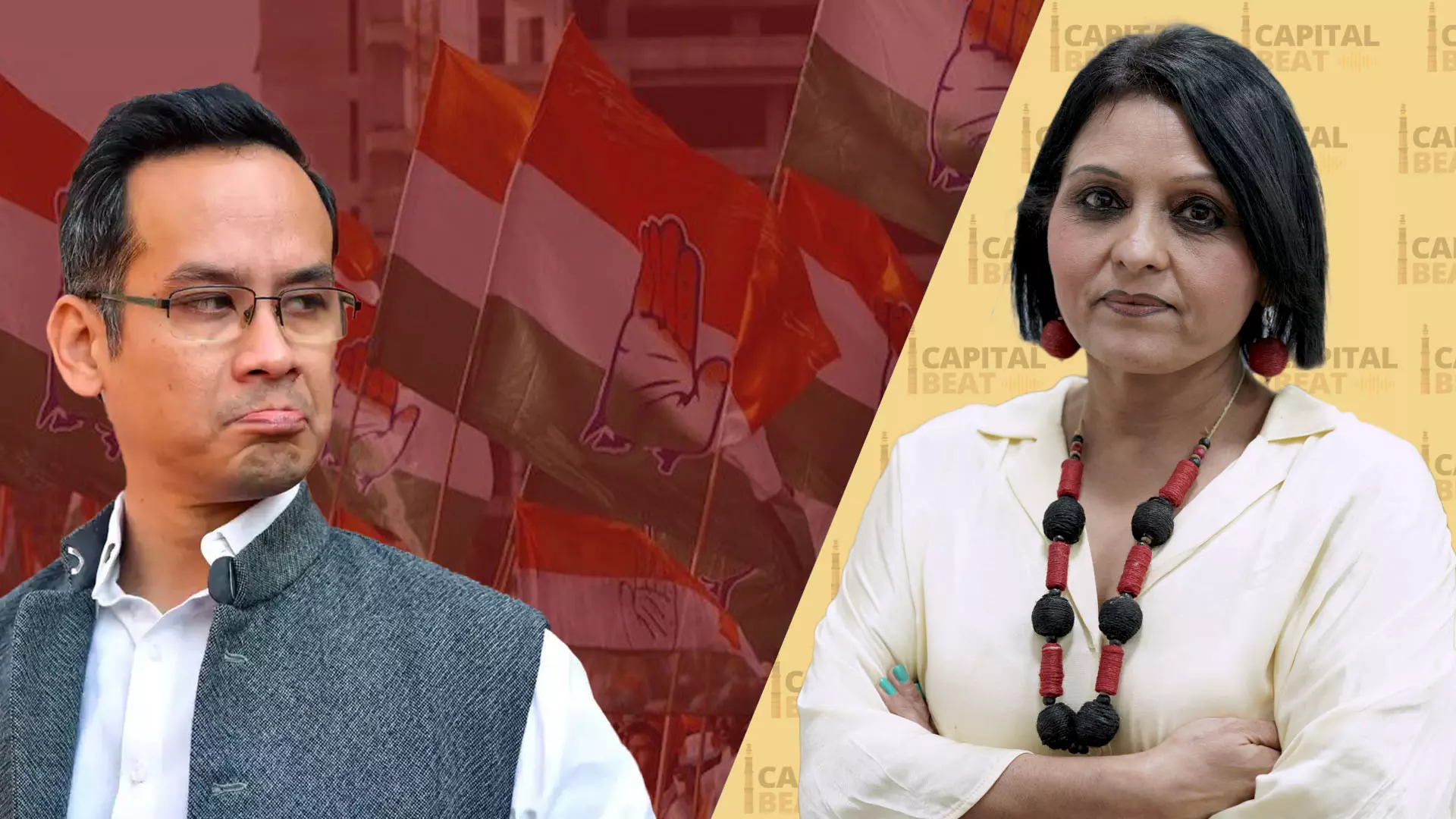
With Assam headed for Assembly elections, Borah’s exit has reignited questions about the Congress’ internal cohesion and electoral preparedness. In The Capital Beat programme, senior journalist, The Federal, Samir Purkayastha, and activist and member of Assam Nagarik Samaj Parash Malakar decode the impact of this development on the state’s political landscape.
Borah, who had been appointed Assam Pradesh Congress Committee (APCC) president in 2021, was recently replaced by Gaurav Gogoi. Though he was entrusted with alliance responsibilities, tensions reportedly simmered within the party. His departure now comes at a time when the Congress is negotiating seat-sharing arrangements and attempting to consolidate opposition unity.
Timing and optics
Purkayastha pointed out that the timing of Borah’s resignation is critical. “Just when elections are a couple of months away, such an exit becomes a roadblock,” he said. Borah was leading the party’s committee on alliance negotiations, and his sudden departure may delay talks with like-minded parties.
Since 2021, seven MLAs have left the Congress in Assam — a trend Purkayastha described as “not a good advertisement for the party.” According to him, electoral success depends not only on performance but also on perception. “You have to present yourself as a winning party. There are always 10–12 per cent fence-sitters who tend to vote for the party likely to come to power,” he explained.
Also Read: Assam Congress not under Gogoi’s control, claims Bhupen Borah
However, he also argued that adversity can present opportunity. Within the BJP, he noted, there is growing discomfort over the influx of former Congress leaders. “Another ex-Congressman joining may cause heartburn among the old guard,” he added.
Alliance calculus
Parash Malakar downplayed Borah’s role in the ongoing opposition unity process. He said the Assam Nagarik Samaj initiative to bring together secular and opposition parties began in December 2024, by which time Borah was no longer central to the negotiations.
“For the last eight or nine months, he was not involved in this unity process,” Malakar said, adding that Borah’s exit would not significantly affect alliance-building efforts.
While acknowledging that defections before elections create ripples, Malakar described the situation as a “political storm” that may subside quickly. “Public perception is that this exit is not going to have a huge impact on Congress’ prospects,” he observed.
He also indicated that Congress leaders had attempted to persuade Borah to withdraw his resignation. “Top leaders went to his residence to convince him personally,” Malakar noted, though the resignation ultimately stood.
Internal dynamics
A key question raised during the discussion was whether Bora’s departure stemmed from tensions with APCC chief Gaurav Gogoi. Purkayastha dismissed the idea of direct rivalry. “The last time I met him, Borah himself praised Gaurav Gogoi,” he said.
Instead, Borah has reportedly blamed Rakibul Hussain for sidelining him and running the show behind the scenes. Purkayastha suggested this narrative aligns closely with BJP talking points. “This is the BJP narrative which he is now peddling,” he remarked, adding that Himanta Biswa Sarma had as early as 2024 predicted Borah’s exit.
Also Read: Why Bhupen Borah’s exit is a big ideological churn in Assam politics
The delay in voicing grievances also raised questions. “If he had issues during earlier incidents, why wait until just before elections?” Purkayastha asked.
BJP’s strategy
The panel discussed whether Borah’s induction could deepen divisions within the BJP itself. According to Purkayastha, the party is not entirely cohesive. “There is a Himanta Biswa Sarma camp and other factions. Even the RSS is reportedly unhappy with old guards being sidelined,” he said.
He cited the resignation of former state BJP president Ranjit Kumar Dass as an example of dissatisfaction over former Congress leaders dominating the party structure.
Gaurav Gogoi, meanwhile, has framed the coming election as a contest between the “real Congress” and the “opportunist Congress.” Purkayastha believes this line could resonate, especially if the party effectively communicates corruption allegations and governance issues linked to the ruling dispensation.
“People are already facing the brand of BJP’s corruption, and there are allegations against senior leaders,” he said, adding that Congress must build its organisation quickly to capitalise on any dissatisfaction.
Polarisation narrative
A controversial remark attributed to Chief Minister Himanta Biswa Sarma — that Borah was among the last Hindu leaders in Congress — prompted discussion about possible polarisation.
Malakar dismissed the remark as mere propaganda. “Such statements will not affect ground reality,” he asserted. He argued that frequent and contradictory political statements have diluted their impact on voters.
Also Read: Assam elections | What led to Borah's resignation and subsequent drama?
Purkayastha, however, cautioned that BJP could use such narratives strategically. He suggested that portraying Congress as being controlled by minority leadership may be part of a broader campaign to consolidate Hindu votes.
“This is definitely a narrative of the BJP,” he said, adding that Congress must counter it effectively on the ground.
Can Congress recover?
The spotlight now shifts to Gaurav Gogoi and Priyanka Gandhi, who is expected to visit Assam soon. This will be one of the first major state elections under Priyanka Gandhi’s charge.
Purkayastha acknowledged the challenge but remained cautiously optimistic. “They can bounce back from here. It’s not that they cannot,” he said.
He noted that BJP is mounting a two-pronged strategy: attempting to poach Congress leaders while simultaneously strengthening smaller parties like AIUDF. Congress must, therefore, handle both internal stability and external competition.
Priyanka Gandhi’s planned one-on-one meetings with leaders could help iron out grievances. “Such meetings will definitely help if there are differences within the party,” Purkayastha said.
Still, he warned that time is short. Instead of focusing solely on campaign preparations, Congress is currently engaged in damage control.
Whether the party can transform this setback into an opportunity may determine its performance in the upcoming elections.
The content above has been transcribed from video using a fine-tuned AI model. To ensure accuracy, quality, and editorial integrity, we employ a Human-In-The-Loop (HITL) process. While AI assists in creating the initial draft, our experienced editorial team carefully reviews, edits, and refines the content before publication. At The Federal, we combine the efficiency of AI with the expertise of human editors to deliver reliable and insightful journalism.