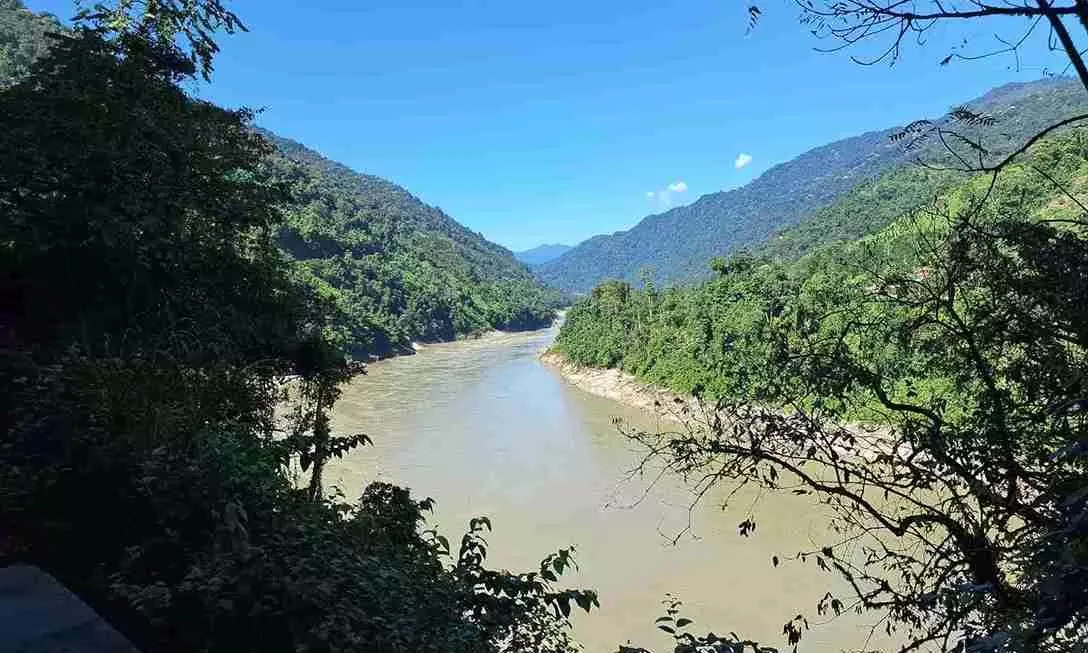
Siang Valley on edge as arrests, CAPF deployment fail to deter anti-dam protesters
69 arrests, 53 police cases, and heavy CAPF deployment fail to quell opposition to Siang mega dam, with protesters demanding detainees’ release

Protesters have vowed to continue their opposition to the Siang Upper Multipurpose Project (SUMP) despite arrests, police cases, and a massive deployment of security forces across Siang Valley in Arunachal Pradesh, where tensions remain high following the October 23 violence in Pasighat.
Police have registered 53 cases across East Siang, Siang, and Upper Siang districts, arrested 69 people, and served notices under the Bharatiya Nagarik Suraksha Sanhita (BNSS) to more than 200 people in connection with the protests. Security personnel have been deployed at the proposed survey and drilling sites as the government moves to facilitate the pre-feasibility report (PFR) for the project.
The Siang Indigenous Farmers’ Forum (SIFF), which is spearheading the movement, has said it will not meet Chief Minister Pema Khandu until those detained during the protests are released and the deployment of Army and paramilitary forces in Siang and Upper Siang is withdrawn.
CAPF deployed for feasibility study
SIFF chief adviser Anong Jongkey said: “We have decided that until the jailed Gen Z or other SIFF members from our villages are released, we will not meet them. Apart from that, the army and paramilitary forces deployed across Siang and Upper Siang must be removed.”
Also read: Arunachal anti-dam fury spreads, NHPC office vandalised as violence erupts again
Security has been intensified by the deployment of Central Armed Police Forces (CAPF) to facilitate the feasibility study for the proposed hydropower project. SIFF and project-affected families (PAFs) have maintained that they never consented to the feasibility study.
The SIFF said security forces had been deployed at Beging, Geku and Jengging, besides the district headquarters of Pasighat, Boleng and Yingkiong, to assist NHPC in conducting the survey for the proposed 11,500-MW SUMP. It also claimed that a drilling machine had been installed at the Beging survey site.
CAPF personnel patrol a Pasighat road
A four-decade fight
The forum and affected families have opposed the project since the early 1980s and described the survey as a “blatant violation” of their fundamental rights. They had announced an indefinite sit-in and peaceful protest at the Beging survey site from May 23, 2025.
Inspector General of Police Hibu Tamang said 53 criminal cases had been registered across the three districts — 26 in Upper Siang, 21 in Siang and six in East Siang.
In connection with the October 23 violence in Pasighat, police registered cases over attacks on public establishments, arson and vandalism. Protesters had set fire to the NHPC office in the High Region area, attacked the Pasighat police station and damaged police vehicles. The office of the Adi Bane Kebang and the residences of state BJP president Kaling Moyong and Pasighat West MLA Ninong Ering were also vandalised.
Forces stationed near drilling sites
East Siang Superintendent of Police Pankaj Lamba said eight criminal cases had been registered over the October 23 incidents. The cases invoke provisions of the Bharatiya Nyaya Sanhita, with one also invoking Section 3 of the Prevention of Damage to Public Property Act.
Also read: Arunachal erupts over Siang mega dam; BJP leaders’ homes attacked, NHPC office torched
Across the three districts, 69 people have been arrested, while police have also detained people under the Arunachal Pradesh Unlawful Activities (Prevention) Act (APUAPA), 2014. The police have said investigations are continuing, including efforts to identify those suspected of instigating violence.
The security deployment includes CRPF, Rapid Action Force (RAF), Indo-Tibetan Border Police (ITBP), Sashastra Seema Bal (SSB), Assam Police Battalion, and Arunachal Pradesh Police personnel. Forces have been stationed near proposed drilling sites, including Ugeng near Riga, Komkar, Parong and Beging.
‘Going beyond government control’
The People’s Party of Arunachal (PPA) has urged the state government to withdraw CAPF personnel from the Siang region and release all anti-dam protesters arrested in connection with the SUMP agitation.
PPA president and MLA Nabam Vivek said the situation was slipping beyond the government’s control and warned that the use of force to prepare the PFR would deepen public distrust.
“Without public support, hydropower projects cannot be implemented. You cannot take up a hydropower project anywhere by using paramilitary forces. The state government should first withdraw the forces, release all arrested anti-dam protesters and then go back to the ground to speak to the villagers and build confidence,” Vivek said.
Geku, epicentre of the anti-dam protests in Siang Valley
Appeal to protesters
He said the resistance to the PFR indicated the difficulties the government could face in implementing the project.
Also read: ITBP Arunachal row: Face-offs on unmarked border not unusual, says China expert
“Just for the PFR, there is so much resistance. Constructing a dam will be even more difficult. Now the government is using paramilitary forces. Will it deploy the Army tomorrow? Such forceful imposition will widen the differences and deepen mistrust. A huge project like the SUMP cannot be executed by crushing the public voice and running misinformation campaigns,” he added.
Vivek appealed to protesters to refrain from violence and cautioned that damage to public property would hurt the state. “Violence should be avoided. Damage to public property and violent protests will only cause losses to the entire state,” he said.
People not convinced
Referring to his experience with the 100-MW Pare Hydropower Project, when he was a zilla parishad member from Doimukh, Vivek said the government must first convince the people who would be directly affected.
He said the PPA’s membership of the National Democratic Alliance (NDA) did not mean it would support the suppression of public opposition to the SUMP.
“Last year, I visited the SUMP-affected areas and spoke to the people. The sentiment among the people is clear. Right now, they are not convinced by the argument that the SUMP is a project of national importance. They do not want to part with their ancestral land,” he added.
CBI case against lawyer-activist
Meanwhile, the Central Bureau of Investigation (CBI) has registered a case against Arunachal Pradesh-based lawyer and activist Bhanu Tatak for allegedly receiving foreign funds for research projects without obtaining mandatory registration under the Foreign Contribution (Regulation) Act (FCRA).
Tatak, legal adviser to SIFF and coordinator with the civil society organisation Dibang Resistance, has been actively involved in protests against the SUMP and a proposed 2,880-MW hydropower project on the Dibang river.
Also read: China's mega dam 'ticking water bomb' for India, warns Arunachal CM Khandu
The CBI’s FIR alleges that Tatak received more than Rs 17.6 lakh from foreign organisations and individuals directly into her personal savings bank account for research projects between 2022 and 2025.
‘People have the right to protest’
Tatak has argued that the people of the Siang Valley have opposed dams on the river for more than four decades and have the right to resist surveys that threaten their homes and livelihoods.
“Our people have been peacefully protesting against the surveys by any government agency or a dam developer. People do have the right to protest against this decision in order to protect their homes and hearths,” she said.
She has also claimed that the deployment of CAPF personnel went against a Gauhati High Court order that had cancelled proposed dams on the Siang. Tatak has warned that the project could pose an existential threat to the Adi tribes and endanger the region’s “rich and rare flora and fauna”.
Former CM seeks immediate end to militarisation
Prominent public figures from Arunachal Pradesh have criticised the deployment of central forces in the Siang Valley, describing it as militarisation and an attempt to intimidate communities opposing the SUMP.
Also read: 35 years on, Sapta Kosi High Dam still a mirage as Bihar faces fresh flood threats | Nepal floods
Former chief minister Gegong Apang demanded an immediate end to the militarisation of the Siang region in the name of maintaining law and order.
He said efforts to “terrorise and intimidate” the Adi people by bringing in large numbers of central paramilitary forces, including the RAF and ITBP, would not stop them from opposing SUMP.
‘Are we people of Pakistan and China?’
Datik Ratan, spokesperson of Adi Baane Kebang-United, asked: “Are we people of Pakistan and China, whose voices the government wants to suppress?” He said such a large deployment could trigger more protests.
He also said that if national security was the real concern, the Centre should strengthen border infrastructure and military preparedness along the Line of Actual Control rather than deploy forces against local communities.
Chief Minister Pema Khandu has claimed the government would protect national interests while respecting the rights and aspirations of the people of the Siang Valley.