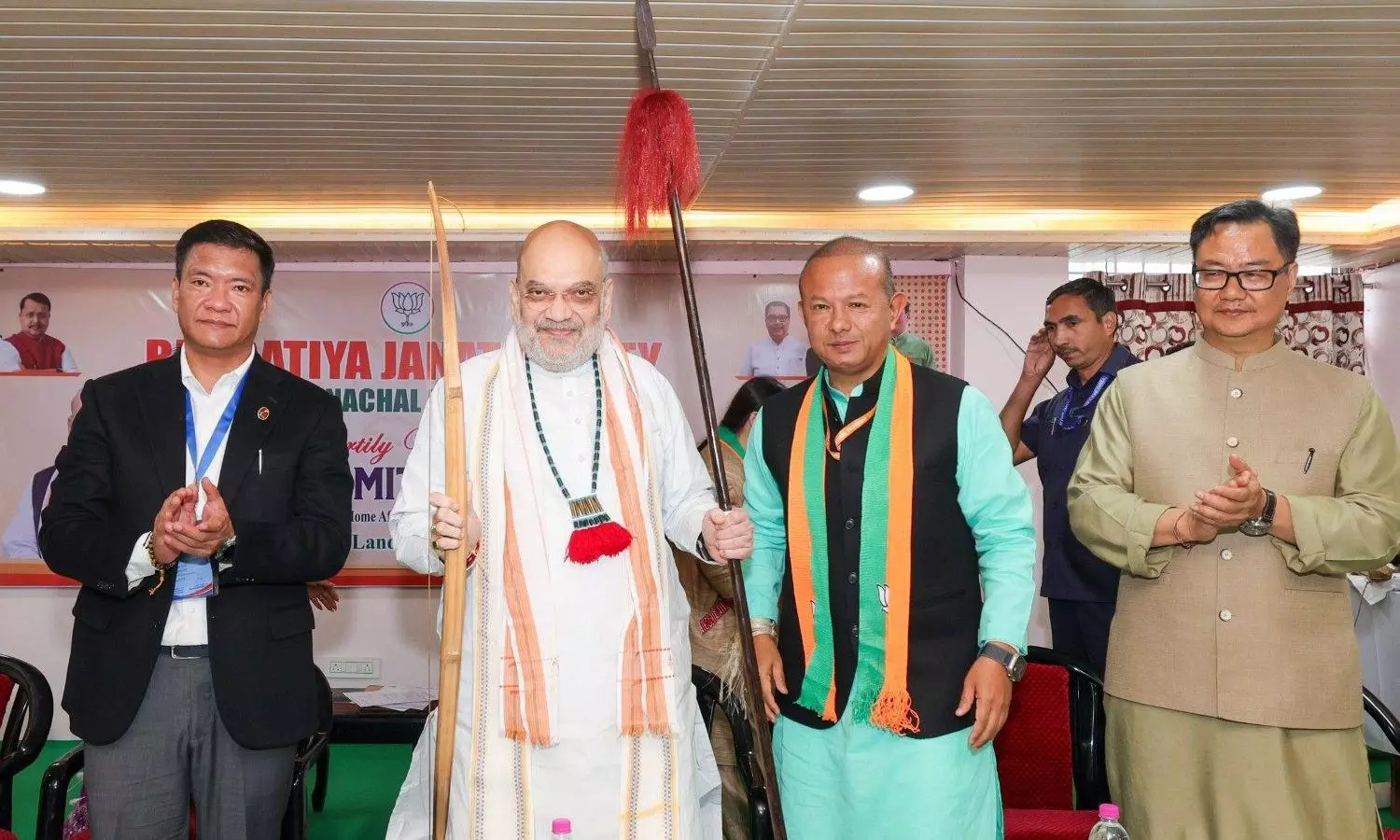
Amit Shah's Siang dam outreach ends in stalemate as protesters hold firm
Union Home Minister pitches 11,200-MW project as a national priority and promises rehabilitation, but anti-dam groups refuse to talk till preconditions are met

Union Home Minister Amit Shah's three-day visit to Arunachal Pradesh ended on Sunday (November 22) without a breakthrough over the proposed 11,200-MW Siang Upper Multipurpose Project (SUMP). This has left the Centre and anti-dam organisations locked in a stalemate.
While Shah framed the mega dam as a strategic national priority and offered talks, protesting groups refused to negotiate until their core preconditions were met. Planned on River Siang, the SUMP is designed as a large-scale hydropower and water-regulation project in the frontier state.
During engagements in Itanagar and Banderdewa, Shah made a strong pitch for the dam, arguing it is crucial to India's energy security, strategic interests, state revenue generation and Arunachal Pradesh's broader development. Addressing residents and organisations opposing the project at the Police Training Centre in Banderdewa, he appealed to them to engage with the state government, saying it could facilitate further discussions with the Union Home Ministry.
Also read: Who is Katon Moyong, the ‘Abor Man’ leading the fight against Siang dam?
The Home Minister assured the protestors that the government would take them into confidence and address their concerns through "positive and constructive" dialogue. He further pledged to protect the region's cultural identity and traditions, and offered an "attractive rehabilitation package" for people likely to be affected by the project.
Core disputes block talks
However, the outreach failed to soften opposition from groups spearheading the movement, which differed sharply with the Centre over the project's necessity, the ongoing survey process, compensation and alleged state high-handedness.
Adi Bane Kebang Union (ABKU) president Dijhi Tamuk reiterated the organisation's opposition under its 'No PFR (Pre-Feasibility Report), No Dam' position and said the ABKU would organise peaceful protest rallies in Adi-inhabited areas to oppose the SUMP. He alleged that the organisation had been denied an opportunity to meet Shah despite seeking an appointment on November 17.
"They did not allow us to meet him in Itanagar. We sought a discussion with him, but our request was turned down. We are reiterating our demand for no dam over the Siang. The government says its doors are open for talks, but it did not allow us to meet the Home Minister," Tamuk said. "If the government is serious about dialogue, it should allow us to meet him. It is adopting a double-standard policy in Arunachal Pradesh."
Also read: Arunachal's anti-dam campaign hardens as protesters snub Khandu’s dialogue offer
Questioning Shah's rehabilitation assurance, Tamuk said compensation could not make up for the loss of ancestral land, culture and heritage. "He offered the best possible rehabilitation package for affected people. But where will they be settled? The loss cannot be measured in terms of compensation. We are fighting to protect our culture, heritage, land, water and hills. Our movement will continue," he said.
Demands over security forces
The Siang Indigenous Farmers' Forum (SIFF) has rejected talks with the government in the presence of security forces, demanding the withdrawal of Central Armed Police Forces (CAPF), release of arrested protesters and unconditional withdrawal of all FIRs against anti-dam activists before negotiations can begin. More than 75 people have been arrested or detained so far.
Why the Centre wants the Siang project
♦ Energy security: 11,200 MW of hydropower for India
♦ Strategic interests in the sensitive border state
♦ Revenue generation for Arunachal Pradesh
♦ Broader development of the state
Why the locals oppose it
♦ Loss of ancestral land, culture and heritage
♦ Compensation cannot make up for displacement
♦ PFR process lacks consultation and landowner consent
♦ Prefer smaller tributary projects, not a mega dam
SIFF spokesperson Tagori Mize said the government must first create a peaceful atmosphere before expecting meaningful discussions. Mize alleged that the ongoing PFR process was being pursued without adequate public consultation, transparency or the consent of indigenous landowners. He also accused the government of using intimidation, arrests and stringent laws against peaceful protesters.
Also read: Siang dam protests put BJP’s political hold on 7 Arunachal seats under scrutiny
SIFF clarified that it was not opposed to development or hydropower projects as such, but strongly objected to a mega dam on the main Siang river, maintaining that smaller projects on tributaries could be considered.
Opposition questions Centre's intent
Indian Youth Congress (IYC) national general secretary Tarh Johny said Shah's visit should have addressed the region's pressing concerns instead of being confined to public appearances and political assurances. Johny sought clarity on whether the Centre would protect ancestral land, indigenous identity, environmental interests and the rights of communities likely to be affected by the SUMP, and questioned whether local residents' consent would be taken into account before the project moved forward.
Raising broader concerns about border development, Johny sought details of measures to improve security, infrastructure and economic opportunities in remote villages along the international border. "People living in border areas deserved concrete action rather than occasional visits and patriotic speeches," he said, adding that the Northeast needed a government that respected the region's identity, protected its land and addressed the concerns of its people.
Also read: Arunachal dam row escalates as police target accused, anti-dam protests spread
Arunachal Pradesh Mahila Congress president Chuku Nachi also questioned the purpose of Shah's visit, seeking clarity on three major issues confronting the state. "What motive have you come to Arunachal Pradesh with? Have you come with a solution to the SUMP issue? Have you come to address national security concerns? Or have you come to resolve the Assam-Arunachal border dispute?" she asked.
The Siang Area Youth Association (SAAYA) has also been named among the organisations whose concerns the state government was urged to discuss, though no specific response from the association to Shah's dialogue offer was recorded.
Calls to resume dialogue
Reacting to Shah's invitation for talks, Rajya Sabha MP Tai Tagak urged the protesting groups to come forward and allow the PFR exercise to be completed.
"When the Home Minister invited them for talks, they should come forward. Let the PFR work be completed. The Home Minister has said the project will be built only after proper consultation at the ground level, not by force. Nobody should hijack the issue for political interests," Tagak said. He added that dialogue is necessary not merely to discuss the dam but also to address the potential threat of a national disaster, local development and economic opportunities: "If they come forward for dialogue in a friendly manner, a solution can be found."
Also read: Indian, Chinese commanders meet to prevent friction along LAC in Arunachal
Pasighat MLA and former Union Minister Ninong Ering welcomed Shah's reference to the Siang project and his assurances to farmers in the valley, noting that Chief Minister Pema Khandu had already clarified that the project would not proceed if the people did not accept it. "But we have to hear what the Home Minister has proposed. We will bring both supporters and opponents to the negotiating table in Delhi," Ering said.
Widening trust deficit remains
For now, the Centre's public backing of the SUMP and the protesters' insistence on prior conditions have left little room for an immediate breakthrough. The standoff over the Siang mega dam has exposed a widening trust deficit between the government and indigenous communities, with Shah's appeal for dialogue yet to translate into any meaningful breakthrough.
While the Centre has projected the 11,200-MW project as vital to India's energy security and Arunachal Pradesh's economic future, the protesting organisations insist that development cannot come at the cost of ancestral land, cultural identity and environmental security. Until that confidence is built, the Siang dam is likely to remain a flashpoint between the Centre's development ambitions and the indigenous communities' determination to protect their land and heritage.