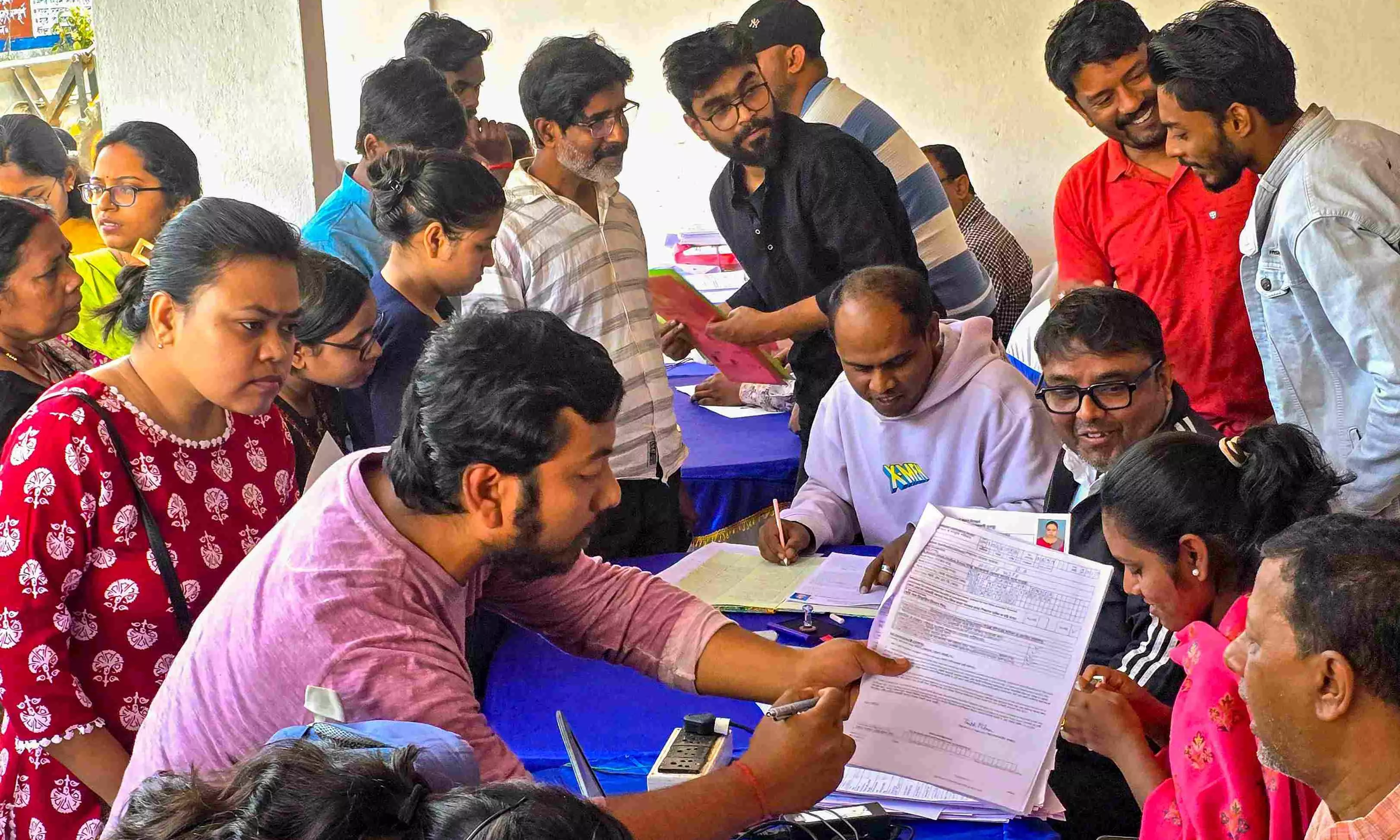
A scene at Suri municipality office after the West Bengal government launched the Banglar Yuva Sathi scheme, in Birbhum district on February 16. Photo: PTI
Bengal’s job crisis exposed? Queues for Yuva Sathi, anger outside Bikash Bhavan
As youth turn up in droves for the scheme while others demand jobs, questions persist over whether this is a long-term fix to Bengal’s unemployment crisis

A video clip shared on the official social media accounts of the Trinamool Congress shows a long queue of young men and women enthusiastically enrolling in the Banglar Yuva Sathi scheme.
Much to the party’s delight, a similar rush has been witnessed at enrolment camps set up across all 294 Assembly constituencies since the registration camps for the scheme began last Sunday (February 15).
The party quickly seized on these visuals to build a campaign narrative projecting the allowance for unemployed youth as a major success of the Mamata Banerjee government.
Also read: Banglar Yuva Sathi Scheme: Eligibility, how to apply; here’s all you need to know
The translated version of the Bengali caption accompanying the video reads: “Registration for the ‘Banglar Yuva Sathi’ scheme has begun under the humane vision of Hon’ble Chief Minister Mamata Banerjee. The Maa-Mati-Manush government will provide financial assistance of Rs 1,500 per month to Madhyamik (secondary)-passed youth aged between 21 and 40 until they secure employment. Hear directly from the youth themselves about how much they have benefited from this landmark initiative of the people’s leader.”
TMC ministers and legislators also visited several camps, urging party workers to mobilise beneficiaries and publicise the scheme’s benefits.
We are not even expecting regularisation of our employment, but are simply urging for 30 days of work each month until the age of 60
The party’s upbeat response reflects its hope that the scheme will translate into electoral gains in the upcoming polls.
However, just a few kilometres away from these enrolment camps in Kolkata on Monday (February 16), starkly different scenes unfolded, laying bare the anxiety surrounding the state’s job market, which was far from reassuring for the TMC.
‘Where are the jobs?’
Groups of Diploma in Elementary Education (D.El.Ed) and Bachelor of Education (B.Ed)-qualified candidates marched toward Bikash Bhavan, which houses the state’s school and higher education departments.
Raising slogans, the protestors demanded appointment letters for teaching posts. Some banged utensils in protest, while others held placards reading, “Degree ache, chakri kothay?” (We have degrees, where are the jobs?).
Also read: West Bengal elections: BJP deploys external aides, private agencies to plug grassroots gaps
Not far from there, civil defence volunteers, who are part of the state’s auxiliary emergency support system, were also agitating for long-term job stability.
These contrasting scenes, one of enthusiastic enrolment for the government’s unemployment allowance and the other of simmering anger over lack of stable employment, capture the delicate political balance confronting the ruling party.
Yuva Sathi scheme
The state government’s latest welfare outreach promises Rs 1,500 per month to the unemployed residents aged 21 to 40 who have passed the secondary examination.
Registration camps across all 294 assembly constituencies saw heavy turnout, with officials indicating that over 15 lakh applications had already beenreceived by Tuesday (February 17) afternoon. Applications are also being filed online.
Also read: The election is over; Mamata has already won: Monideepa Banerjee
For many unemployed youths the stipend offers immediate, if modest, financial support as they search for work or prepare for competitive exams.
“This will help cover my daily travel expenses and the fees for application forms for competitive exams,” Pritam Dutta, an applicant from the Kolkata’s Tollygunge assembly constituency, told The Federal.
Beneficiaries laud the scheme
Dutta, who has been seeking a stable job since graduating in 2018 and now gives private tuition to support himself, said the stipend could at best betemporary relief and that the government must create more permanent job opportunities.
Shreya Mukherjee, a resident of Kashi Bose Lane under the Shyampukur assembly constituency, was more generous in her praise for the scheme, saying it would provide crucial support during the interim period until she secures a job.
She said the monthly assistance would ease some of her financial burden as she continues to look for stable employment.
Also read: Worried about jobs, Bengal teachers challenge SC’s TET mandate, threaten to agitate
Mukherjee had earlier benefited from the state government’s Kanyashree Prakalpa, an annual scholarship programme for unmarried girls aged 13 to 18 enrolled in secondary, higher secondary, vocational or equivalent courses, and felt that the new initiative similarly reflected the government’s focus on supporting youth.
Young voters support
Politically, the strong response to the scheme may help create reassuring optics for the TMC ahead of the elections, though its longer-term impact remains to be seen, as deeper employment concerns are unmistakable.
The party has previously used targeted welfare schemes to consolidate key voter bases, and it now appears to be positioning Yuva Sathi as an outreach aimed at consolidating support among young voters.
Can Yuva Sathi yield similar electoral dividends by easing the palpable anxiety surrounding the state’s employment situation?
Employment has become a major political issue in the state ever since the school recruitment scam led to the cancellation of thousands of appointments.
Recruitment scam
In April 2025, the Supreme Court upheld a Calcutta High Court order annulling the 2016 recruitment process of the West Bengal School Service Commission (WBSSC), leading to cancellation of 25,753 teaching and non-teaching appointments over large-scale irregularities and alleged cash-for-jobs deals.
The verdict caused one of the largest employment disruptions in the education sector, a major public-sector employer in the state.
Also read: Unemployment in India rose slightly to 5 pc in January: Govt survey
Subsequently, the apex court permitted around 15,403 “untainted” teachers to continue in service temporarily till August 31, 2026. However, many [others] remain out of employment, and the recruitment process is still underway.
This uncertainty has now sparked fresh protests by TET-qualified, B.Ed and D.El.Ed aspirants who are still waiting for appointment letters.
Mamata Banerjee has mastered the art of soothing public discontent with the balm of welfare handouts. As a result, no agitation against her government has ever gained sustained momentum, despite the undeniable crises of unemployment and other governance failures
Despite clearing the required eligibility tests and holding the necessary qualifications, these candidates allege that the fresh recruitment exercise, ordered by the apex court after cancelling the 2016 WBSSC panel, has been slow and opaque.
Employment crisis
Job-related unrest is not just limited to the education department.
Temporary civil defence volunteers have also intensified their agitation, demanding long-term job security.
There are approximately 75,000 trained civil defence volunteers in the state, of whom around 14,000 are currently active. Among them, 554 have undergone advanced training and form the state’s Quick Response Team.
Also read: Govt study on new labour codes has some surprise findings, conclusions
“Those who get 120 days of work in a year are classified as active volunteers. The rest face severe underemployment, with some receiving fewer than 10 days of work annually. Volunteers are assigned critical and often dangerous duties, such as disaster management and rescue operations. They are also deployed for crowd management during major festivals, events, and VIP visits,” said Rezaul Karim, president of the West Bengal Civil Defence Volunteers Social Welfare Association.
“We are not even expecting regularisation of our employment, but are simply urging for 30 days of work each month until the age of 60,” Karim said, highlighting the deeper frustration over limited employment opportunities in the state.
Official labour data shows West Bengal’s unemployment rate at about 3.6 per cent in the October-December 2025 quarter, lower than the national average, which recent government survey data put at around 5 per cent in January 2026.
The figure, however, does not portray the real picture of underemployment and the scarcity of secure government jobs, as reflected in a series of protests demanding employment over the past five years.
‘Band-aid’ approach to employment crisis
The rush to fill out forms for the Rs 1500 monthly allowance, the BJP alleges, merely highlights the government’s monumental failure to generate employment.
The government’s priority should be to fill all vacancies and provide employment. Allowances can serve only as a stop-gap measure and cannot substitute for stable careers
“Even fathers, often over the age of 60, were seen standing in line to collect forms for their unemployed children. This is the picture the Chief Minister has gifted to the people of West Bengal. The rush only points to the skeletal state of employment in the state,” BJP leader Dilip Ghosh said, criticising the government’s latest welfare scheme.
“The long queues for Yuva Sathi forms do expose the existing employment crisis in the state and could give the opposition a fresh tool to target the government over job creation,” observed Sucharita Sengupta, a member of the Calcutta Research Group (CRG) and political science faculty at GITAM School of Humanities and Social Sciences.
But she was quick to clarify that she did not want to be dismissive of the scheme, as it would offer at least some relief to the beneficiaries, since some measure is better than none.
Ranjit Sur of the Association for Protection of Democratic Rights (APDR) expressed a similar view, claiming that the TMC would reap a significant political dividend from the scheme in the upcoming polls.
“Mamata Banerjee has mastered the art of soothing public discontent with the balm of welfare handouts. As a result, no agitation against her government has ever gained sustained momentum, despite the undeniable crises of unemployment and other governance failures. Yet these issues have never coalesced into a strong anti-incumbency factor,” Sur added.
This band-aid approach may give her political leverage, but for the greater good of the state, the government should unveil a long-term strategy to tackle the growing unemployment before it becomes an unmanageable crisis, he pointed out.
Summing up the contention, Mintu Mandal, a protesting aspirant for an Upper Primary teaching job, said, “The government’s priority should be to fill all vacancies and provide employment. Allowances can serve only as a stop-gap measure and cannot substitute for stable careers.”