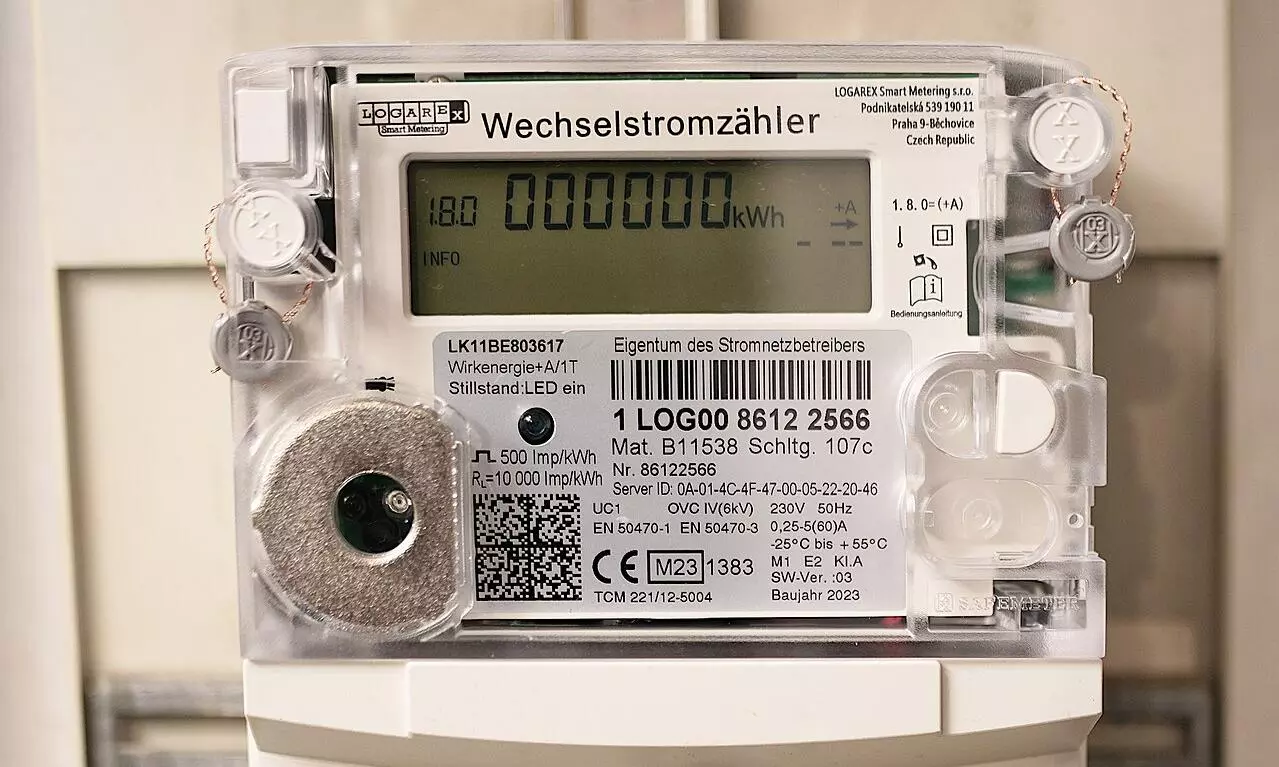
Bengal smart meter push: BJP’s U-turn sparks consumer concerns over cost, billing
When smart meters were being tested under the TMC govt, Suvendu Adhikari, then the LoP, had strongly criticised the move and had urged consumers to resist it

The West Bengal BJP government’s push to install smart electricity meters across the state has triggered a political debate, not just over electricity bills but also over a noticeable shift in the BJP’s own position on the issue.
What was once strongly opposed by BJP leader Suvendu Adhikari during the TMC regime is now part of a large-scale rollout plan, covering nearly two crore households in the state, with support from the Centre’s power ministry.
Revamped policy
The programme forms part of the Centre’s Revamped Distribution Sector Scheme (RDSS), under which smart meters are being installed across India. State government officials said the Centre will provide a subsidy of around Rs 900 per meter, while the remaining cost will be recovered by power distribution companies over time.
Also read: Modi wants ‘Team India’ to be energy independent, but how are the states placed?
The policy shift has become a talking point in Bengal’s political circles.
Uncertainty over installation
Union Power Minister Manohar Lal Khattar recently said the installation drive would begin in phases from July, starting with government buildings and gradually expanding to domestic consumers.
The Union power ministry has also indicated that consumers in West Bengal will have the option of postpaid billing.
But even before the rollout gains pace, confusion and resistance are building. “People still don’t know whether this is compulsory or optional,” according to the All Bengal Electricity Consumers Association (ABECA). “There is no clear communication on tariffs or billing structure.”
Adhikari’s changing stand
The political twist lies in Adhikari’s earlier position.
When smart meters were being tested under the previous TMC government in parts of North 24-Parganas, Adhikari, then in the Opposition, had strongly criticised the move.
Also read: Will Karnataka's flagship schemes be continued? What DKS and Siddaramaiah say?
He had described smart meters as a “burden on middle- and lower-middle-class families” and warned that they could be imposed without proper safeguards.
He had also argued that smart meters were not mandatory under regulatory guidelines and questioned the transparency of the rollout process.
At that time, he had urged people to resist forced installation, saying consumers should not be compelled into a system that could increase electricity costs.
Postpaid smart metering
Those remarks are now being widely discussed again as the BJP supports a much larger expansion of the same technology.
One important difference between earlier trials and the current proposal is the billing model, state officials said, justifying the new government’s renewed push for smart meters.
During the TMC-era pilot projects, smart meters were largely linked to prepaid systems in which electricity supply could be cut once the balance ran out. That model triggered strong public backlash in several areas, with complaints of sudden disconnections and higher-than-expected bills.
Also read: Bengal heist: How BJP captured the state by hollowing out democracy
The current plan being discussed is largely postpaid smart metering, where consumers will receive monthly bills similar to the existing system, but with automated digital readings, officials said.
Concerns over tariff
In a letter issued earlier this month, Chief Secretary Manoj Agarwal asked state government employees to cooperate with the installation of smart meters at their residences as part of the RDSS programme, underscoring the BJP government's embrace of a policy that Adhikari had once urged consumers to resist.
Even so, consumer groups remain unconvinced.
ABECA argues that the lack of clarity over charges is the real problem. “We are hearing about monthly meter rent and future tariff changes, but nothing is officially spelled out in simple terms for consumers,” said Subrata Biswas of the ABECA.
UP’s model
Adding to the political heat is the experience of Uttar Pradesh, which launched one of India’s biggest smart meter programmes in 2020, targeting over 3.5 crore connections.
While the system was initially promoted as a model reform, the state has now begun rolling back parts of the prepaid structure after widespread complaints.
Also read: SIR effect: Bengal, Bihar to bar deleted names from welfare schemes
Officials from the Uttar Pradesh Power Corporation Limited (UPPCL) were quoted by media confirming that many prepaid meters are being converted into postpaid billing systems after consumer protests over billing errors and disconnections.
These developments in Uttar Pradesh are now being closely watched in West Bengal, where consumer groups say the same risks could repeat if the rollout is rushed.
Cost and billing debate
One major concern is the monthly rental cost of smart meters, which is expected to be significantly higher than existing digital meters.
While precise figures vary, consumer bodies argue that long-term costs have not been clearly explained to households.
There is also anxiety over time-of-day pricing, where electricity may cost more during peak demand hours, typically evenings, potentially increasing household bills. “A family cannot shift when it uses electricity,” said an ABECA member. “But the tariff may shift against them.”
Smart meters are being promoted as a step towards modernising electricity distribution and reducing manual billing errors.
Government officials maintain that the technology will improve billing efficiency, reduce power losses and allow consumers to monitor their electricity consumption in real time.
However, the rollout has exposed deeper issues, including poor communication, technical limitations and growing consumer distrust, much of which was fuelled by the BJP when it was in Opposition.
As one Kolkata consumer put it, “If this system was wrong before, how has it suddenly become right now?”