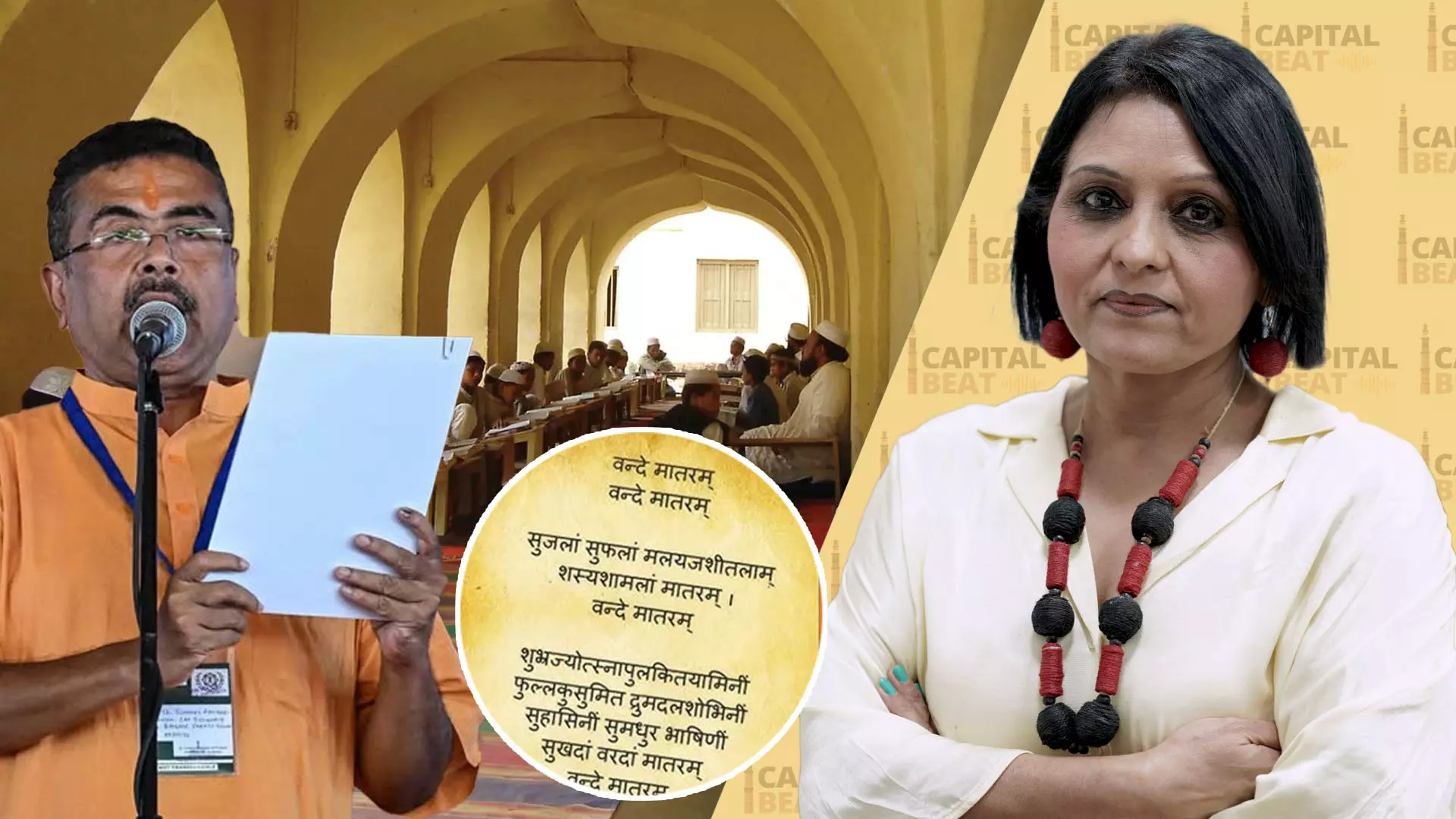
Will Vande Mataram order for madrasas deepen communal fault lines in Bengal? | Capital Beat
West Bengal’s move to make Vande Mataram mandatory in madrasas has triggered protests, raising questions over identity, nationalism and choice

The West Bengal government’s decision to make the singing of Vande Mataram mandatory in madrasas has triggered a sharp political and ideological debate in the state. While the ruling establishment has defended the move as a nationalist exercise, madrasa representatives and political commentators have raised concerns over religious freedom, constitutional rights and growing communal polarisation.
The Federal spoke to senior journalist Shikha Mukherjee, Trinamool Congress spokesperson Shubhankar Bhattacharya, senior journalist Samir K Purkayastha, and madrasa board member Ruma Choudhury on whether the directive could deepen communal fault lines in the state.
Political row
The latest order issued by the Directorate of Madrasa Education mandates the singing of Vande Mataram during morning assemblies in all recognised, aided and unaided madrasas under the Minority Affairs and Madrasa Education Department.
The order comes just days after the West Bengal government directed all schools under the School Education Department to make the singing of all six stanzas of Vande Mataram compulsory during morning assemblies.
The move has triggered mixed reactions on social media, with several Muslim groups stating that they are not against Vande Mataram but object to compulsory participation on religious grounds.
The debate has also acquired political overtones, with concerns being raised over whether the issue is being used to create communal divisions ahead of future political contests in the state.
TMC reaction
Reacting to the decision, Shubhankar Bhattacharya called the move “pseudo-nationalism” and alleged that it was part of a larger political strategy.
Also read: 'Detect, delete, deport': Suvendu signals tough border shift with BSF land handover
“It’s a very welcome move if all schools sing the national anthem and national song. But why target one particular segment and one particular community only?” he said.
Bhattacharya argued that the issue was being used to divert attention from governance and education-related failures. “They don’t have a vision for education. So they are trying to involve the entire state in a pseudo-nationalist political drama,” he added.
He also questioned why songs like “Saare Jahan Se Achchha” were not being similarly promoted. According to him, the controversy was less about patriotism and more about creating a Hindu-Muslim divide.
Question of choice
The discussion also centred around the question of personal and religious choice.
Bhattacharya said nationalism could not be restricted to a single expression. “If I sing Vande Mataram, I’m nationalist. If I sing Jana Gana Mana, I’m nationalist. Why is it that if I sing Saare Jahan Se Achha, I’m not nationalist?” he asked.
Senior journalist Shikha Mukherjee argued that the issue was not about “cultural nationalism” but “ideological nationalism”.
Also read: Bengal cattle slaughter crackdown before Eid triggers backlash from Hindu dairy farmers
“This is ideological nationalism prescribed by a particular political party,” she said, adding that India’s constitutional framework recognises pluralism and diversity.
Mukherjee pointed out that West Bengal has around 600 state-run or state-aided madrasas, many of which also have Hindu students and teachers. She said the real legal challenge could emerge in recognised but unaided madrasas that may object to implementing the directive.
Religious concerns
Ruma Choudhury strongly opposed the move and said madrasa institutions were preparing to protest against the directive. “We are definitely going to protest this because Islam is all about worshipping one God, but making our students sing Vande Mataram goes against monotheistic belief,” she said.
Choudhury cited Articles 29 and 30 of the Constitution, arguing that minority institutions have the right to preserve their religious and cultural identity. She also expressed concern about the possible psychological impact on students. “It’s not the right time to plant the seeds of communalism in children’s minds,” she said.
According to Choudhury, many students in madrasas have grown up singing the national anthem “Jana Gana Mana” with “deep pride and respect”, and replacing it with mandatory singing of Vande Mataram had created anxiety among students and parents.
Legal angle
Senior journalist Samir K Purkayastha said the issue was likely to become legally contentious.
He pointed out that madrasas in West Bengal had historically sung the first two stanzas of Vande Mataram without objection. “Madrasas never objected to singing Vande Mataram earlier,” he said.
Also read: Bengal govt ends religious honorarium schemes, launches Rs 3,000 Annapurna aid
According to Purkayastha, the controversy intensified after the state government made all six stanzas mandatory. He argued that earlier national leaders, including Mahatma Gandhi, Subhas Chandra Bose and Rabindranath Tagore, had supported limiting the rendition to selected portions after extensive deliberation.
Purkayastha alleged that the present political climate was deliberately encouraging polarisation. “The intention is that there should be protests so that there can be much more polarisation on religious lines,” he said.
At the same time, he advised religious organisations to pursue legal remedies instead of extreme protests. “If they react extremely, they will fall into that trap,” he cautioned.
Identity clash
Mukherjee described the controversy as a larger battle over freedom and identity.
“My interpretation of nationalism versus yours. My interpretation of my freedom versus your interpretation of my freedom — that is what is at stake,” she said.
The discussion also touched upon concerns over whether similar measures could eventually extend to broader restrictions on minority institutions and religious practices.
Choudhury warned that the directive was creating fear among sections of the minority community. “Today they are imposing this national song, tomorrow they may say all madrasas will be closed,” she said.
Also read: Why Suvendu's BJP govt in Bengal can never truly claim Rabindranath Tagore
As the debate intensifies, the Vande Mataram directive has become more than an educational order in West Bengal. It now sits at the intersection of religion, constitutional rights, nationalism and politics — with all sides bracing for a larger ideological battle in the days ahead.
(The content above has been transcribed from video using a fine-tuned AI model. To ensure accuracy, quality, and editorial integrity, we employ a Human-In-The-Loop (HITL) process. While AI assists in creating the initial draft, our experienced editorial team carefully reviews, edits, and refines the content before publication. At The Federal, we combine the efficiency of AI with the expertise of human editors to deliver reliable and insightful journalism.)