



'Detect, delete, deport': Suvendu signals tough border shift with BSF land handover
Days after taking charge, Bengal's new BJP government greenlights crucial border fencing with Bangladesh and outlines a strict mechanism to stop infiltration

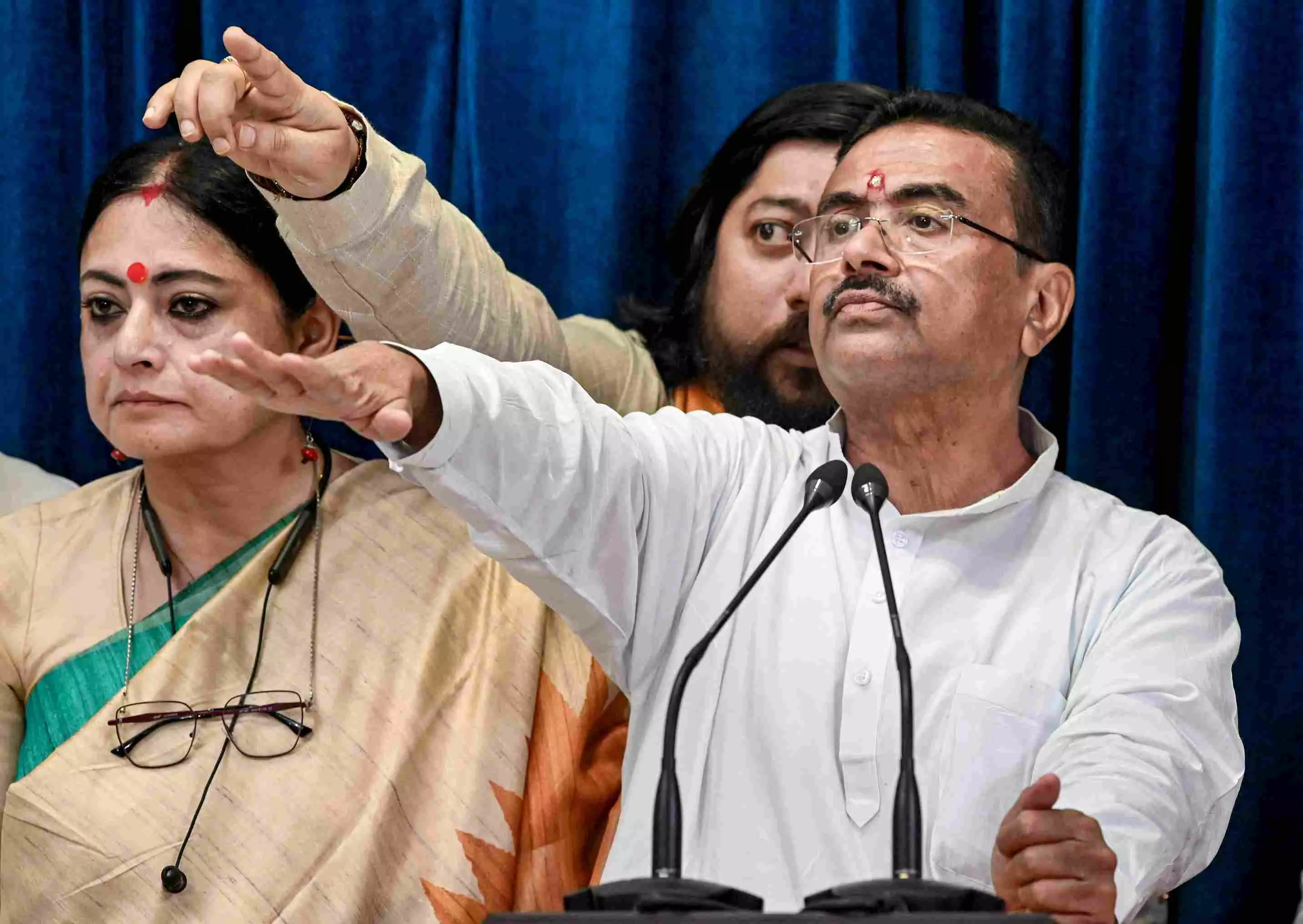
Days after taking charge as the chief minister of West Bengal, Suvendu Adhikari on Wednesday (May 20) announced a dual approach to border security. The initiative includes the transfer of a 27-kilometre section of land to the Border Security Force (BSF) for long-awaited fencing projects, besides executing a comprehensive "detect, delete, and deport" strategy aimed at addressing the issue of infiltrators.
Addressing a press conference at Nabanna, the state secretariat in Kolkata, alongside BSF officials, Adhikari said land covering an initial 27-km stretch would be transferred to the force within two weeks and asserted that it marked only the beginning of a larger border security architecture and transfer of required land for making the border secure.
Also read: Suvendu's blitzkrieg in first week as CM: Border fencing to bulldozers to RG Kar
At the same event, he also announced the implementation of a mechanism for direct handover of 'infiltrators' to the BSF by the state police, asserting that communities not covered under the Citizenship (Amendment) Act (CAA) would be detained and deported under a process coming into force with immediate effect.
The CM also described the framework as "detect, delete and deport" of infiltrators, while explaining the mechanism.
BJP govt enforces strong border policy
The twin announcements marked one of Bengal's new BJP government's earliest high-impact policy interventions, bringing together two issues that have long sat at the centre of the party's political messaging in the state -- border security and infiltration.
"As a beginning, the land required to secure the 27-km stretch is being provided to the BSF. Our patriotic citizens and efficient officials will complete the process and extend all cooperation in the coming days," Adhikari said.
The CM added his cabinet had approved the land transfer proposal and tasked the chief secretary and the land and land reforms secretary with completing the process within 45 days.
CM slams previous government
Projecting the decision as a course correction, Adhikari took a dig at the previous Trinamool Congress (TMC) led by Mamata Banerjee, accusing it of withholding land sought by the BSF due to "appeasement politics" and vote bank calculations.
Referring to the long and porous India-Bangladesh border, Adhikari said substantial fencing gaps had left the state vulnerable.
Also read: Wild East? BSF may use snakes, crocodiles to guard porous Bangladesh border
"India shares a 4,000-km border with Bangladesh, of which nearly 2,200 km falls in West Bengal. Around 1,600 km has already been fenced, while nearly 600 km still remains unfenced," he said.
He alleged that out of the unfenced portion, land for nearly 555 km could have been handed over earlier, but it was not done because of political reasons and appeasement politics of the previous government.
"Wherever land is needed for fencing and border security, we will hand it over to the BSF," he added.
The chief minister also sought to frame infiltration as not merely a border issue but a wider law-and-order challenge.
"In issues related to law and order, love jihad, forced religious conversion and crimes concerning women's safety, a large section of those arrested are infiltrators from Bangladesh," he claimed.
Adhikari also announced what he described as a stricter implementation of mechanisms to deal with illegal immigration.
"A letter had been sent by the Centre to the state on May 14 last year regarding the direct handover of infiltrators to the BSF, but the previous government failed to implement this important provision or law. We are now enforcing it with immediate effect," he said.
CM Adhikari on CAA
"On one hand, the previous government had opposed the CAA and had also not implemented this law or didn't use this opportunity. We are implementing it from now," he said.
Referring to provisions under the CAA, Adhikari said seven communities covered under the law and entering India before the cut-off date would not face action.
"Under the CAA, seven communities have been named, and those who came till December 31, 2024, are protected, and police cannot detain them," he said.
"Those who are not covered under the CAA will be treated as infiltrators. State police will detain and hand them over to the BSF," Adhikari said.
The BSF would then coordinate with BGB, the Bangladesh border authorities, for initiating the deportation process, he said.
"The BSF will speak to the Border Guard Bangladesh (BGB) and take necessary steps to deport them," Adhikari said.
He said instructions had already been communicated to the state's top administrative and police officials.
"We have informed the DGP and the home secretary that this law will be implemented in all police stations in border areas for the sake of West Bengal and India's security," he said.
Also read: The battle after victory: Suvendu targets Abhishek’s turf as Falta goes to repoll
Adhikari also alleged that institutional coordination along the border had weakened over the years.
"For the last several years, coordination meetings between the BSF, state police and administration in bordering areas did not happen," he said.
He claimed such meetings had resumed after the BJP assumed office and would now be held regularly.
For the BJP government, the announcements appeared to signal more than an administrative shift. Border security, citizenship and migration have long occupied a central place in the party's Bengal politics; on Wednesday, those themes moved from campaign rhetoric to policy execution.
Reactions were also heard from the Bangladeshi side after Bengal's BJP government decided to fence the border, with one top source saying Dhaka was not afraid of the barbed wire and would take up issues with New Delhi whenever it is required.
(With agency inputs)