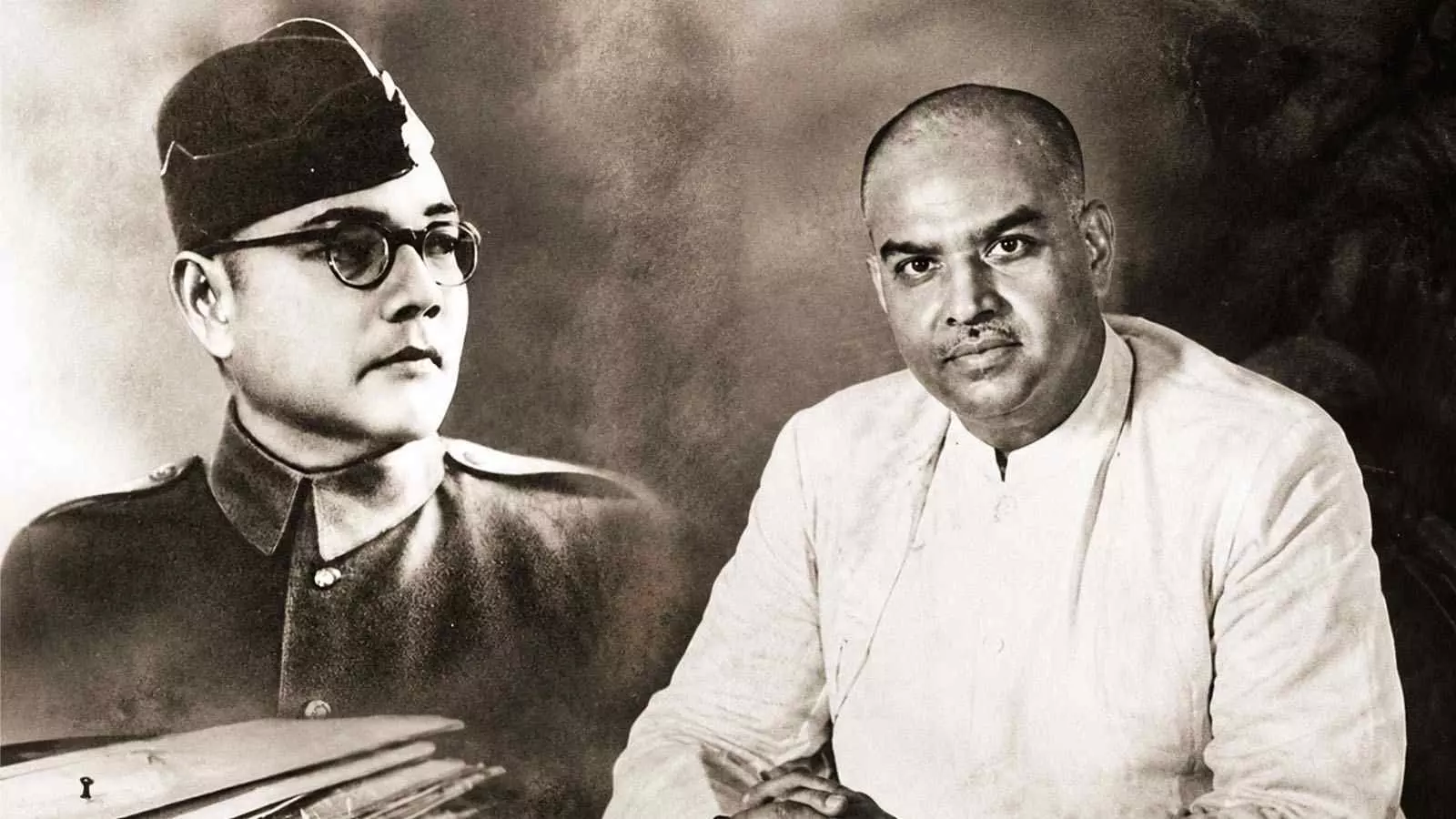
Netaji or Mookerjee? BJP's ideological tightrope walk in West Bengal
After a row over remarks against Netaji and a contested road renaming, BJP moves to calm public anger even as critics call its retreat temporary

West Bengal BJP president Samik Bhattacharya's latest remarks describing Netaji Subhas Chandra Bose as “leader of leaders” appear to be a course correction aimed at containing a controversy that has revived ideological differences between Bose and Syama Prasad Mookerjee.
Bose-Mookerjee rivalry comes alive
The controversy began after Bhattacharya, speaking at a programme commemorating Mookerjee on July 6, highlighted the political rivalry between the two leaders.
He alleged that Forward Bloc workers attacked Mookerjee while he was addressing a gathering at Mohammad Ali Park during the 1940 Calcutta Municipal Corporation election.
Also Read: Why a building in Vietnam, said to have links with Subhas Chandra Bose, lies ‘dilapidated, neglected
Calling the attackers “goons”, Bhattacharya said stones were thrown at Mookerjee, leaving him injured.
He, however, stopped short of naming the leader of the attackers, saying that doing so would trigger a “fresh controversy”. His remarks were an oblique reference to Bose, who led the Forward Bloc at the time.
Roy's remarks deepen BJP's Netaji trouble
The controversy widened after BJP Rajya Sabha MP Nagen Roy, also known as Ananta Maharaj, reportedly described Bose as a “war criminal” and questioned the role of his Azad Hind Fauj (Indian National Army) in India’s freedom struggle. He also claimed that Netaji lacked the ability to organise and raise an army like the INA.
Also Read: SC refuses plea to bring back Netaji’s 'ashes'; asks why daughter is not the petitioner
In another controversy, a plaque declaring Rampurhat’s Netaji Subhash Road as Dr Syama Prasad Mookerjee Road was unveiled on August 12 in the presence of BJP MLA Dhruv Saha, although the municipality said it had not approved the name change.
The remarks and the renaming drew protests and a backlash on social media, putting the BJP on the defensive as it sought to balance its ideological association with Mookerjee against Netaji's enduring popular appeal in Bengal.
Mookerjee's ideological importance
The developments assume political significance because they come barely months after the BJP came to power in West Bengal and began giving greater public prominence to Mookerjee, the founder of the Bharatiya Jana Sangh, the BJP's political predecessor.
Also Read: Mamata faces ‘chor, chor’ slogans at Kolkata event over Netaji remarks row
The controversy has also added to the perception that the BJP is seeking to elevate Mookerjee's place in Bengal's public memory.
“The BJP is trying to give Mookerjee greater prominence at the expense of Bose for obvious ideological and political reasons. But history cannot be distorted so easily because it is all documented,” said Debabrata Biswas, former general secretary of the All-India Forward Bloc.
The issue, however, goes beyond the renaming of roads or remarks by individual leaders, said Dr Ratan Kumar Nandi, president of Bangiya Sahitya Parishad.
A rivalry rooted in Bengal
“It has brought back a much older political rivalry and, with it, a question over how two very different strands of Bengal's nationalism fit into the BJP's political narrative,” he told The Federal.
The rivalry has deep historical roots. Several historical accounts suggest Bose and Mookerjee were both powerful nationalist figures, representing competing approaches to politics in Bengal during the turbulent years before Independence.
Also Read: Bengal BJP faces heat as charges of cut money, factional feud echo TMC-era practices
The differences became particularly visible in the late 1930s and early 1940s, when the Congress, Muslim League, Hindu Mahasabha and Bose's Forward Bloc were competing for political influence.
The 1940 Calcutta Corporation election was one such event.
Mookerjee’s own writings also record a direct political confrontation with Bose. He wrote that Bose opposed the Hindu Mahasabha’s efforts to establish itself as a rival political force in Bengal.
Mookerjee noted that Bose warned him directly that if the Mahasabha tried to establish itself as a serious rival political force in Bengal, Bose “would see to it, by force if need be, that it was broken before it was really born”.
Why Mookerjee matters to BJP
Mookerjee matters to the BJP for more than his place in Bengal’s political history. He is an ideological fountainhead of the party and an important link between the party and Bengal's Hindu nationalist politics.
Also Read: BJP yet to end extortion despite coming to power in Bengal, admits state chief
Bose's nationalism, by contrast, sought to build an Indian identity that transcended religious divisions. The INA deliberately brought together soldiers from different religious communities.
“Bose opposed communal politics as the basis of Indian nationalism,” Biswas pointed out.
That distinction is important. It would, however, be wrong to suggest that the RSS or BJP has always been dismissive of Bose. The BJP has, in fact, spent more than a decade seeking to appropriate Bose’s legacy.
BJP's long engagement with Bose
Prime Minister Narendra Modi has invoked Bose since coming to power in 2014. His government declassified files relating to him, designated his birth anniversary as Parakram Diwas and installed a large statue of Bose near India Gate.
The BJP's engagement with Bose, however, has largely emphasised his militant nationalism, his opposition to British rule and the INA's military campaign.
Also Read: Extortion culture haunts Bengal BJP as two leaders sound alarm
His opposition to communal politics and advocacy of an inclusive nationalism, however, have received far less emphasis in the BJP’s efforts to claim his legacy.
“Before coming to power in Bengal, the BJP could invoke Netaji as a national icon because his legacy transcends party politics. After coming to power, however, it has a greater reason to project Syama Prasad Mookerjee, because he gives the BJP a direct political and ideological connection to Bengal,” said Commonwealth fellow and political commentator Debasish Chakrabarti.
Balancing Bose and Mookerjee legacies
“The BJP can celebrate Mookerjee as its ideological forebear and Bose as a nationalist hero. But when the two legacies are placed in direct political competition, the differences between them become harder to ignore,” he added.
“The question for the BJP is therefore no longer whether it can invoke Netaji, but how far it can promote Mookerjee without appearing to diminish Bose,” he said.
Also Read: Bengal's Adina masjid becomes new flashpoint as Hindu groups push temple claim
Trinamool Congress spokesperson Manojit Mandal also pointed to the greater emphasis on Mookerjee since the BJP came to power in the state, arguing that the government was seeking to promote figures whose political legacy was closer to that of the saffron party.
“The BJP and its government in the state are taking up various initiatives to promote Mookerjee in colleges and universities. But we do not see similar attempts to project Netaji or other leaders,” he said. “The BJP has this tradition of pitting one national hero against another, which is highly condemnable,” he added.
BJP moves to contain backlash
The BJP government, however, has moved to distance itself from the controversy. Chief Minister Suvendu Adhikari directed police to take action against people posting derogatory comments about Netaji on social media. At least five people have been arrested so far over social-media posts. The government also withdrew the Banga Bibhushan award conferred on Ananta Maharaj following his remarks about Bose and the INA. At the same time, Bose’s name was restored to the Rampurhat road.
The BJP state president, too, struck a more conciliatory note on Friday (August 14), saying, “Netaji lives in the heart of every nationalist. Netaji is the leader of leaders. There may be political differences, but Netaji remains an immortal personality.”
'Retreat is temporary': Congress
He also said that if people’s sentiments had been hurt over the remarks on Netaji, the party would consider the matter. He argued that Bose had opposed the partition of India and the truncating of Vande Mataram, and suggested that had Bose remained in the Congress, India might not have been partitioned.
Also Read: Beyond NEET: Why NEP rollout is creating anxiety in Bengal’s classrooms
Congress leader Ranajit Mukherjee, however, feels that the BJP’s “retreat is temporary” and has been forced by the public backlash. “The Netaji controversy should not be seen in isolation. It reflects a larger attempt to recast Bengal's political and cultural memory,” he said.
Opposition protests continue
“The damage-control exercise it has undertaken now is also a classic BJP ploy. First, you float a theory that polarises people. If it backfires, you quietly retreat. But by then, the damage is already done. The poison is out. The same controversy can then be revived at the next opportune moment,” he alleged.
Meanwhile, the West Bengal Pradesh Congress staged a satyagraha protest outside Netaji Bhavan on Elgin Road in Kolkata, demanding the arrest of Ananta Maharaj for allegedly insulting Bose. The party also demanded that Roy resign as an MP.
The controversy has clearly put the BJP on the back foot, forcing it to walk a tightrope between promoting Mookerjee’s legacy and preserving Bose’s place as a nationalist icon whose appeal cuts across political and ideological boundaries.