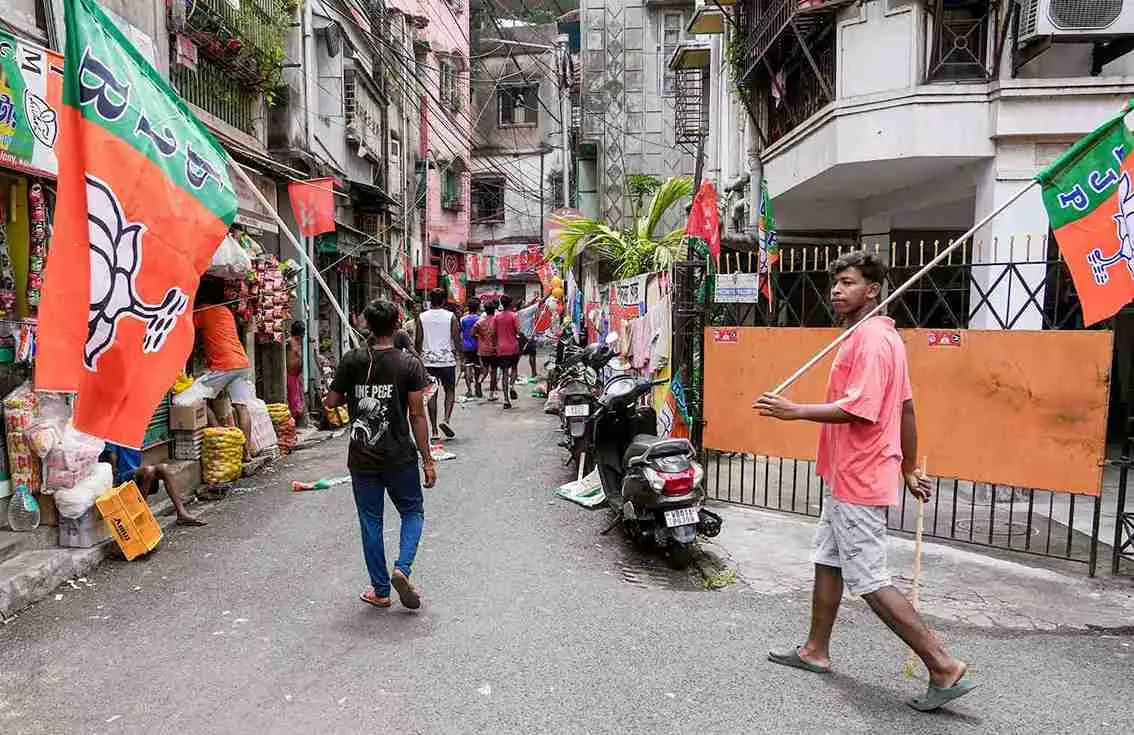
Bengal BJP faces heat as charges of cut money, factional feud echo TMC-era practices
Egg therapy backfires, with angry BJP cadres hurling protests at their own leaders, exposing cracks in saffron party’s anti-corruption narrative

When Kolkata-based real estate promoter Amarnath Singh refused to pay Rs 5 lakh allegedly demanded by a group of BJP workers, he says they stormed into his office in Dum Dum, vandalised the premises and assaulted him.
Singh’s police complaint, filed on Tuesday (August 4), is the latest in a string of allegations against local Bharatiya Janata Party (BJP) functionaries that suggest the same culture of cut money, extortion and factional feuds the party vowed to dismantle is beginning to take root within its ranks less than three months after it came to power.
The allegations come even as the BJP government intensifies its crackdown on alleged corruption under the previous Trinamool Congress (TMC) administration, while reiterating its “zero tolerance” policy on graft.
Several districts, same story
The cases span several districts and range from allegations of extortion and “cut money” demands to violent factional clashes over local political and economic networks.
In Cooch Behar’s Sitalkuchi, local BJP workers on Monday hurled eggs at their own leaders after accusing them of accepting “cut money” from a TMC gram panchayat chief and attempting to facilitate her return to the panchayat office without consulting grassroots workers.
Also read: Extortion culture haunts Bengal BJP as two leaders sound alarm
The confrontation quickly escalated into clashes between rival BJP factions, forcing police to escort local mandal president Pabitra Adhikari and other leaders away from the scene before angry workers locked the panchayat office.
Adhikari denied the allegations, saying those behind the violence were “people who picked up the BJP flag after May 4”, and insisted that party leaders were only trying to restore normal functioning of the panchayat after administrative work had stalled following the change of government.
BJP leaders get a taste of ‘egg therapy’
The symbolism was striking. For months, the BJP had projected “egg therapy” as a form of protest against TMC leaders accused of corruption, portraying it as an expression of public anger. On Monday, a section of BJP leaders themselves became the targets of the protest.
In another incident in West Bardhaman’s Jamuria, police arrested BJP worker Rakesh Maji after a video, purportedly showing men stopping sand-laden trucks and demanding money, circulated widely on social media.
The Federal could not independently verify the authenticity of the video, which appeared to show men wearing saffron scarves demanding money from truck drivers transporting sand through the area.
Police registered a suo-motu case after the video surfaced and arrested one person. Local BJP leaders, however, said the accused was not an active party functionary.
Factional infighting
Jamuria has also witnessed increasingly visible factional infighting. On Sunday night, BJP MLA Bijan Mukhopadhyay was forced to abandon the inauguration of a party office after rival groups of BJP workers confronted each other, and engaged in scuffles.
The dispute centred on control over the area’s lucrative sand, coal and stone-dust businesses, according to party sources, although BJP leaders declined to publicly discuss the reasons behind the clash.
Also read: Why Bengal’s trend of ‘egg justice’ may not be as harmless as it looks
Internal rivalries have surfaced elsewhere as well.
In Chief Minister Suvendu Adhikari’s home district of East Midnapore, supporters of BJP Zilla Parishad chief Bamdeb Guchhait on Monday (August 3) unsuccessfully attempted to remove a BJP gram panchayat chief through a no-confidence motion.
The effort collapsed after several BJP members stayed away from the vote, exposing deep divisions within the district unit. Rival party workers later celebrated openly and raised slogans against their own district leadership.
Farmer’s allegation
In another incident in East Bardhaman’s Jamalpur block, farmer Uttam Maji alleged that local BJP leaders prevented him from cultivating land he had farmed for nearly two decades.
Maji claimed the same individuals who had obstructed him during the previous TMC government switched allegiance to the BJP after the change in power and continued to keep him off his fields.
Local BJP leaders rejected the allegation, saying the disputed land was under official examination.
Allegations of political pressure also surfaced elsewhere in the district. In Ausgram, the family of a minor girl accused a local BJP leader and several associates of repeatedly threatening them to withdraw a pending case under the Protection of Children from Sexual Offences (POCSO) Act.
They also alleged the girl’s father was assaulted after refusing to withdraw the complaint. Local BJP leaders dismissed the allegations as the fallout of a personal dispute, while police said they were verifying the complaint.
Same old evils, different political colour
Similar accusations over alleged political patronage emerged in Bankura’s Simlapal, where Opposition parties accused BJP leaders of backing illegal sand mining after videos circulated online purportedly showing excavators extracting sand from the Shilabati river at night.
BJP leaders denied the allegations, saying villagers had merely undertaken desilting and river restoration work to improve water flow before the monsoon.
Also read: A century and counting: List of key TMC leaders arrested in a month of new Bengal regime
While the allegations remain under investigation, they have put the BJP’s promise of ending West Bengal’s entrenched patronage system under fresh scrutiny.
The allegations have become serious enough for senior BJP leaders to publicly acknowledge that some of the political practices associated with the TMC era may be creeping into the organisation.
Admissions by BJP leaders
Reflecting the party’s concerns, Urban Development Minister Agnimitra Paul claimed that political change alone could not erase entrenched practices.
“We have not washed everyone clean in a detergent or washing machine. Some people think this is their opportunity to make money. We do not operate the kind of extortion arrangements that existed under the previous government,” she said.
State Panchayat and Rural Development Minister Dilip Ghosh went further, acknowledging that some within the party were succumbing to the same temptations the BJP had campaigned against.
“Many of our leaders have developed a taste for the honey of extortion. There is no reason to think this culture will disappear overnight,” Ghosh said.
“The police have been instructed to act whenever complaints are received. Many of our leaders are getting addicted to this honey. The party is also keeping watch. Some of them have become too close to the very people who had caused suffering to the public. We must not forget why people voted for change.”
He also warned that newly elected legislators were becoming magnets for vested interests.
Also read: BJP yet to end extortion despite coming to power in Bengal, admits state chief
“Some newly elected MLAs have begun to enjoy the taste of power. Extortionists are trying to cultivate close ties with them. Some people, after experiencing power, believe they are above everyone else,” Ghosh said.
Promise of action
State BJP President Samik Bhattacharya warned that the party would not shield anyone accused of wrongdoings.
“If you develop links with promoters, the party will not spare you. Whether it is a police officer or a BJP leader, anyone trying to provide protection will face action. The government will do its job, and the party will not show leniency,” he said.
The BJP rode to power promising to dismantle what it described as the TMC’s entrenched “syndicate raj”, a system in which political influence allegedly determined access to contracts, construction materials, government services and local business opportunities.
Whether these latest allegations prove isolated or mark the return of the politics the BJP came to power promising to end may ultimately shape the credibility of its pledge to end “syndicate raj”.