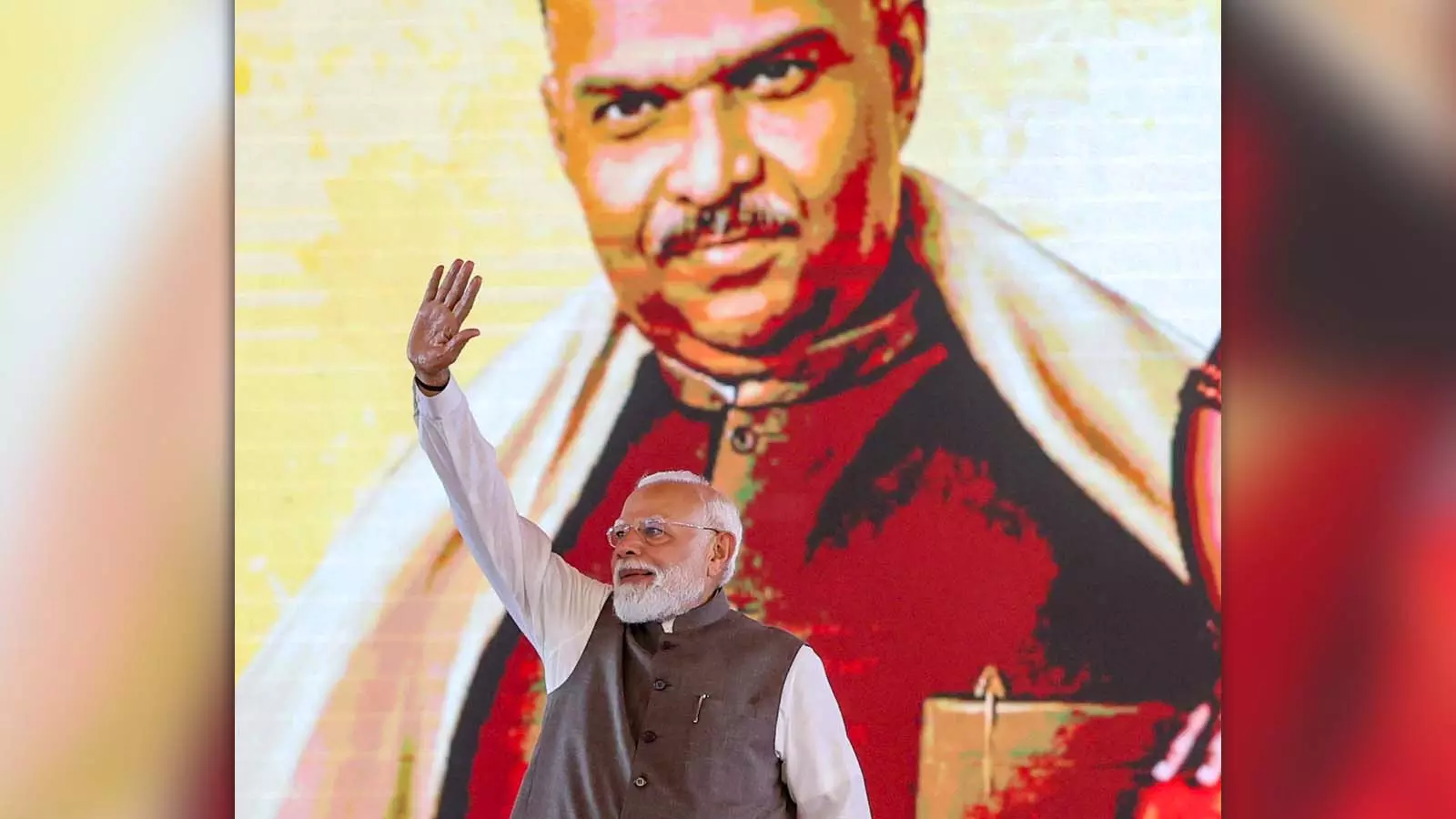
Prime Minister Narendra Modi waves to a gathering during the 'Paschimbanga Divas', West Bengal Day, celebration at Tarakeswar, in Hooghly district of the state, on June 20, 2026. Photo: PMO via PTI
Modi propels BJP vision to reshape Bengal's foundation narrative
The PM joins BJP government’s June 20 celebrations in Hooghly to honour Syama Prasad Mookerjee; opposition slams the move for glorifying a painful history

Prime Minister Narendra Modi on Saturday (June 20) attended West Bengal's Bharatiya Janata Party (BJP) government's first official 'Paschimbanga Divas' (West Bengal Day) celebration in Tarakeswar in Hooghly district of the state, an event that has sparked a political debate over the state's formation and the role of Syama Prasad Mookerjee, the founder of the Bharatiya Jana Sangh, the ideological predecessor of the BJP.
The event was a key highlight of Modi's two-day visit to Bengal, his first since the BJP came to power in the state last month.
Also read: Bengal smart meter push: BJP’s U-turn sparks consumer concerns over cost, billing
Besides attending the statehood celebrations, Modi released the latest PM-KISAN instalment, launched the PM Fasal Bima Yojana in the state, rolled out several central agriculture schemes, inaugurated development projects and addressed a public rally.
He will lead the International Yoga Day celebrations in Kolkata on Sunday (June 21).
The choice of Tarakeswar for the statehood programme and public rally carried political symbolism.
BJP leaders have linked the venue to developments preceding June 20, 1947, when the then Bengal Legislative Assembly voted in favour of partitioning the province of Bengal, paving the way for the creation of West Bengal within independent India.
The party credits Mookerjee with mobilising support for the demand that Hindu-majority districts remain with India rather than becoming part of (East) Pakistan.
Historians, however, have long contested attempts to portray him as the sole architect of West Bengal.
In her book Bengal Divided: Hindu Communalism and Partition, 1932-1947, historian Joya Chatterji argues that Bengal's partition emerged from a complex political process involving the Congress, Muslim League, Hindu Mahasabha, British authorities and sections of Bengal's Hindu elite, making it difficult to attribute the creation of Bengal to any single individual.
Chatterji's research also notes that influential sections of the Bengali Hindu "bhadralok" backed Partition, making it a broader political process rather than an individual achievement.
BJP govt declared June 20 as Bengal's foundation day
The BJP government has declared June 20 as the state's official foundation day, replacing the previous Trinamool Congress government's practice of observing "Poila Baisakh" (Bengali New Year’s Day) as West Bengal Day.
The BJP argues that the date marks the moment when West Bengal secured its place within India and honours Mookerjee's role in that process.
Also read: Why Bengal’s trend of ‘egg justice’ may not be as harmless as it looks
Modi reiterated that position on Saturday. In a social media post ahead of his visit, he said June 20 was a significant day in Bengal's history because it ensured that West Bengal remained "an integral part of India".
He also described Mookerjee's contribution as "invaluable" and noted that 2026 marks his 125th birth anniversary.
Warm greetings to my sisters and brothers of West Bengal on the occasion of Paschimbanga Divas.
— Narendra Modi (@narendramodi) June 20, 2026
This day celebrates a state that has profoundly shaped India's history through its contributions to diverse areas be it literature, music, art, spirituality, science, trade and…
Opposition slams BJP govt decision
The decision to observe June 20 as West Bengal Day has, however, drawn criticism from the opposition.
The Communist Party of India (Marxist) argues that June 20, 1947, was the day the Bengal assembly approved the partition of Bengal, a process that led to widespread displacement and suffering.
CPI(M) central committee member Sujan Chakraborty questioned the government's interpretation of the date, arguing that the present territorial shape of West Bengal emerged only after the later integration of Murshidabad, Cooch Behar and Purulia.
The disagreement reflects a wider contest over how Bengal's history is interpreted in contemporary politics.
At the heart of the debate is whether June 20 should be celebrated as the beginning of West Bengal's journey within independent India or viewed primarily through the lens of Partition, which uprooted millions and left a lasting mark on the region.
Also read: Bengal heist: How BJP captured the state by hollowing out democracy
What is missing from the debate, and perhaps more relevant in the current context, is a discussion on the larger political developments that ultimately led to the Partition.
Historians generally view Bengal's division as the culmination of decades of growing communal polarisation, constitutional deadlock and competing political visions advanced by the British administration, the Congress, the League and the Mahasabha.
With the prime minister lending his weight to the first official observance of West Bengal Day, the BJP appears keen on placing the state's Partition-era history at the centre of Bengal's political discourse.
Also read: TMC collapse: Has BJP solved one problem and created two new ones?
By emphasising Mookerjee's role and linking June 20 to the state's creation, the party is seeking to embed its own historical narrative into Bengal's political identity.
At the Tarakeswar programme, Chief Minister Suvendu Adhikari welcomed Modi with a Dokra-crafted idol of Goddess Durga, a photograph of Baba Taraknath and traditional Bengali sweets.
The venue was decorated with motifs showcasing Bengal's culture and heritage, further reflecting the BJP’s wider attempt to weave Bengali cultural pride into its political narrative following its rise to power in the state.