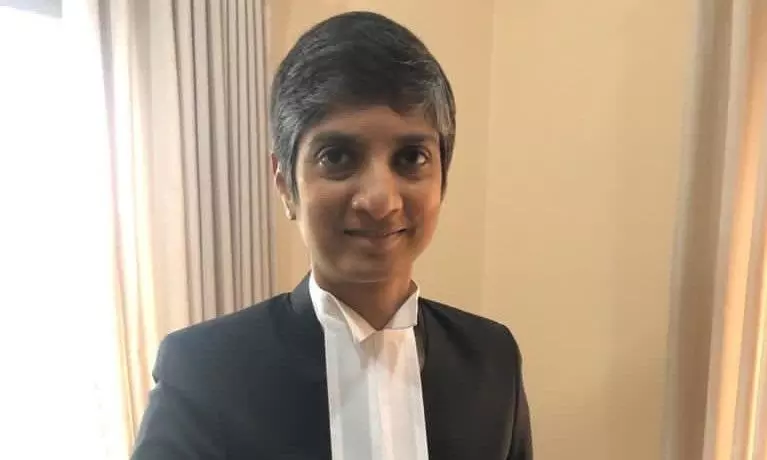
Menaka Guruswamy, a senior advocate at the Supreme Court, rose to national prominence as one of the lawyers in the 2018 constitutional challenge. File photo: X/@MenakaGuruswamy
Menaka Guruswamy’s RS nomination: What's behind TMC move ahead of Bengal polls?
The nomination aligns with party’s broader Rajya Sabha approach of selecting candidates who reflect social diversity while advancing its wider political positioning

The nomination of senior advocate Menaka Guruswamy to the Rajya Sabha by the Trinamool Congress (TMC) is being seen by political observers as a calculated signal of inclusion and progressive positioning ahead of West Bengal’s upcoming Assembly election.
Also read: Menaka Guruswamy, TMC candidate for Rajya Sabha, poised to be India’s first LGBTQ MP
Guruswamy, a senior advocate at the Supreme Court, rose to national prominence as one of the lawyers in the 2018 constitutional challenge that led to the reading down of Section 377 of the Indian Penal Code (IPC), decriminalising consensual same-sex relations between adults.
‘More than a nomination’
If elected to the Upper House, she would become the first Member of Parliament (MP) to publicly identify as a member of the LGBTQ community, a significant milestone in the country’s political and civil rights history.
Guruswamy also represented the TMC in the court in recent case concerning Enforcement Directorate (ED) searches at the office of the I-PAC.
While the TMC on Friday night (February 27) announced its list of all four nominees, including former state police chief Rajeev Kumar, minister Babul Supriyo and actor Koel Mallick, analysts say Guruswamy’s inclusion carries the strongest symbolic weight.
Also read: Budget 2026-27 leaves transgender welfare largely untouched
“This is not merely a nomination. It is a message,” said Arundhati Roychoudhury, president of the Thakurpukur Centre for Peace and Development Initiatives, a Kolkata-based non-profit working on social inclusion. “Through this move, the TMC appears to be reinforcing its claim as the principal platform for liberal and rights-based politics.”
Inclusion strategy
The party has not foregrounded identity in its official statement, instead saying its nominees would uphold its commitment to protecting “the rights and dignity of every Indian.”
Her nomination is also in line with the party’s recent outreach on questions of social inclusion and representation.
Also read: Why LGBTQIA+ community is battling India’s blanket ban on blood donation
A few months ago, when two women from a remote village in the Sundarbans formalised their same-sex union, local TMC legislator Bapi Halder organised a public felicitation for the couple, a rare gesture in rural areas. Party national general secretary Abhishek Banerjee also called to congratulate them.
Diversity in the Upper House
The nomination of Guruswamy is consistent with that positioning, extending the party’s messaging on LGBTQ inclusion from the local to the national stage.
India decriminalised consensual same-sex relations in 2018 after the Supreme Court overturned a colonial-era provision of the penal code.
Though activists have since pushed for broader protections, including marriage equality and anti-discrimination safeguards, openly queer representation in Parliament has remained absent.
Also read: How India can make educational institutions queer- and trans-inclusive
The nomination also aligns with the party’s broader Rajya Sabha approach of selecting candidates who reflect social diversity while advancing its wider political positioning.
Given its numerical strength in the West Bengal assembly, the TMC is expected to secure four of the five Rajya Sabha seats that have fallen vacant from the state. The BJP is poised to win the remaining one seat.