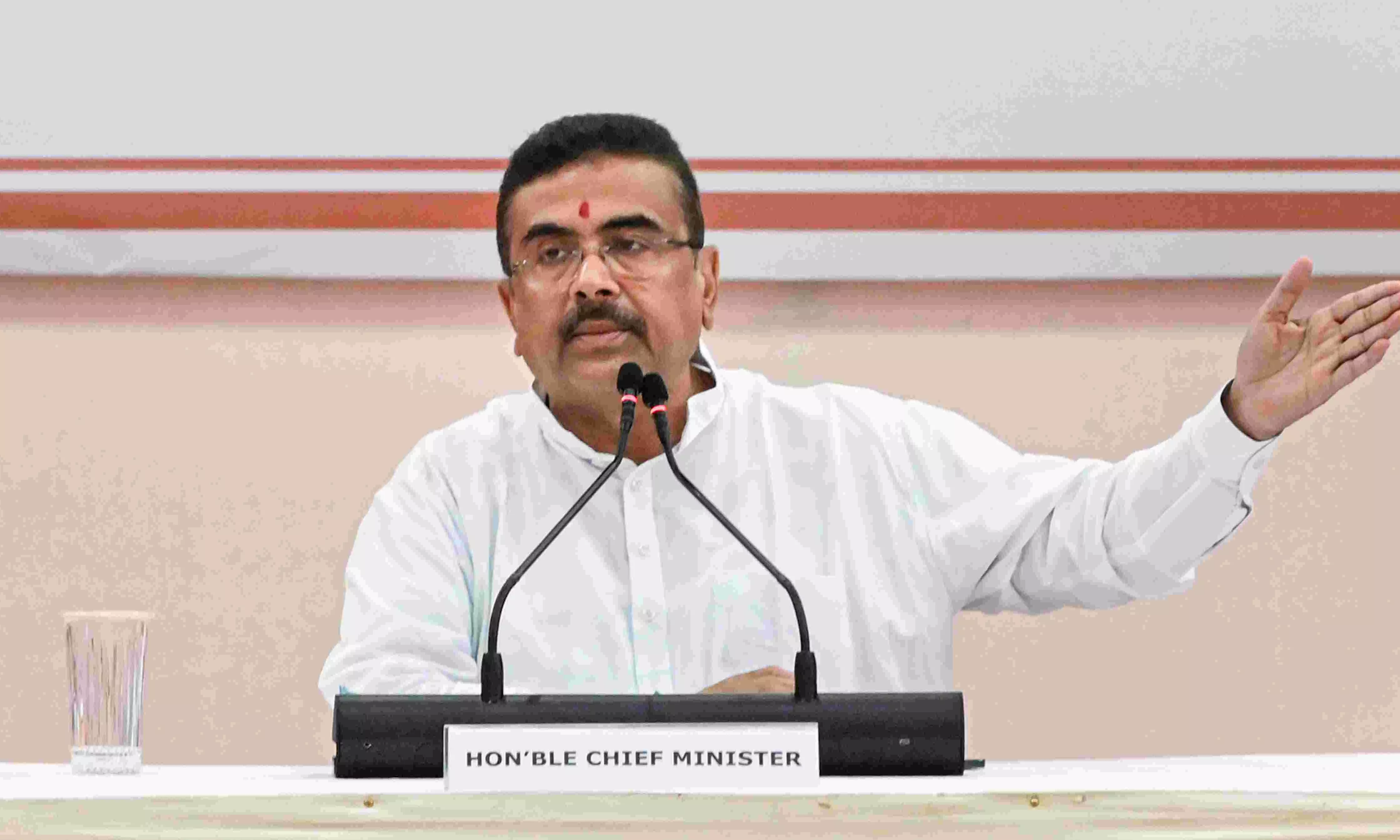
Eggs, egos and an anti-goonda law: Bengal BJP govt's first 100 days
The Suvendu Adhikari government has moved quickly on law and order, welfare and its ideological agenda, but jobs, law and order and governance remain key tests

They say you can't make an omelette without breaking a few eggs. Suvendu Adhikari's government, it turns out, has broken plenty — some literally, hurled at rallies; others procedurally, in classroom lunch menus. Unmistakably, the humble egg has emerged as an unlikely symbol as the new BJP government completes 100 days in office.
100 days of Vijay/TVK govt in office: Have you read our analysis?
Beyond the egg debates, Suvendu's first 100 days have been marked by a proposed anti-goonda law, changes to OBC quota, and early steps toward a Uniform Civil Code. Together, these moves reveal a government in a hurry, determined to break from the Trinamool Congress era. On the job front, there were promises galore, but the govt has yet to make a move.
Baptism by eggs?
Suvendu Adhikari was sworn in as chief minister on May 9, along with five cabinet ministers. The political controversy over eggs began soon after the new government took charge, with eggs thrown at Trinamool Congress leaders, including party national general secretary Abhishek Banerjee, and at government officers accused of corruption. It also led to the arrest of BJP leaders and critics dubbing the government “eggocracy”.
Also read: 100 days of Bengal BJP govt: Will face public 'test' after 1 year, says CM Suvendu
On August 13, four BJP leaders were arrested in Birbhum after they allegedly threw eggs at a land-reforms officer and detained him inside his office. The incidents have raised questions about whether the BJP, which campaigned heavily against what it described as the TMC's culture of political intimidation, is now creating a similar culture of its own.
The egg controversy took another turn when the government announced a pilot project in Kolkata under which International Society for Krishna Consciousness (ISKCON) would provide vegetarian meals in schools. The initial proposal did not include eggs, which had earlier been part of school meals, drawing criticism from Opposition parties and teachers.
They questioned why eggs were being left out and whether a school nutrition programme should be linked to a particular dietary preference.
The government later clarified that eggs would continue to be provided separately through self-help groups. The state would procure the eggs, while ISKCON would provide the vegetarian food. “The issue became politically sensitive in Bengal, where food habits are closely linked to everyday social and cultural life,” said Sukumar Pyne of the All-Bengal Teachers’ Association.
Beyond the egg politics
The egg controversy, however, is only one of several issues that have made headlines during the more than three months of the Suvendu Adhikari government. One of its biggest legislative moves, the West Bengal Public Safety and Control of Anti-Social Activities Bill, has also drawn controversy.
Also read: Bengal CM alleges Rs 15K Cr revenue leak in Birbhum, says Mamata govt complicit
Also termed the “anti-Goonda law”, it is yet to be notified despite receiving the Governor’s assent. It allows preventive detention of people involved in, or likely to engage in, anti-social activities for up to a year.
The new government also amended the state's public-order law to provide for recovery of compensation for damage to public and private property during riots and protests. The government says the measures are needed to tackle organised crime and political violence.
Law and order concerns
The Opposition criticised the provisions, arguing that they give the administration and police unrestricted powers. CPI(M) leader and Calcutta High Court advocate Sabyasachi Chatterjee warned that its broad definition of a “goonda” could allow the state to arbitrarily label and arrest people.
Law and order was one of the BJP's main campaign issues. The party had repeatedly accused the previous TMC government of failing to control political violence and allowing criminal networks to flourish. “The new laws will now be closely watched for how they are implemented,” said another Kolkata-based lawyer, Nabapallab Roy.
OBC quota restructure row
The government also moved to restructure the state's OBC reservation quota. It reduced the OBC quota from 17 per cent to 7 per cent and removed 113 communities from the earlier list, while restoring 66 communities to the list.
The government defended the changes as necessary to comply with court orders and correct alleged irregularities under the previous government. “The changes have nevertheless created uncertainty among students and job seekers who had relied on the earlier OBC lists,” said Sheikh Jamal, a teaching-job seeker from Kalanabagram village in East Burdwan district.
Also read: Suvendu vows to bring Tatas back to Bengal, blasts previous govt over 'lies, photo ops'
Most communities removed from the earlier OBC list were Muslims. Of the 113 communities on the old list, 77 were Muslims, and 36 were non-Muslims. The revised list has 54 Hindu and 12 Muslim communities. The OBC decision is one of the government's most significant moves so far, affecting access to welfare, education and government jobs.
Prioritising UCC
The BJP has also begun work on legislation reflecting some of its longstanding political priorities. The government has started preparing a Uniform Civil Code (UCC) and announced plans for a law against religious conversion. It also indicated that it wants to regulate inter-community land transactions.
The government's handling of the controversy surrounding Netaji Subhas Chandra Bose also came under scrutiny.
These proposals are at different stages, but they signal the direction of the government's legislative agenda. This marks one of the clearest differences between the BJP government and its TMC predecessor. While the government has moved cautiously on some of these proposals so far, its legislative agenda shows it is using its mandate to pursue the BJP's political and ideological priorities.
The government's handling of the controversy surrounding Netaji Subhas Chandra Bose also came under scrutiny, with critics seeing it as part of the BJP's ideological politics.
Netaji controversy
The government's handling of the controversy surrounding Netaji Subhas Chandra Bose also came under scrutiny.
BJP state president Samik Bhattacharya's remarks about the political rivalry between Bose and Syama Prasad Mookerjee triggered the controversy, which deepened after BJP Rajya Sabha MP Ananta Maharaj described Bose as a “war criminal” and questioned the role of the Indian National Army. The controversy widened further after a road named after Netaji in Rampurhat was renamed after Mookerjee in the presence of BJP MLA Dhruv Saha.
The developments drew protests and put the BJP on the defensive. The party then sought to distance itself from the controversy. Bhattacharya, who had earlier criticised the Forward Bloc over its confrontation with Mookerjee, later described Bose as the “leader of leaders” in what appeared to be a bid to contain the backlash.
Also read: Suvendu revives 1993 police firing report to undermine Mamata’s Martyrs’ Day legacy
The government also ordered police action against people posting derogatory comments about Netaji online, while it later withdrew the Banga Bibhushan award given to Maharaj. The road plaque was later restored to Bose's name, marking another retreat by the BJP amid growing criticism over its handling of the controversy.
Education and welfare
Education has been another area of change, with the government moving towards greater adherence to the National Education Policy and reviewing textbooks and curricula introduced under the previous TMC government. The BJP government has also started changing the welfare schemes inherited from the previous government.
The changes in the education sector could become one of the government's more significant moves, but their success will depend less on textbook changes than on whether it can fill teacher vacancies, resolve recruitment uncertainty and restore confidence after years of recruitment controversies.
The move into welfare is politically important because the BJP is trying to replace schemes closely associated with Mamata Banerjee with programmes carrying the stamp of the new government.
The BJP government has also started changing the welfare schemes inherited from the previous government. It has introduced Ayushman Bharat in Bengal after the state stayed out of the central health scheme during the previous government. It also sought to build its own political identity around the Annapurna scheme as an alternative to the TMC's Lakshmir Bhandar.
The move into welfare is politically important because the BJP is trying to replace schemes closely associated with Mamata Banerjee with programmes carrying the stamp of the new government.
But changing the political branding of welfare will matter less to beneficiaries than timely payments, simple access and effective delivery. Complaints of delays and non-payment already leave many eligible beneficiaries without the promised benefits.
Jobs promise falls flat?
On jobs, the government has announced plans to fill 1 lakh vacant government posts, including 50,000 in education, 20,000 in the police and 30,000 in other departments.
But the School Service Commission's admission that it will not complete the fresh school-teacher recruitment process by August 31 has raised questions about the government's promise to fill vacant posts. Any further delay in fresh recruitment risks turning one of the government's biggest promises into another source of public frustration.
The larger challenge over its full term will be whether the announcements and promises lead to more jobs, better administration and improved public services
The past 100 days also saw several TMC leaders arrested in corruption cases, renewed efforts to push ahead with pending border-fencing projects and promises of industrial revival and more job opportunities.
The arrests have allowed the BJP government to demonstrate that its anti-corruption campaign is being pursued against tainted leaders associated with the previous regime. But these cases will ultimately be judged on the speed of the investigations and prosecutions rather than the number of arrests.
“The larger challenge over its full term will be whether the announcements and promises lead to more jobs, better administration and improved public services, and how far the government can pursue its political and ideological agenda,” said political commentator Nirmalya Banerjee.