







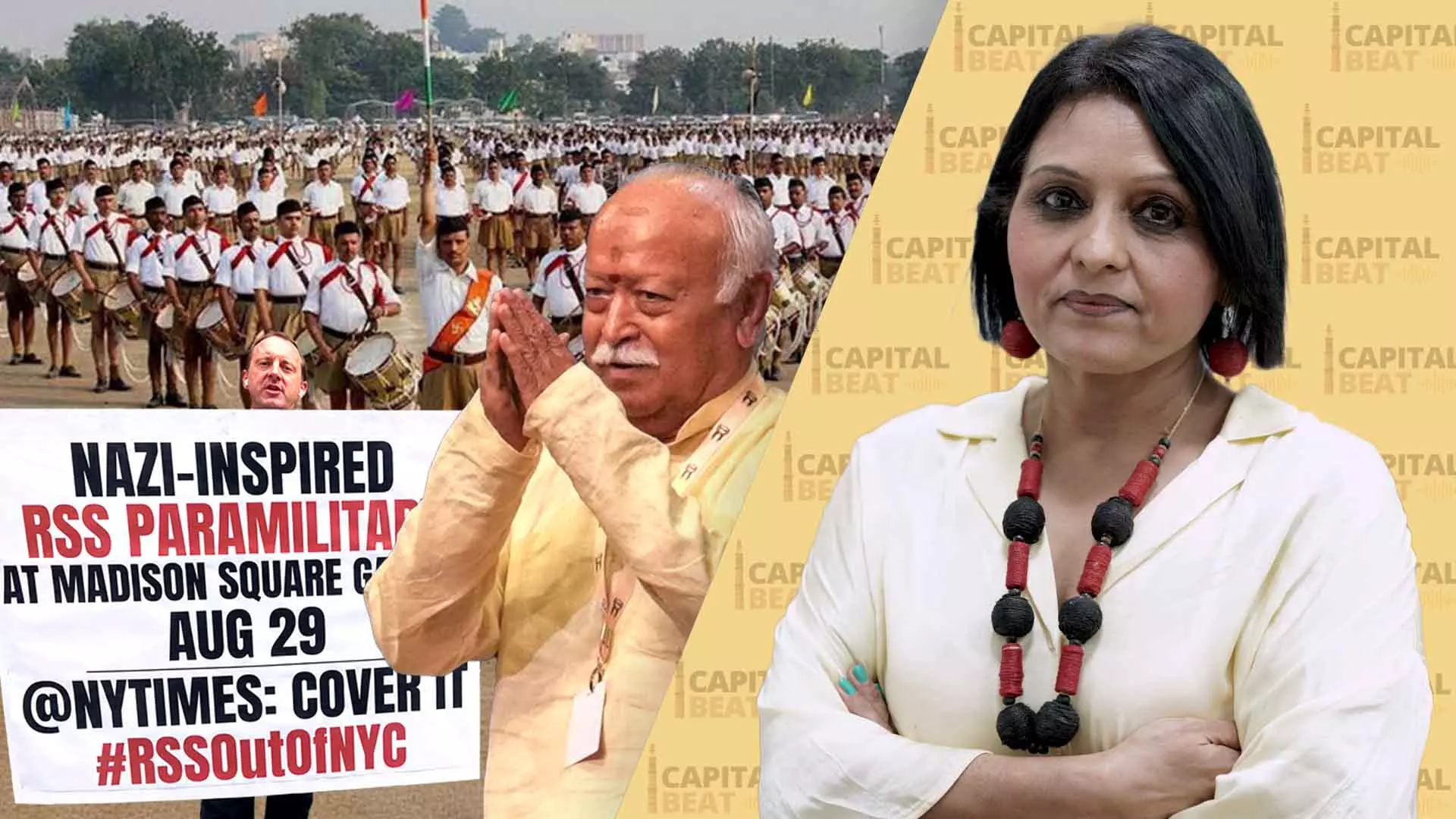
As protests grow in US, what could RSS chief’s visit mean geopolitically?
What is the objective of RSS chief Mohan Bhagwat’s US, Canada, and UK tours? Is it an attempt to project the RSS as an entity separate from the BJP govt?

RSS chief Mohan Bhagwat’s planned appearance at Madison Square Garden on August 29 has triggered growing opposition in the US, with protests, social media campaigns and calls for Washington to deny diplomatic courtesies to RSS leaders.
The controversy has also raised questions about the political purpose of Bhagwat’s three-country tour and its implications for India-US relations.
In this context, The Federal spoke to Sanjay Kapoor, senior journalist, and Pushparaj Deshpande, author and policy expert, to examine why the protests have intensified and what Bhagwat’s visit could mean politically and geopolitically.
US’ own problems
Kapoor said the US is currently going through a period of political churn, with the midterm elections approaching. He argued that Bhagwat, despite his relatively withdrawn public personality, remains a controversial figure and that his decision to travel to the US and address an event at Madison Square Garden was significant.
Also read: Bhagwat speaks Gen Z's language, but Sangh's script hasn't changed
He also suggested that the US political environment could influence the response to Bhagwat’s visit, while arguing that the Indian government’s backing would make any major action against the RSS chief unlikely.
Canada and UK tours
Bhagwat’s tour is not limited to the US. He is scheduled to travel to Canada and the United Kingdom as well, with questions already being raised over whether similar protests could emerge in those countries.
Kapoor said he expected strong reactions in both countries but did not believe governments would want to antagonise India because of broader considerations, including trade and the geopolitical importance of India.
He also argued that the ideological overlap among right-wing political forces in different countries could shape the response. In his view, while there may be opposition to Bhagwat from sections of society, the broader political environment would make an extreme diplomatic response unlikely.
On the question of whether US President Donald Trump could use the controversy as a diversion from domestic political issues, Kapoor disagreed. He said Trump already has several issues that can serve as political distractions and that the Bhagwat controversy would have limited value as a diversionary tactic.
Far-right links
Deshpande took a different approach to the growing protests. He said the backlash reflected deeper unease among sections of the political establishment and diaspora over what he described as ideological cooperation between the BJP, RSS and far-right political forces abroad.
According to Deshpande, the BJP and RSS have worked with right-wing political groups in the US, the UK, and Europe. He cited the MAGA faction of the Republican Party, the Conservative and Reform parties in the UK, and the Alternative for Germany (AfD) as examples of political forces he believes are part of this broader ideological network.
Also read: Bhagwat’s pitch on Gen Z protests exposes RSS-Modi fault line over dissent
Deshpande argued that a section of the Indian diaspora had been mobilised to support such political forces through campaigning and fundraising. He said this has created concern among progressive political groups, which view such activities as a form of foreign interference.
He also argued that the loud protests outside Madison Square Garden may not necessarily be the most effective political strategy. Instead, he said progressive groups should focus on policy advocacy and engagement with lawmakers and political organisations.
Bhagwat’s mission
A key question in the discussion was the broader objective of Bhagwat’s foreign tour. Deshpande argued that the trip should be viewed against what he described as growing tensions between the BJP government and sections of the international right wing.
He claimed that some right-wing forces increasingly see Prime Minister Narendra Modi and the BJP as unreliable partners who have not delivered expected political, geopolitical or economic gains. He cited recent criticism of Modi from figures including Donald Trump, Boris Johnson and US Ambassador to India Sergio Gor.
Also read: Mohan Bhagwat calls youth India’s ‘demographic dividend’, warns of future burden
Deshpande argued that Bhagwat’s tour could therefore be an attempt to distinguish the RSS from the Modi government. He suggested Bhagwat may seek to project the RSS as having a separate identity and position from the BJP government.
Kapoor, however, rejected the idea that the distinction between the RSS and BJP could be easily established. He said the RSS remains a major ideological force and argued that government officials and diplomats supporting Bhagwat’s visit demonstrate the close relationship between the organisation and the government.
