Bhagwat's endorsement of protest as legitimate democratic tool counters Modi’s ‘andolanjeevi’ rhetoric, revealing unease within RSS over govt’s handling of dissent
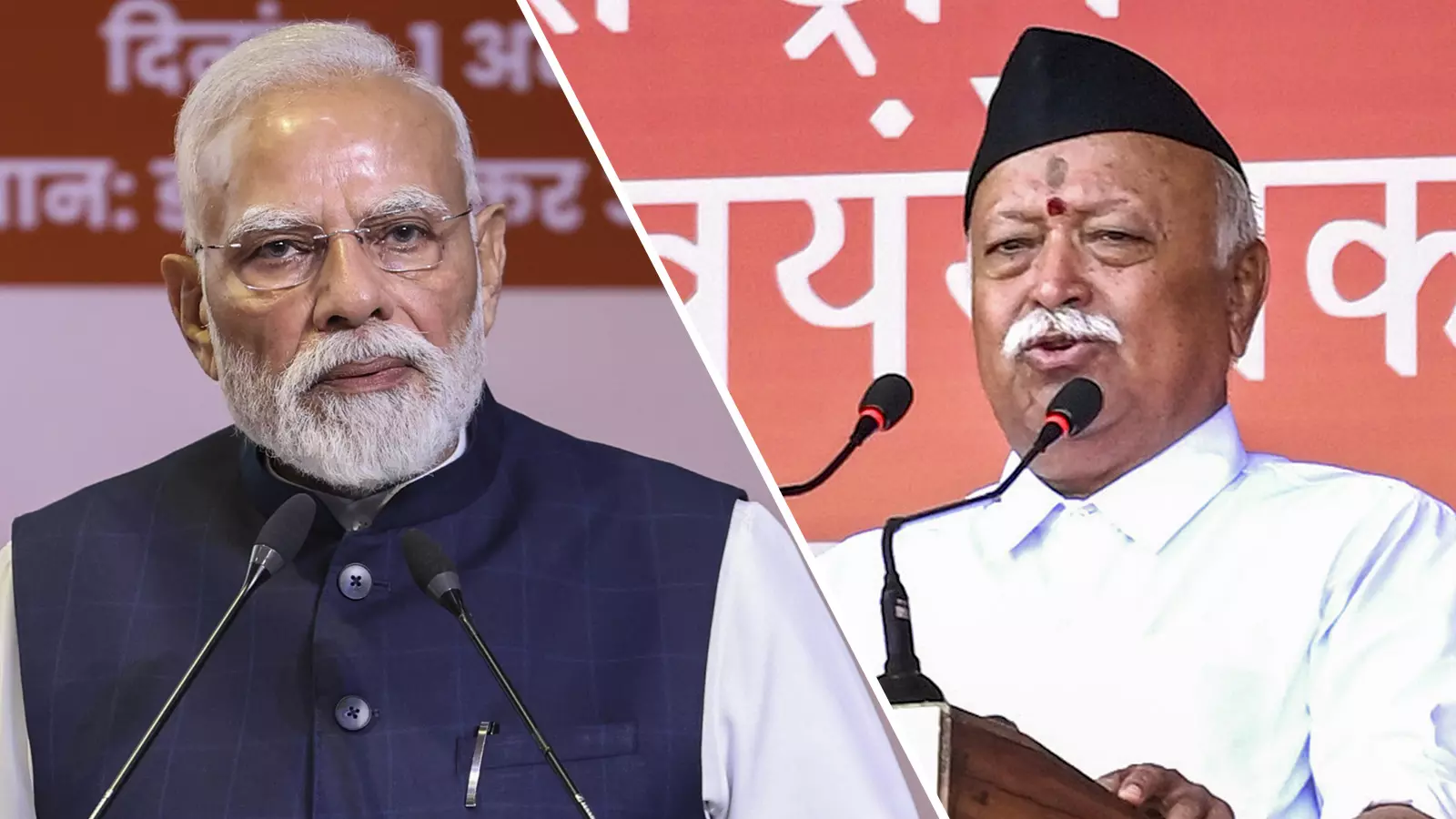
The divergence that came to the fore recently between Rashtriya Swayamsevak Sangh (RSS) chief Mohan Bhagwat’s opinion on protest being a "legitimate form of democratic dialogue" and Prime Minister Narendra Modi’s February 2021 coinage of andolanjeevi (alluding to “omnipresent” groups comprising various professional and demographic groups who allegedly “live off” or “subsist” on agitations and were “parasitic” in character) to trash the gathering support for the farmers’ stir against the contentious three farm laws, highlights a fundamental ideological and political tension within the Sangh Parivar ecosystem.
This unease within the fraternity stems chiefly from the RSS worry, that unwavering support for government actions would undermine its support base, especially if a particular protest or people’s movement is seen as a legitimate stir centred around an important matter, as the recent students’ and youth protest was almost universally perceived.
In contrast, the government or just the PM, have no principled position vis-à-vis protests or mass agitations, even though he personally and a large number of his colleagues were part of agitations in the years when the BJP and its affiliates were part of the opposition.
Modi’s public image
As witnessed during the protests in New Delhi and several other cities and towns across India, the government made brutal attempts at putting down the agitation because it wanted to safeguard Modi’s public image of being an inflexible and unyielding leader.
The strategy was a replication of the template used for all previous protests or agitations against the government. As in the instance of the farmers’ stir, this time too, Modi accepted the basic demand for the resignation of education minister Dharmendra Pradhan, only when he realised that the protests were gathering further support and beginning to erode the BJP’s electoral constituency.
Also Read: RSS chief Mohan Bhagwat: Gen Z is highly emotional, easily drawn to 'visibly authentic' causes
Despite the discomfort of the RSS, Modi remains steadfast in presiding over an authoritarian regime, increasingly being affixed the fascist tag. Undeniably, over the 12 years since Modi assumed office, the RSS has constantly undertaken a tightrope walk.
Bhagwat's criticism is aimed at subtly demarcating itself from the BJP and its leadership, although this will be easier said than done.
While its proverbial “heart” has not been enthusiastic in backing the personality-centric Modi regime, the “head” advocated caution, given the government’s unwavering pursuit of Hindutva objectives – the latest one being the passage of the Vande Mataram Bill in Parliament and securing presidential assent.
Furthermore, unlike the gripe of the RSS and its affiliates during six years of Atal Bihari Vajpayee’s tenure as PM, that they “got nothing”, Modi ensured that the entire Sangh Parivar benefited - the organisation and its affiliated bodies - by way of seemingly infinite resources, and its key functionaries and members securing positions across a multitude of institutions, from educational to sports and cultural bodies.
Differing stances on dissent
Despite this, as evident in some assertions made by Bhagwat at the recent interaction aimed at the Gen Z and Gen Alpha, the two personalities, while operating from the same ideological bedrock, their public stances on dissent reveal opposing frameworks regarding the role of street mobilisation in a constitutional democracy.
As Bhagwat explained, the RSS considers dialogue with protestors as a legitimate instrument for consensus-building when formal channels fail.
Also Read: As Gen Z rises, Modi's magic falters and Rahul finds his voice
In contrast, as the andolanjeevi barb demonstrated, Modi sees every protestor or protest as parasitic activity. Activists are depicted as people who have built careers through protests. He contends that such people shift from one agitation and issue to another.
During his reply to the Motion of Thanks to the President for his address to Parliament in Rajya Sabha in 2021, Modi juxtaposed the so-called andolanjeevis with traditional Hindi terms like Shramjivi (those who live by manual labor) and Buddhijivi (intellectuals) to further demean protestors by comparison with others who “contributed” to advancing the nation.
Earlier position on protests
But the PM ignored the fact that he himself had been one such full-time protestor or political activist from his early days in the RSS. Not just personally, but political organisations and parties periodically mobilise support on a wide range of issues.
Protests against national developments, follow-up government action or inaction, official policies, and decisions are little but the raison d'être of opposition parties, trade unions, and other organisations in democracies, to gain political power by winning elections.
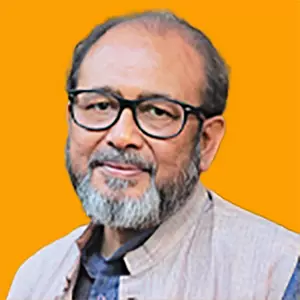
Back in 2012, during one of the interactions with Modi in the course of writing his biography, I had asked if there was any need for political parties to break new ground when it came to politics of protests.
Also Read: Bhagwat speaks Gen Z's language, but Sangh's script hasn't changed
His reply was indicative: “In a democracy, the ultimate goal of protest is to spread political awareness or education. And that has to be the basic goal. This is not the British Sultanate that only agitation will work. It is not necessary that every agitation should be successful – it is not necessary that all the time there will be so much anger against our own government all the time – but this process every time will educate people.”
Importantly, the compere of the show in Mumbai specifically asked if Bhagwat thought that protestors were anti-nationals, and he answered in the negative. Unlike the ready aspersions cast on protestors by Modi or his associates in the government or the party, Bhagwat and other RSS leaders who speak publicly, have never said that agitationists are intrinsically driven by opportunistic disruption, foreign influence ("foreign destructive ideology"), or political opposition.
An approach like Indira Gandhi’s
Modi’s approach is reminiscent of Indira Gandhi’s trait when she was battling Punjab-rooted terrorism in the years before her assassination, and routinely lay the blame for any matter spiralling out of the government’s control as being the handiwork of the “foreign hand” - there was always a “conspiracy” against the government, nation, or country.
Bhagwat also conveyed his sense that the agitationists, in this instance those drawn from the Gen Z demographic group, are “our own people” or honest people who are not protesting with the intention of harming the nation. In contrast, Modi and his associates question the legitimacy of protestors at every step, accusing that they have chosen the path of agitation with the intention of destabilising the government.
In his interaction, Bhagwat did not veil his sentiment that it was the responsibility of the government to enter into dialogue with protestors and make systemic corrections if the situation warranted, like in the case of paper leaks, where much more has to be done than what the government has embarked to do currently.
Also Read: 79 years after Independence, what a ‘free’ India looks like to Gen Z
Modi, however, has a different approach and remained resolute on identifying so-called “subversives” and preserving “public order” against professional agitators. This may have been officially stopped, but the storm troopers and vigilante squads who back Modi’s words with actions remain firm on the path of vendetta.
Bhagwat expressed his view that citizens had the right to stage protests if dialogue stalled, or if there was no response to the issues they were flagging. In contrast, Modi coined a pejorative which may not have been used this time, but his actions during the agitation and even after it had been called off, reflected the same sentiment.
Subdued criticism of Modi
There is little doubt that the RSS, during the tenures of BJP-run governments, fashions itself as a societal mediator, outreach figure, and moral arbiter at one level. Within the Sangh Parivar, Bhagwat sees the role for the RSS as an ideological mentor and policy monitor.
The PM ignored the fact that he himself had been a full-time protestor or political activist from his early days in the RSS.
But because the ideological objectives and logistical necessities of the RSS and professional pursuits of integral stakeholders within the saffron ecosystem are met by Modi and the government, Bhagwat’s criticism remains subdued, and care is taken that relations do not reach a breaking point.
Also Read: RSS chief Bhagwat backs Gen Z, says protesting doesn't make them anti-national
Since June 2024, Bhagwat has repeatedly obliquely criticised Modi. Bhagwat’s critiques have ranged from warnings about arrogance and remarks on self-proclaimed divinity, to calls for humility (maryada) and handling the opposition with respect.
These observations are neither an attempt to trigger a political fallout nor simple moral pontification. They however have to be assessed as part of Bhagwat’s move to try pushing for a calculated institutional recalibration wherein Modi adopts a consultative approach vis-à-vis the RSS and tones down the projection and promotion of the Modi-cult.
Rejection of Hindutva ecosystem
Bhagwat’s recent words harp on the power and rights of the people and underplays the belief of supremacy of either the government or Modi.
The oblique message to Modi to mind his ways and become more accommodative also stems from the present worries of the RSS.
Given the fact that the protests by students and youth were not just unprecedented but have also unleashed scorn and ridicule directed at Modi, the RSS fears that the broader Hindutva ecosystem could face systemic rejection.
Bhagwat's criticism is thereby aimed at subtly demarcating itself from the BJP and its leadership, although this will be easier said than done.
The message to the public, conveyed unobtrusively, is simple: The political party may err at times, due to personally-propelled desires of certain individuals, but the sangathan or organisation and the core ideology would remain firmly on the participatory path that movement is committed to.
(The Federal seeks to present views and opinions from all sides of the spectrum. The information, ideas or opinions in the articles are of the author and do not necessarily reflect the views of The Federal.)