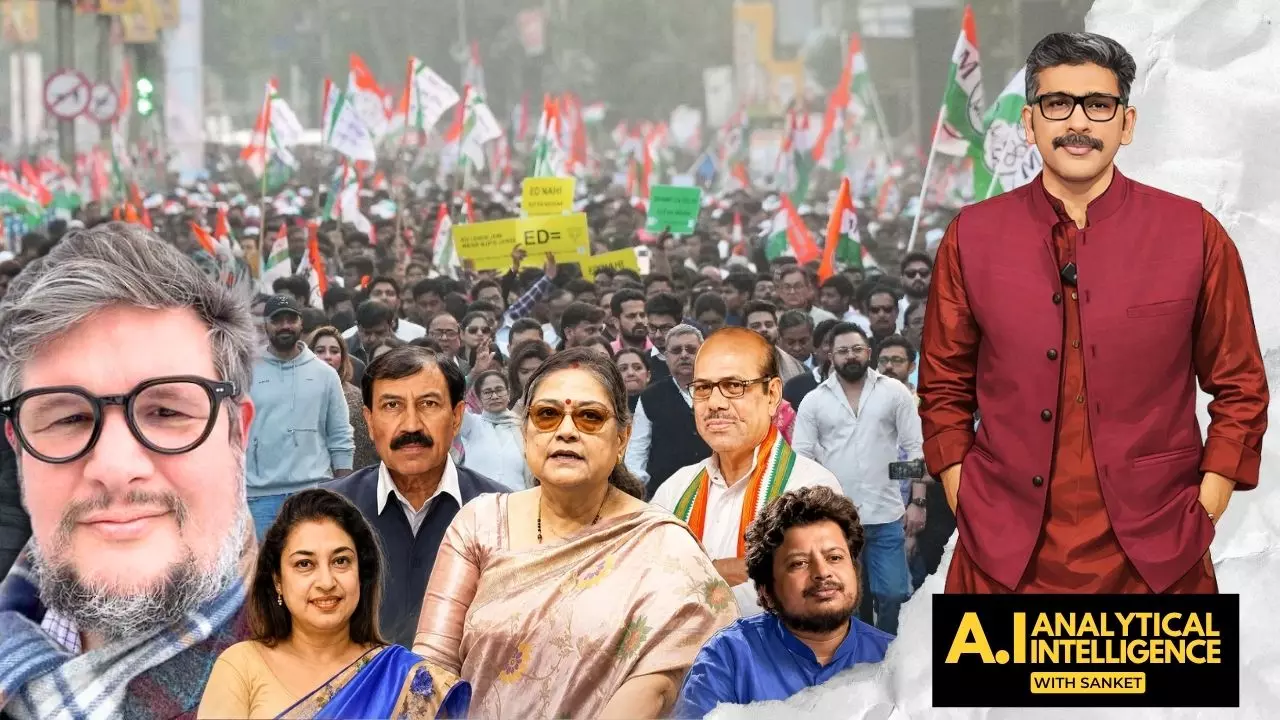
Anti-defection law now offers a roadmap to defect: Gilles Verniers | AI With Sanket
Researcher Gilles Verniers says India's anti-defection law has become ineffective, while party centralisation and political incentives fuel defections

"The anti-defection law is defective. It actually provides a roadmap for how to change party affiliation rather than preventing it," researcher Gilles Verniers remarked on The Federal's special programme AI With Sanket.
As political turmoil engulfs the Trinamool Congress and allegations of a BJP-backed split dominate national politics, questions are once again being raised about defections, democratic mandates and the effectiveness of India's anti-defection law.
It was in this context that The Federal spoke to Verniers, researcher at CERI, about the motivations behind political defections and whether India's democracy is equipped to deal with them.
Edited excerpts:
What was your initial reaction to the way the developments in the Trinamool Congress unfolded?
I would not exactly call it salami slicing. This is more like a party put on the chopping block because it's a big chunk. Most of their MPs are allegedly shifting support from their own party to the NDA.
What I find interesting is the shape that it's taking. Instead of resigning, which has been the usual form in recent years, and calling for fresh elections within six months or so, they are basically splitting the party vertically, attempting to create a new entity.
What that new entity is remains unclear. They are professing support for the BJP.
Also read: As TMC crumbles, what's next for Mamata and the state forces she fought over the years?
For the BJP, it's a net gain because they have the support of a large number of new MPs, around 20 or so. The numbers will, of course, keep shifting. They don't have to get into the trouble of fielding candidates or other candidates in elections, which takes time and is costly. So it is really an immediate gain for them in the form of a party split.
Why would a large section of an Opposition party decide to break away and support the BJP?
You have different actors involved. From the BJP's point of view, the interest is very clear. They cut down to size major Opposition parties and they get a net gain in terms of support in the Lok Sabha.
The goal for the BJP, of course, is to get to that two-thirds majority in the Lok Sabha, which would enable it to bring about the kind of constitutional change that it has been dreaming of for quite some time but has not been able to do because of the lack of such a majority. So the gains are very clear.
For the individual MPs, we can only speculate and summarise that there is an element of individual gain to be derived from shifting support from one party to another. This is the hardest thing to prove, but there is an element of individual opportunism and probably individual greed involved.
But what I said in my piece is that we cannot summarise this or limit it to the sum of individual opportunism alone because there is also an element of collective decision. So many MPs shifting support at the same time points to a number of systemic factors.
At the end of the day, the question is what makes Indian MPs or MLAs so prompt to shift party allegiance. According to me, it has a lot to do with who gets recruited to become an MP in the first place, the conditions in which they are recruited and the conditions in which they have to compete.
Also read: Sudip Bandyopadhyay’s meeting with BJP minister fuels fresh TMC revolt buzz
Most MPs in India are one-term MPs. That has to do with competitiveness and the uncertainty that exists in Indian politics. The cost of entry is extremely high. It creates incentives for people who have resources and are willing to stake a large fortune to get into an elected position for a short time.
Then there are regional factors. In Bengal, when parties lose, they usually lose for good. We saw that with the communists, who were utterly destroyed after the TMC took over in 2011. Now the TMC is facing a similar predicament.
For the MPs who want a longer political career, there is a very long desert opening in front of them and that creates further incentives.
And lastly, the laws that prevail over the question of defections and party affiliation are utterly defective. The anti-defection law is defective.
Is India, moving towards a system where election winners eventually absorb the Opposition?
If it was only a matter of individual decision, people making career choices and choosing to betray their own party to join others, there would not be much one could do because it is their decision.
One can regret that they have betrayed the mandate they received from voters by switching sides, but technically speaking there is nothing illegal.
Of course, the conditions under which this is happening, the incentives being offered and the way one party uses its money power to incentivise people to jump ship are extremely reprehensible.
But that is the hardest thing to prove. The only thing voters have is the power of the vote. They may decide to punish those individuals afterwards.
Also read: TMC’s double coup and Mamata’s silence: Martyrs’ Day will be her last test
If you look at the record of party switchers who contest elections later on another party ticket, they usually do not do that well. These defections are more about immediate gain than long-term political prospects. In fact, most people who defect end up in some political dungeon. They may enjoy some fame right now, but they are soon forgotten.
Who remembers the 16 or 17 MLAs who defected with Jyotiraditya Scindia? They have more or less disappeared. The problem is that this process takes place in complete opacity and there is room for all kinds of ill practices.
The larger problem is that we have a party in power that will use every means at its disposal to dispose of its opponents. India no longer has free and fair electoral competition. You have a party that concentrates much of the resources devoted to political funding. You have a party in power that uses its position to create legal complications for opponents and uses the resources at its disposal to cut down opponents between elections.
The other fundamental problem is that it alters election outcomes outside the places where they should be decided, which is the ballot box. You have meetings taking place in party offices, ministerial residences or private spaces where majorities change hands. By my count, eight state governments in India have changed hands since 2016 because of post-election resignations.
Those resignations do not happen spontaneously. That is deeply troubling because a functioning democracy requires parties to accept election outcomes rather than trying to alter them afterwards.
Should defections be treated as unethical or even illegal in a democracy?
First, I want to push back a little bit on what you said. It is not unprecedented. Defections were absolutely widespread in the 1970s and early 1980s, which is why we have an anti-defection law in the first place.
The late constitutional expert Subhash Kashyap measured that between 1968 and 1970, around 1,400 defections took place. State governments used to fall regularly. The anti-defection law sought to check that and it worked for some time. But soon enough, political parties across the board found loopholes and ways to circumvent the law.
Also read: What went wrong for Mamata Banerjee and what lies ahead for TMC? | Capital Beat
Is it a democratic problem? Yes, absolutely. It changes the outcome of elections after elections have taken place. It is also a form of betrayal of the mandate received by MPs who choose to defect. In a regular setting, voters have the power to punish those individuals and they often do.
But for the sake of preserving elected majorities, it is legitimate to ask whether the anti-defection law should be amended. It is not surprising that punishing defectors is among the demands of the Cockroach Janta Party. But the problem is that the people who are directly concerned by the practice are the ones who would have to legislate on it.
The Opposition may complain about defections now, but some of these parties did the same when they were in power. Perhaps they want to preserve the ability to do the same thing to the BJP if roles are reversed one day.
There is always the judiciary, but that process is lengthy and courts are usually reluctant to intervene in legislative matters. There are solutions worth debating. Should someone who defects or resigns be allowed to contest the very next election? I am not suggesting permanent ineligibility because everyone has the right to contest elections.
But perhaps there should be a waiting period. That could be a way to disincentivise defections. At any rate, we need to be very cautious that in trying to solve one democratic problem, we do not end up damaging other democratic rights.
Should anti-defection laws be abolished or made much stronger?
I do not think people should necessarily be tied to their party for five years by law. A party leader can do something utterly egregious. Circumstances can change. People should be able to resign based on conscience. There should be an exit.
They should not be forced to serve a full five-year term. The question is whether there should be consequences. This question has a lot to do with how political parties are organised.
Also read: A century and counting: List of key TMC leaders arrested in a month of new Bengal regime
In functioning democracies, if you have a problem with a leader, you mount a leadership challenge within the party. That does not happen in Indian political parties. They are hyper-centralised and highly personalised. In effect, political parties are often the private property of individuals or families.
They do not have the procedures or internal democracy needed to resolve such questions internally. So those who feel compelled or incentivised to leave have no choice but to resign in a spectacular fashion rather than address those issues within the party.
Has the anti-defection law harmed parliamentary democracy in other ways?
There were provisions added that have killed internal pluralism within parties. One such provision is the prohibition on MPs voting differently from what the party directs them to do. It prevents MPs and MLAs from voting according to their conscience.
It has killed parliamentary debate. It has imposed party discipline by law. An MP or MLA has effectively become nothing more than an obedient servant of the party. So it becomes a make-or-break situation.
Either you toe the line or you leave. If you want a political career, you naturally try to join another party. So the situation is more complex. The law is ineffective.
Also read: Crisis in Mamata's TMC leaves Bengal’s Opposition politics at a crossroads
It creates loopholes and even roadmaps for defection. There are wrong incentives and unhealthy politics around party switching. There are also systemic factors built into how parties and parliament function in India. All these factors together make the situation quite complicated.
Is the normalisation of defections the most worrying trend for democracy?
Yes, because it makes people less likely to stand up for democratic norms. If people expect those norms to be violated, they stop reacting. Many people have grown cynical about politics, elections and representation itself. Honestly, you cannot really blame voters for being cynical. They do not bear primary responsibility.
Candidates are selected from the top. The buck stops with party leadership, which decides who becomes a candidate. These are not people who necessarily emerge from popular support or grassroots movements. They are chosen because they meet certain criteria.
In my mind, the anger should be directed towards party leaders rather than individual MPs, who are often just cogs in a system over which they have very little control.
(The content above has been transcribed from video using a fine-tuned AI model. To ensure accuracy, quality, and editorial integrity, we employ a Human-In-The-Loop (HITL) process. While AI assists in creating the initial draft, our experienced editorial team carefully reviews, edits, and refines the content before publication. At The Federal, we combine the efficiency of AI with the expertise of human editors to deliver reliable and insightful journalism.)