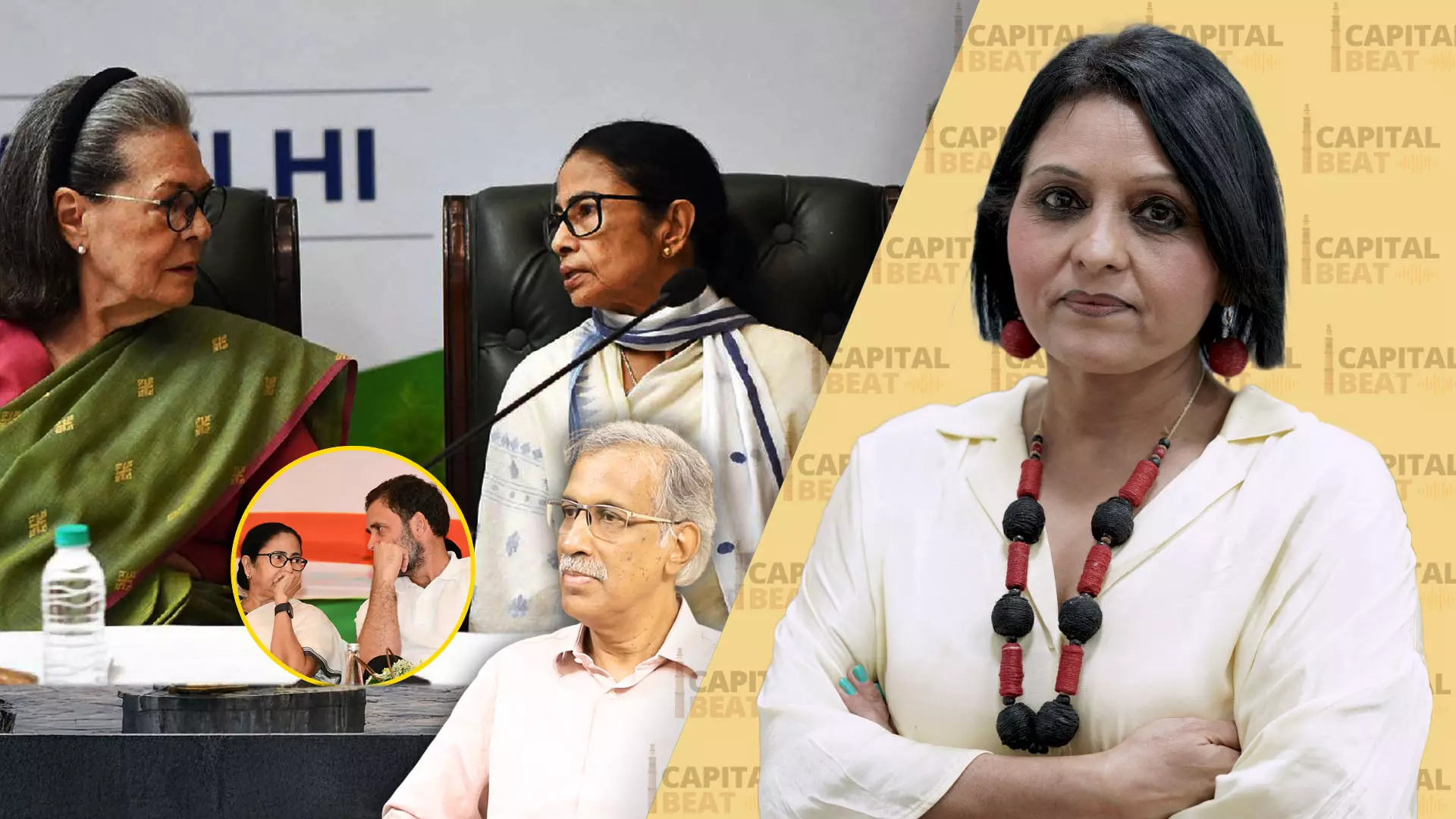
What went wrong for Mamata Banerjee and what lies ahead for TMC? | Capital Beat
As MPs and MLAs continue to desert Mamata's TMC after its Bengal poll rout, The Federal's editor-in-chief breaks down what went wrong and what may come next

As Mamata Banerjee's Trinamool Congress faces its worst internal crisis since its founding, with rebel MPs and MLAs jumping ship nearly every day, the Congress has denied merger talks, and the question of who leads the TMC's future — or its ruins — remains unanswered.
As the TMC's political crisis deepens with each passing day—from the scale of the BJP's sweep in West Bengal to Kalyan Banerjee's explosive outburst against Abhishek Banerjee—S Srinivasan, Editor-in-Chief of The Federal, offered a sweeping assessment of what went wrong for Mamata and what lies ahead in this Capital Beat special episode.
Excerpts from the interview:
Congress General Secretary KC Venugopal today denied reports of a TMC-Congress merger, calling them rumours. But the closed-door meetings between Sonia Gandhi and Mamata Banerjee, and then Abhishek Banerjee and Rahul Gandhi, raise questions — what is Mamata planning? And can she stop the exodus within the TMC?
It's a pretty tough situation for Mamata Banerjee. She wouldn't have imagined that this entire election would end up the way it has. She is currently in a very, very difficult situation — between a rock and a hard place.
If you do a quick analysis of what happened, before the election, people thought Mamata would scrape through. There was a feeling that her support among women was intact, that some anti-incumbency had outlived its shelf life, and that she would be able to overcome it. That was the expectation. But the results showed something else. Despite campaigning extremely hard, the outcome was very different — BJP swept over 200 seats and is firmly in place now.
Also read: Mamata Banerjee alleges BJP rigged counting in 177 Bengal seats
What we're seeing is a very different kind of politics breaking out in West Bengal. In the past, the Congress held power for three decades, then the Left for more than three decades, and then Mamata Banerjee for more than 15 years. There's a cycle here, a certain shift that has happened.
And Mamata is being hit hard for two or three specific reasons. One is what they call tolabaji — haftabazi in the North — which is essentially extortion, cut money. Many of the cadres who shifted from the Left to the Trinamool brought with them the same rent-seeking culture they practised earlier. It became so excessively problematic that people grew tired of it and replied in very strong terms at the ballot box.
The other thing is this culture of violence, corruption, and opportunism. All the bad elements you can imagine in politics seem to have come together for her at once. For a leader like Mamata, who carried so much self-confidence and belief in herself, to see it all come unravelling so quickly is really very difficult.
In the assembly, she did manage to hold 80 seats. But now there's a split, with around 60 MLAs going to Ritabrata Banerjee, who has been recognised as Leader of the Opposition. Then there are splits in the parliamentary party too. What is really happening?
In the Assembly, at least she had 80 MLAs, which would have given her a respectable place in the Opposition, with the BJP having over 207 seats. But what has happened now is that with the split in the legislative party — at least 60 MLAs going to Ritabrata Banerjee, a former CPI(M) member who joined TMC and has now broken away and been recognised as Leader of the Opposition — that has changed things significantly.
Also read: Why urban women and middle class turned their back on Mamata Banerjee
Then you saw a split developing in the parliamentary party in Delhi as well, with Rajya Sabha members stepping away. And about 100 councillors from seven municipalities have also expressed their displeasure. Many of them are pointing fingers squarely at Abhishek Banerjee, Mamata's nephew.
When she came to Delhi for the INDIA bloc meeting, she was very quiet. Sonia Gandhi tried to pacify her — made her sit next to her, hugged her. Sonia was behaving more like a mother figure, trying to give assurance rather than putting down a defeated leader. I think the same dynamic continued when Mamata later met her again.
I think at this moment, though there is a lot of speculation about the future of Trinamool Congress and Mamata Banerjee, she is in a state of shock. The fall has been really, really big. Someone who has been fighting from the streets is now, literally, back in the streets. Something she built from the ground up with a lot of hard work, sweat, and labour, has come unravelling so fast.
Congress denied the merger reports today through KC Venugopal. What does the party's approach tell us? Is it a calculated move, weighing the pros and cons — including what one Bengal Congress leader reportedly called "mixing drainage water with clean water"?
That colourful analogy captures something real. The problem with Congress is how it would manage a merger question at all. I feel it is premature to talk about a merger. It is very, very far off.
In our own reporting, I read that a Congress leader said, with a certain pride, that the push for a merger actually came from Mamata Banerjee herself. That is significant — because barely a year ago, Mamata was the one putting spokes in the INDIA bloc itself. She was playing hard to get. For someone to now be seeking a merger is a big admission.
Also read: A century and counting: List of key TMC leaders arrested in a month of new Bengal regime
But look at the legal problems alone. TMC is in no position to do anything right now because the MLAs and MPs who have broken away are still formally constituents of TMC — they have formed a separate group but have not yet resigned and gone over to the BJP the way the Aam Aadmi Party members did. For a merger to happen, there need to be both a split in the legislative party and a split in the political party, and the latter has to be formally endorsed. That condition has not yet been met. So this is very much a status quo situation — both sides watching.
Legally, that step is still slightly far off. In the assembly, Ritabrata has been given the Leader of Opposition status and is sitting as a separate group. But the formal political split hasn't happened yet.
Just before we came on air, there was a very sharp byte from Kalyan Banerjee, in which he blames Abhishek Banerjee directly — saying "it's because of him that we have lost" and asking not to be treated like a dustbin. What does this anger tell us?
Kalyan Banerjee has raised something Mamata Banerjee has to sort out quickly. A lot of MLAs and MPs are complaining about the highly centralised, almost corporatised functioning of Abhishek Banerjee. They felt completely helpless. Even appointments with journalists had to be cleared through his office. Everything had to go through Abhishek's office.
And here you have Kalyan Banerjee — 45 years in the legal profession, a senior figure in politics — saying, "Please don't treat me as dirt." That is a serious statement.
So there is an opportunity here, in the sense that if Mamata handles this carefully, she might be able to win back some of the MLAs and MPs. It depends on what she does with it.
Also read: Several TMC rebels jumping ship carry baggage: Is 'washing machine' back at work?
That said, I think there are many in this group doing a wait-and-watch, but largely most of them have made up their minds. The blame on Abhishek could also serve as a convenient fig leaf — people need a reason to jump ship, and Abhishek is an easier target than Mamata herself. I'm not saying Abhishek is entirely without fault, but he may also be something of a scapegoat here. Many of these issues, I feel, are beyond redemption.
This is not new to Indian politics, by the way. Suvendu Adhikari heavily resented the rise of Abhishek Banerjee — when Suvendu was made head of the TMC youth wing, another wing was created, of which Abhishek was also made chief, and he eventually took over the whole party. Suvendu resented it, quit, and is today the Chief Minister of West Bengal.
You have a similar example from Tamil Nadu: Vaiko was very, very close to Karunanidhi, but he heavily resented when MK Stalin was being promoted as the heir apparent at his cost. Vaiko had to leave, launch his own party — the MDMK — and he remains bitter about it even today. So this pattern of a powerful nephew or successor figure alienating senior loyalists carries on.
Mamata has to really think through how to sort this out.
You said a Congress-TMC merger would be harakiri for Congress. But now Congress has announced a national agitation — dharnas, protests at the state, block, and national level over the next four to five days. Could Congress use Mamata Banerjee's energy for these protests?
Again, it's a very difficult situation. We have to recognise that the kind of agitational politics Mamata Banerjee practised in West Bengal, or what Lalu Prasad Yadav built in Bihar, has drastically changed.
The younger generation looks at politics very differently. A major reason for that is the rise of social media, the growth of young voters, and the BJP's constant delegitimisation of the political class and the mainstream media. Nobody trusts mainstream television anymore. People are pushed towards social media for information — which is often inaccurate — but they're driven there precisely because of the relentless berating of the media and opposition leaders by the BJP.
Also read: Will Mamata’s TMC follow history? A look at 6 parties that merged with Congress
BJP has also been consistently telling people that everyone — whether Mamata Banerjee, Rahul Gandhi, RJD, or state parties — is corrupt, doesn't work for the nation, and is only lining their own pockets. What has now happened is a certain generalised distrust of the political class, which is not a healthy situation. In West Bengal, it is even worse — post-election violence, eggs and shoes being thrown — all of this is looked at with revulsion by the new generation of voters.
So bringing in Mamata Banerjee to change the situation would be premature thinking. Congress will have to re-imagine its own politics. It's not business as usual. Whenever something big happens, Congress tends to announce a nationwide agitation and then it is forgotten. That's not how it works. It has to be done on a sustained basis.
The only new development for Congress in the last two weeks is a certain momentum — but it's still far off. They have to build their state units. Their state leaders have to get their act together.
And let's not forget that at the INDIA bloc meeting, at least two or three senior leaders raised the issue of the arrival of the Cockroach Janta Party. On its own, it may not amount to much, but it is a serious indication of something wrong with the political system. The youth is genuinely dissatisfied. That should worry the Opposition. I'm sure it worries the ruling government too.
Some sections of the media are talking about an end game for Mamata. There's also speculation that Sharad Pawar might return to Congress. Do you see these regional leaders returning to the Congress fold?
These are largely media speculations. Congress, which was seen as untouchable within the INDIA bloc and viewed with deep suspicion, has come some distance from that. But they first have to get their own act together.
Also read: TMC moves Calcutta HC against Speaker’s recognition of Ritabrata Banerjee as LoP
Look at every state unit of Congress — there are far more divisions and dissensions within their own ranks than from outside. What happened in Kerala, what happened in Rajasthan, what's happening in Punjab — you see the same thing: Congress is a faction-ridden party. People haven't forgotten the corruption at high places that preceded the BJP's rise to centre stage.
If they have to mount a meaningful agitation, it certainly helps to have big leaders on their side. If Sharad Pawar joins, if Mamata Banerjee joins, if MK Stalin and other leaders strengthen the INDIA bloc, that will certainly help their cause. But as of now, all of this looks like wishful thinking because there is still no cogent idea of what issues to take up, what platform to build.
There is a certain immediate sense of urgency — Congress did hold agitations at various places following the NEET debacle — but it was not widely covered. Media shuts out these things. That is a challenge. They have to address it.
Quick solutions — thinking "let's bring in Mamata's energy, use her, and then agitate" — these will not work.
One last question: Among the rebel TMC MPs, who do you think would stake a claim to lead this breakaway faction?
That's an interesting question, because what you're getting at is that — unlike in Maharashtra, where Eknath Shinde emerged very clearly against Uddhav Thackeray — there is no clear leader of this breakaway faction as yet.
It hasn't reached that stage because Mamata Banerjee was always an overarching figure who handled everything. We haven't seen anyone emerge from beyond her shadow. But I'm sure they have done some thinking on this, because all of these things are being orchestrated from behind the scenes. The BJP is very much involved. They must have figured a way to handle the leadership question.
Also read: Shatrughan Sinha rejects TMC rebellion, vows loyalty to Mamata Banerjee
And there is another factor. Many of the rebel leaders, as we have reported at The Federal, have serious cases against them — criminal cases, corruption cases. That is a Damocles's Sword hanging over their heads. They are not in a position to be overly selective. So this is not a genuine ideological breakup of a political unit from its mother party. It is very much opportunism. And therefore, I'm sure it can be managed.
The headache of figuring out leadership is one for the people sponsoring this from behind the scenes to solve — not an insurmountable problem for those with the BJP's washing machine at their disposal.
(The content above has been transcribed using a fine-tuned AI model. To ensure accuracy, quality, and editorial integrity, we employ a Human-In-The-Loop (HITL) process. While AI assists in creating the initial draft, our experienced editorial team carefully reviews, edits, and refines the content before publication. At The Federal, we combine the efficiency of AI with the expertise of human editors to deliver reliable and insightful journalism.)