Before celebrating the Women's Reservation Bill, every party must answer for decades of broken promises, proxy candidates, and all-pervasive muscular misogyny
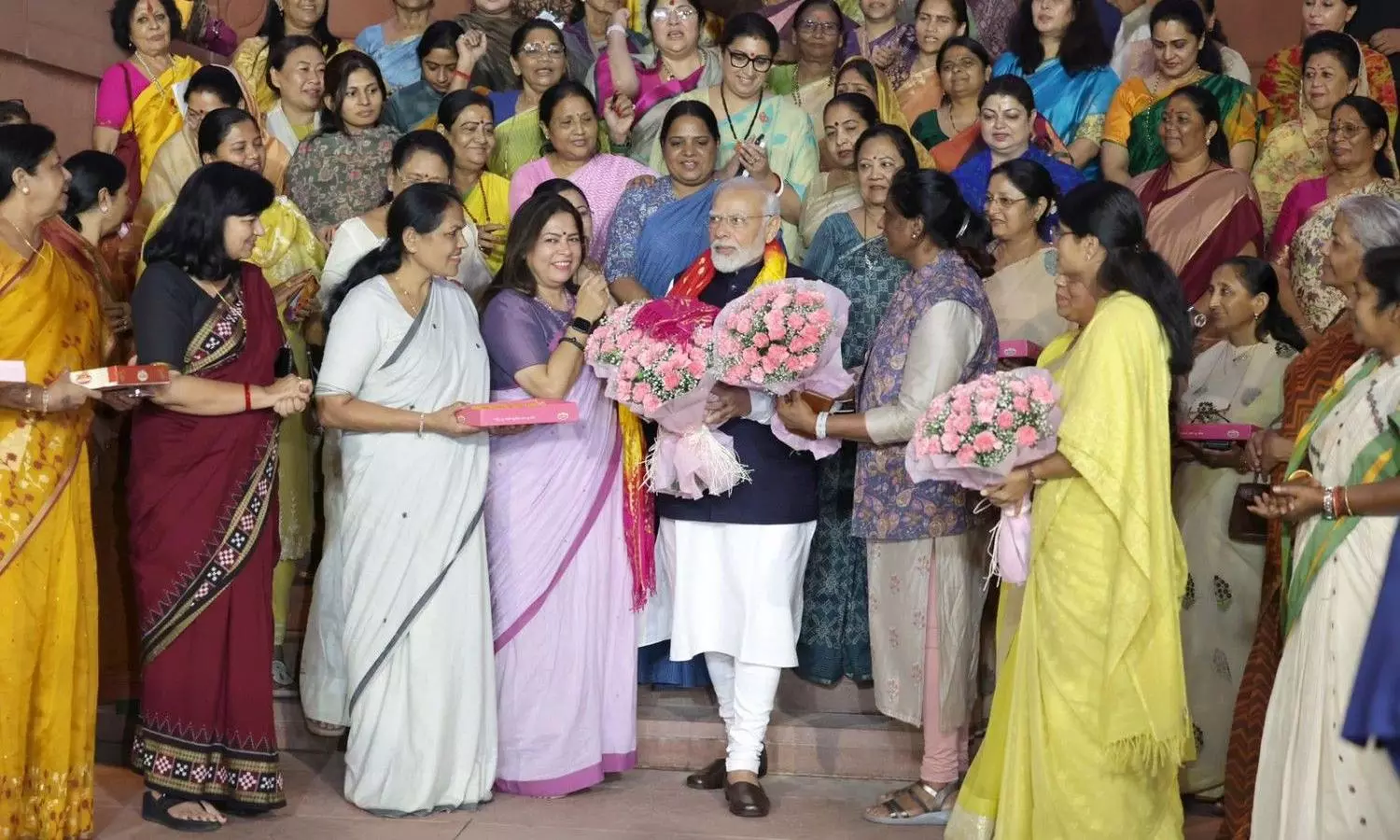
Now that Prime Minister Narendra Modi has been declared by a woman MP of his party as "the only flag bearer of feminism", and he has not hesitated to promote himself as the saviour of all Indian women, we need to trace another history.
Prior to this, we may remind ourselves, his party in government had ‘saved’ Muslim women from Muslim men, when Triple Talaq was criminalised, even after it had been declared legally invalid.
Phogat, Manipur, Hathras
We need to remind ourselves too, of the innumerable times in the past decade when he chose to look the other way when women complained of being molested by men in power (for example, Vinesh Phogat), was tardy in his response to the humiliation of women in times of ethnic strife (for example, Manipur), and has shown not the slightest qualm when his own ‘double engined’ government in Uttar Pradesh decided to deal viciously and heartlessly with women who had been raped and killed (for example, the Hathras rape victim and her hasty cremation).
Also read: Why BJP’s ‘women insult’ pitch may not work in Bengal: 'Not primary concern' | AI With Sanket
Never mind the recent forceful assertion by the Centre in the Supreme Court that women must continue to be governed by community norms, instead of constitutional provisions — an alternative morality that would grant them basic equalities in rights to worship.
Perhaps the women members of his party feel that these are but small sacrifices to be made on the way to the true ‘feminist’ victory, a full 30 years after the first women’s reservation bill was introduced, in 1996.
TMC has conspicuously been the only party to put up a significant number of women candidates, leading to an arguably higher percentage of about 14% of women in the Bengal legislature of 2021. Elsewhere in India, the numbers have been dismal.
As feminists, it will not do to merely point to the rich ironies in political statements and claims, particularly those of the party in power. As feminists who have closely followed the multiple ways in which women’s reservations have been blocked, allowed to lapse, or finally passed not as rights but in the name of ‘honouring’ women, it is time to trace another history before asking important questions.
Towards Equality report
In the landmark Towards Equality report of 1974-75, the Committee on the Status of Women in India decided against a demand for reservations in state legislatures and Parliament, despite its recognition of the very poor representation of women in elected bodies.
It cautiously recommended reservations in local bodies, including possibly statutory women’s panchayats, but as a ‘transitional measure’. But it did make an interesting suggestion — that political parties must commit to fielding women candidates, beginning with 15 per cent and gradually increasing that proportion. This is exactly what most parties from left to right have steadfastly refused to accept or attempt.
Also read: Beyond empowerment, India needs women leaders for its own good
The 1996 bill followed a few years of experiments with reservation of seats for women in local bodies, following the important 73rd and 74th amendments. Studies repeatedly showed that not all (or even a significant number of) women were proxies (as was carelessly insinuated each time political assessments of women candidates were made by parties reluctant to support women), and that the family was as crucial to the ‘success’ of both male and female political aspirants as the party itself.
In states such as Karnataka, women representatives even occasionally exceeded the 33 per cent reservations.
Male OBC leaders' misogyny
But the 1996 bill was stymied by the torrent of misogyny that flowed from male OBC leaders who viewed this as a sly plot of bal kati (savarna) women to steal the fruits of robust OBC political gains in these bodies. When the bill was finally passed in 2010 in the Rajya Sabha, it was allowed to lapse before being presented in the Lok Sabha.
Even local political mobilisation, as in neighbourhoods which are the recruiting ground for political participation at higher levels, remains resolutely muscular, masculine and misogynistic.
In the tumult that has followed the latest attempt of the BJP and the government led by it to use women’s reservations as a ruse to sneak in the controversial delimitation plan, there is one set of questions that needs to be asked of all political parties, from right to left.
Mamata Banerjee’s Trinamool Congress (TMC) has conspicuously been the only party to put up a significant number of women candidates, leading to an arguably higher percentage of about 14 per cent of women in the Bengal legislature of 2021.
Also read: Nari Shakti: A convoluted stratagem to preserve male dominance
From Kerala to Uttar Pradesh, from Karnataka to Gujarat, the record of putting up women candidates has been abysmal. What has stopped those parties whose hearts are haemorrhaging today for women’s rights, such as the BJP, from taking the risk, and indeed the pains, to field a larger proportion of women candidates?
What stopped the others?
All political parties (TMC excepted) thus far have seen the process of elevating women to political office as an expensive political liability. Fielding women candidates in legislatures and Parliament can happen only when this liability is enjoined by law, i.e., when it burdens all parties equally. Even cadre-based parties such as the CPI(M) and the BJP have therefore resisted strongly any attempt to recast the political process by nominating more women to the electoral process until a law is passed.
Meanwhile, even local political mobilisation, as in neighbourhoods which are the recruiting ground for political participation at higher levels, remains resolutely muscular, masculine and misogynistic. If Bengaluru’s flexi-boards are any indication, the city is visually awash with crowds of males commemorating temple events, festivals, birthdays, and even road-building efforts.
The local body reservation experience teaches us that only legislation will challenge and change that visual culture, if not political discourse itself.
(The Federal seeks to present views and opinions from all sides of the spectrum. The information, ideas or opinions in the articles are of the author and do not necessarily reflect the views of The Federal.)