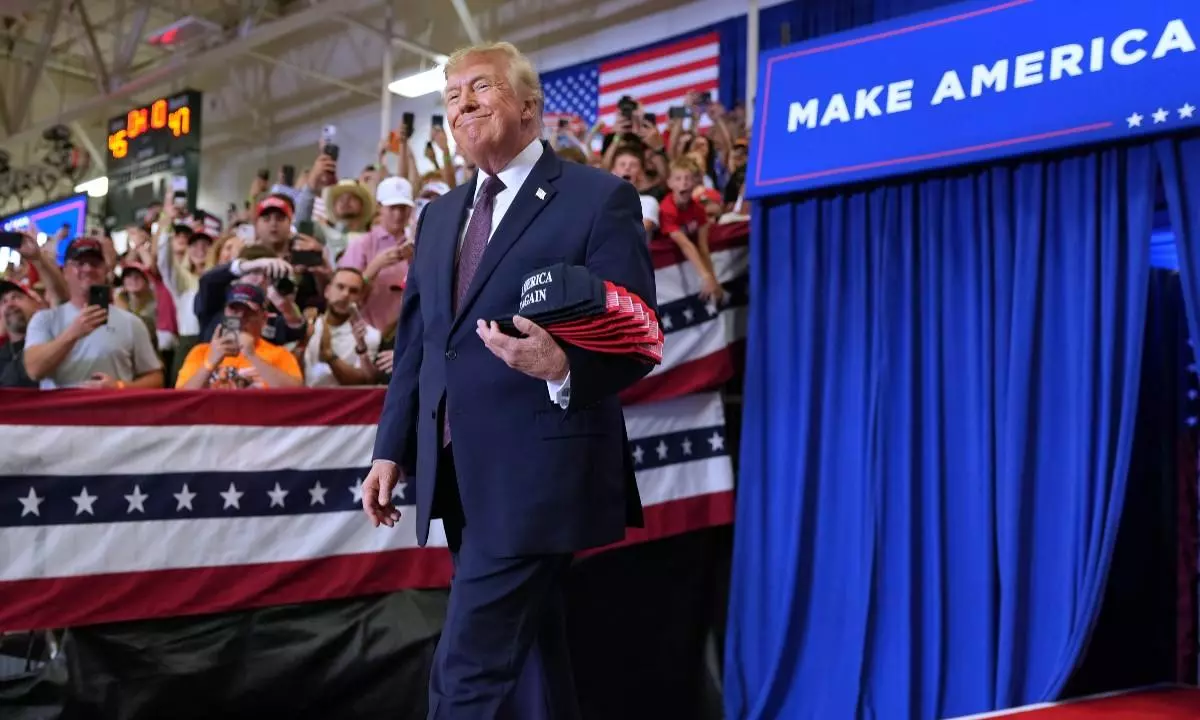
The war against Iran has been the most prominent issue with US opinion polls giving a thumbs down on Trump’s decision to strike Iran
Beyond the US mid-term elections scheduled for Tuesday (November 3), the bigger question is whether President Donald Trump will resume military strikes on Iran after the results.
Conflicting messaging has emerged from the White House, with Trump sending a mix of messages that effectively keeps all options open. Results will start to come in as the last of the polling ends tomorrow. In the next few days, the world will witness whether Trump’s goose is cooked or he emerges unscathed, which looks unlikely going by trends.
Usually, mid-term polls focus on US’s internal issues. This time, however, foreign policy has taken over. The war against Iran has been the most prominent issue, with opinion polls giving a thumbs down on Trump’s decision to strike Iran and the way he has handled it. Around 60 per cent have reportedly expressed themselves against the war.
Iran war major factor in mid-term polls
The Iran war has turned into a major factor as it has pushed up gas prices across the US and brought in an overall rise in costs of essential commodities, touching every American voter. And, Trump contrary to promises of ending the war soon after he launched strikes on Iran end-February, the conflict has dragged on.
Also read: Trump and the US midterms: A political asset or liability for Republicans?
The question is: what will determine Trump’s decision on resuming attacks on Iran? If the Republicans manage to somehow hold on to their majority in the Senate and House of Representatives, the two arms of Congress, would that embolden him to continue US strikes on Iran?
Alternatively, if the Republicans and, by extension, Trump lose control of both houses of Congress, will that deter him from resuming the strikes? Or, will he anyway go ahead and attack Iran as he and his party have nothing to lose politically for the time being?
The Congress, under the Democrats, can prove to be an impediment to Trump but the US presidency is extremely powerful and there are ways by which he can work around the disadvantages to continue what he wants to.
As commander in chief of the US armed forces, Trump has the power to continue the war without Congress authorisation if he terms it a “limited war”. The newly-elected Congress takes office only in January next year. Until then, under the existing Republican-majority Congress Trump is free to continue the war.
Israel's hung parliament
But another factor has cropped up – the hung parliament in Israel and the inability of prime minister Benjamin Netanyahu to gain a majority for his ultra right-wing coalition. While the situation there is still a work in progress, the victory and emergence of a sizeable Israeli-Palestinian bloc of 19 members in the Knesset has skewed Netanyahu’s plans.
Also read: Maldives' Islamabad handshake is a warning India cannot ignore
It is entirely possible that Netanyahu’s opponent Gadi Eisenkot will join his rival to form a national unity government, if only to keep out the Arab bloc from getting into the next government. This will be possible if Eisenkot joins hands with either of the two Arab parties who together won 19 seats.
Popular pressure within Israel is for Eisenkot to replace Netanyahu as he faces corruption charges. Prior to the October 7, 2023 Hamas attack, there had been a widespread upsurge within the country against Netanyahu’s perceived attempts to bring in laws that would weaken the independence of Israel’s judiciary.
Ideologically, both Netanyahu and Eisenkot are considered on the right wing and have similar views on most issues of foreign policy, including Gaza, the Iran war and other security issues.
Strait of Hormuz issue
But, will Eisenkot want Trump to continue military strikes on Iran? Eisenkot has indicated that he is for attacking Iran only if there is a clear threat that Tehran is planning to attack Israel. In which case Trump, if he decides to strike Iran, may not have a Netanyahu-like backing of Israel, if Eisenkot takes over.
If Netanyahu manages to somehow cling on to power by manipulating opposition parties loyal to Eisenkot then Trump will have a ready partner if he strikes Iran. Either way, Trump is likely to see a non-Netanyahu government in Israel only as an impediment that he can afford to ignore.
Also read: Vivek Ramaswamy: The ambitious Indian-American eyeing Ohio’s governorship
Parallelly, the Gulf states along with Iran and mediators including Qatar, Pakistan, Egypt and Turkey have been meeting over the last two days trying to convince Iran to work out an agreement with the US that will enable the full opening of the Strait of Hormuz.
If they succeed in persuading the Iranian negotiators, the possibility of war will recede considerably as it will immediately ease the economic situation around the globe. Simultaneously, the Iranians and the Trump administration have exchanged proposals with each other to open the Hormuz strait.
Iran’s stand is that any deal should include a permanent ceasefire and not limited to just the opening of the Hormuz Strait. On the other hand, the Trump administration has insisted that Iran first let go the Strait, enable free commercial traffic and later follow up on other negotiations including dismantling Iran’s nuclear programme to achieve lasting peace.
While there are a multitude of factors that look to play a part in the eventual outcome of a US decision on resuming strikes against Iran, the moot question is how important any of these are.
Iran, knowing fully well that Trump is capable of taking the most outlandish action has already indicated it is prepared to face another attack. Top Iranian military officials say they have learnt their lessons from the first two rounds of missile strikes (in June 2025 and February 2026) and are ready to confront more effectively if there is a third.
Two options for Trump
Trump, meanwhile, realises how unpopular his war with Iran has been within the US. If he resumes the attack, he loses nothing as he cannot contest again for president under US laws, but risks a bigger loss for the Republican Party.
In fact, there are reports that sections within the Republican Party could revolt against Trump if he resumes the war with Iran after the election results. Already, a few candidates in the mid-term election campaign have publicly expressed their opposition to Trump’s war on Iran, including Iowa’s Ashley Hinson and Mike Rogers from Michigan. Many Republican lawmakers and nominees, including David Valadao from California and Max Miller from Ohio, have skipped Trump’s mid-term convention and other election rallies, where the president was on stage.
There are two options for Trump. One: ride the wave of unpopularity and try to turn it around in his favour by resuming the war and proving he was right to go on the offensive in the first place. Two, back down in the face of a mid-term loss and try to salvage at least some hope for the Republican Party that enabled him to American presidency.