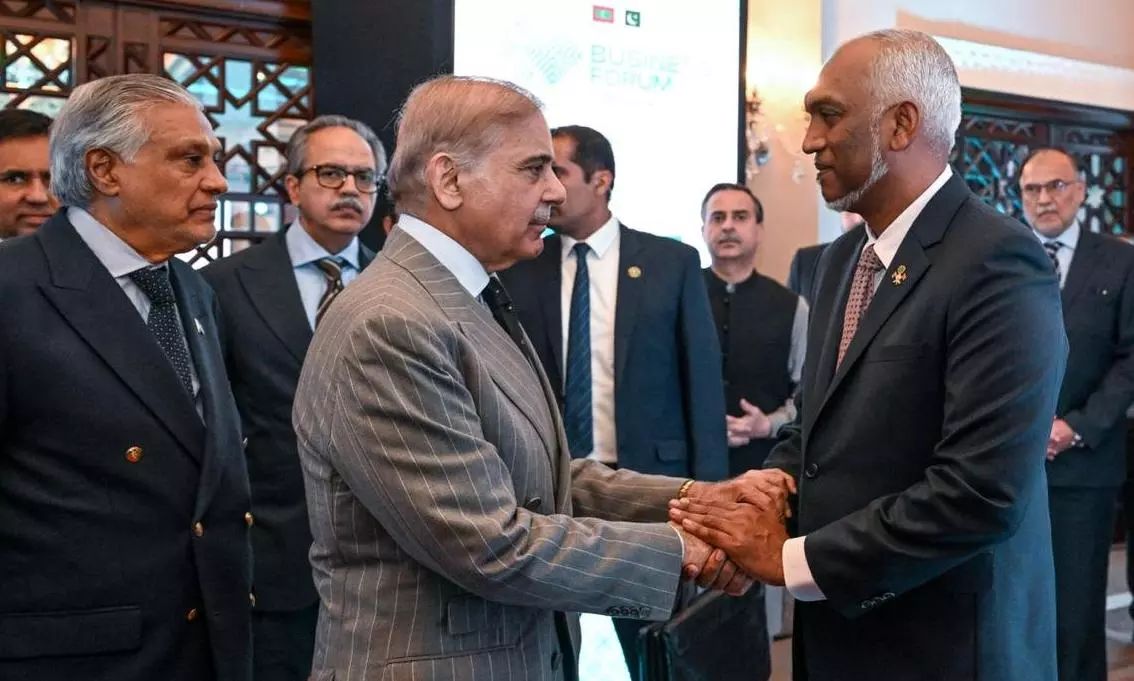
The Maldivian president's visit to Islamabad signals a wider effort to diversify partnerships, with 20 MoUs covering defence, trade and technology and renewed calls for SAARC revival. File photo of Maldivian President Mohammed Muizzu (right) and Pakistan Prime Minister Shahbaz Sharif (left) during the former's visit to Pakistan. Photo: X/@MMuizzu
Muizzu’s Pakistan outreach and the two defence MoUs underline why New Delhi must sustain its diplomatic, economic and security engagement with its strategically placed neighbour
Maldivian President Mohammed Muizzu’s recent visit to Pakistan, the first by a Maldivian head of state in over a decade, would have set alarm bells ringing in New Delhi. His outreach to Islamabad carries serious geostrategic implications for India, given its deep stakes in the strategically located Indian Ocean archipelago.
As part of his efforts to diversify the archipelago’s partnerships and forge close economic ties with countries beyond India and China, Muizzu has assiduously courted Islamic nations since taking office as President. Before Pakistan, he visited Turkey, Malaysia, Qatar, UAE, Saudi Arabia, Bangladesh and Azerbaijan.
‘Maldives First’ Policy
Muizzu is pursuing a policy of ‘Maldives First’ to prioritise national benefit as well as sovereignty. Amid this push by Malé to shore up ties with other nations, with economic cooperation being the lynchpin, India faces a precarious shift that threatens its long-held position as the archipelago’s primary security and development partner.
Also read: PM Modi announces $565 mn line of credit for Maldives
Straddling vital commercial sea lanes, Maldives lies just 70 nautical miles away from Lakshadweep’s southernmost island, Minicoy, and 300 nautical miles from India’s west coast.
Islamabad rolls out red carpet
Invited by Pakistan Prime Minister Shehbaz Sharif on a state visit, Muizzu was effusive about his desire to “move the Maldives-Pakistan partnership into a new era: one that is broader, more dynamic and more beneficial to our peoples” during his visit. Muizzu, who described Pakistan as a “trusted friend” for six decades, also said their bilateral ties are “rooted in deep fraternal affection and, above all, in the enduring bond of our Islamic faith”.
Pakistan, equally eager to embrace the Maldives, rolled out the red carpet for Muizzu, with Pakistan's top leadership calling on him. During his three-day visit, the two sides signed as many as 20 MoUs across sectors from defence, agriculture and education to health, fisheries, IT and AI.
Trade and strategic stakes
During Muizzu’s visit, the two sides set an ambitious bilateral trade target of $200 million over the next two years, a quantum leap from the existing $13 million. Economic imperatives and a desire to move away from the Maldives’ traditional dependence on India and China are driving Malé’s embrace of Islamabad, seemingly at the expense of India’s security interests. With India already having to grapple with an ever-growing Chinese footprint in the archipelago, the possibility of a China-Pakistan nexus in the Maldives will only queer the pitch further for it.
Also read: Explained: All about Chagos Islands, UK-Mauritius deal, and India’s role
Even if Pakistan lacks the economic capacity to meet Maldives’ financial ambitions, it can join forces with China to counter Indian influence or leverage its deepened access to stoke security challenges in India’s maritime backyard. It’s noteworthy that Pakistan’s powerful military chief Field Marshal Asim Munir too paid a courtesy call on Muizzu during his visit.
Of immediate concern are the two defence MoUs signed during the visit. While one is broad in its remit for deeper defence cooperation, the other is for specific maritime security cooperation. While the details remain undisclosed, these pacts threaten to erode India’s traditionally strong security architecture in the region.
Another concern is over growing extremism in the Maldives, which is being fuelled by countries like Saudi Arabia, Pakistan and Egypt. Islamic radicalisation in the country, once known for its ‘Dhivehi’ culture and tolerant practices, has had many foreign governments, including India, worried. Maldivian students returning from institutions in Saudi Arabia and Pakistan have been known to be exposed to radical ideologies.
SAARC revival push
Muizzu's choice to raise the revival of the South Asian Association for Regional Cooperation (SAARC) while in Pakistan would also have irked New Delhi. He referred to its potential and the importance of “rebuilding trust and fostering meaningful dialogue among member states”.
The sub-regional grouping has been effectively dormant since 2016 when its leaders' summit was to be hosted by Islamabad. This followed a boycott spearheaded by India and supported by three other SAARC nations - Afghanistan, Bangladesh and Bhutan - scuttling the summit.
Also read: SCO and BRICS, yes, but is it time for India to revive SAARC?
India was then seeking to diplomatically isolate Pakistan in the subcontinent following the Uri terror attacks, efforts for which have only strengthened after the Pahalgam massacre in April last year. Since SAARC works on the basis of consensus, the grouping has been comatose for the last decade.
Ties with Delhi
Capitalising on the visit, Pakistan also used Muizzu’s presence to rake up the Kashmir dispute and the Indus Waters Treaty, which India has kept in abeyance, during his meeting with Sharif.
On the surface, the Muizzu government, which rode to power on an ‘India Out’ campaign, has maintained cordial ties with New Delhi after initial friction over Indian military personnel operating aircraft and helicopters in the archipelago. Subsequently replaced with civilian personnel, New Delhi-Malé ties have been relatively stable even though the Muizzu government has discarded the ‘India First’ policy followed by two of its predecessors, Mohamed Nasheed and Ibu Solih, both from the Maldivian Democratic Party (MDP).
The signalling by the Muizzu government is unequivocal – the Maldives is no longer hesitant to sidestep India’s strategic interests. For India, retreat is not an option. In a region where Beijing and Islamabad are eager to exploit any opening, India must double down on its diplomatic, economic and security engagement to safeguard its strategic presence in the Indian Ocean Region.
(The Federal seeks to present views and opinions from all sides of the spectrum. The information, ideas or opinions in the articles are of the author and do not necessarily reflect the views of The Federal.)