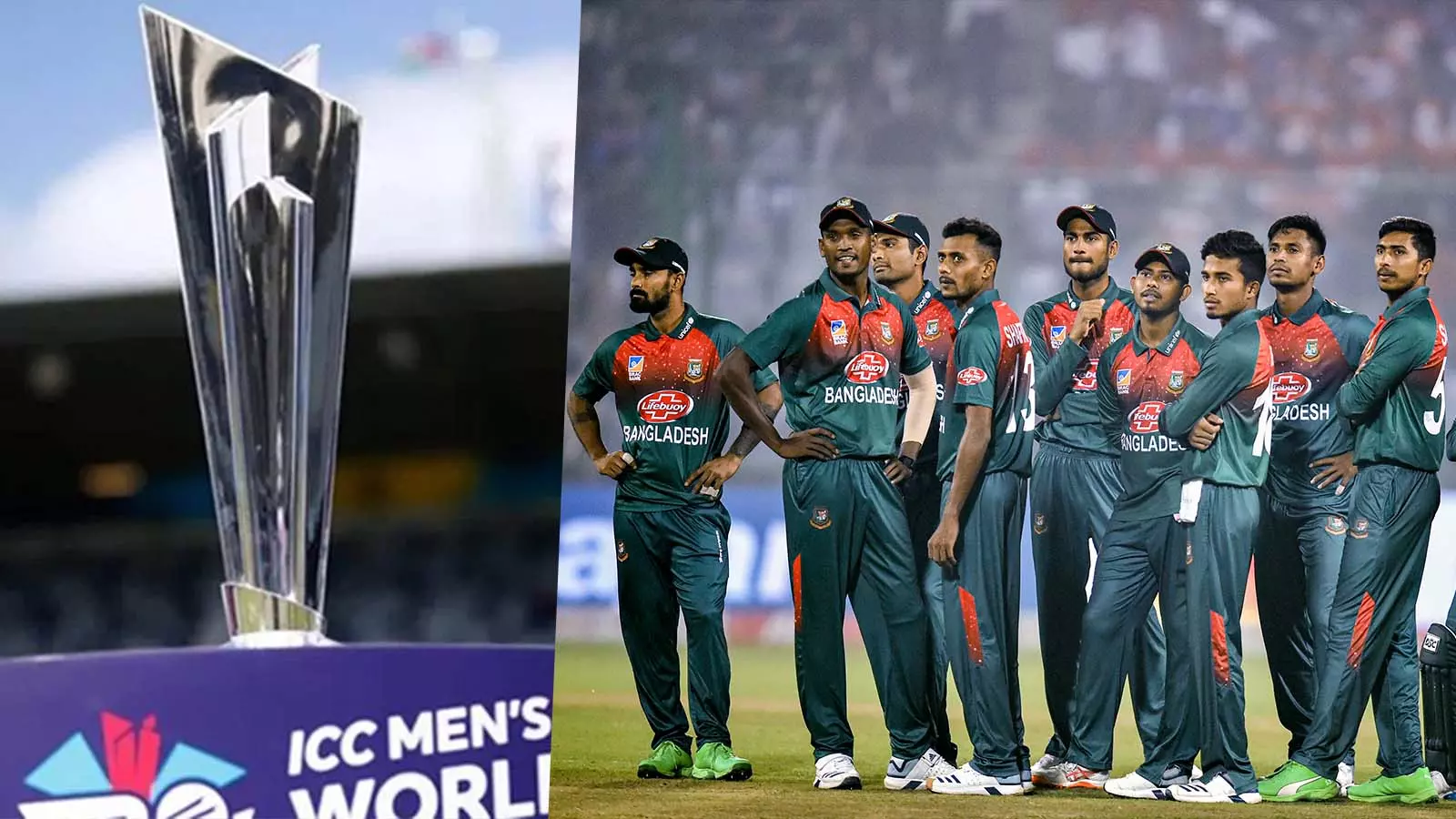
A World Cup hijacked by politics: At the heart of the disruption lies Bangladesh’s dramatic removal from the tournament and their replacement by Scotland at the eleventh hour. File PTI photo
Bangladesh’s exclusion, Pakistan’s doubts, ICC’s reactive governance - build‑up to T20 World Cup has been defined more by politics not by squads and strategy
Australia is carefully managing fast-bowling workloads, ahead of the ICC Men’s T20 World Cup 2026, with lingering fitness concerns around Pat Cummins and Josh Hazlewood shaping their final plans.
South Africa is anxiously monitoring David Miller’s recovery even as their squad absorbs late injury setbacks. England, meanwhile, are touring Sri Lanka, using the series as a high-intensity rehearsal under subcontinental conditions, fine-tuning combinations and roles just days before the tournament.
But if you have barely noticed any of this, it is hardly surprising.
Politics dominates
Because the loudest noise around the T20 World Cup has had very little to do with cricket. Instead, the build-up to one of the sport’s biggest global events has been dominated by Bangladesh’s non-participation, Scotland’s sudden inclusion, and suggestions that Pakistan might also reconsider its involvement.
Just days before the tournament begins in a cricket-worshipping region, politics, administration and regional tension have become the headline act.
Also read: T20 World Cup 2026: Full schedule, groups, venues, format after Bangladesh exit
With less than two weeks to go, the focus should firmly be on squads, strategies and anticipation among fans across the world. A World Cup is meant to narrow the conversation to form, match-ups and possibility. Instead, cricket’s biggest T20 spectacle has arrived under a cloud of uncertainty.
A World Cup is supposed to be a moment when governance fades into the background and the game takes center stage. This time, that separation has not held.
Bangladesh's removal
At the heart of the disruption lies Bangladesh’s dramatic removal from the tournament and their replacement by Scotland at the eleventh hour.
The sequence of events is now well known. Bangladesh refused to travel for scheduled matches in India, citing security concerns and pressing for neutral venues. After prolonged discussions and its own assessments, the ICC rejected the request, enforced the original schedule and ultimately exercised its authority to exclude Bangladesh when confirmation was not forthcoming.
From a sporting standpoint, the optics are deeply troubling. A full-member nation being removed weeks before a World Cup is almost unheard of in modern cricket. The decision triggered criticism from former players and administrators, raised questions about precedent and process, and even within Bangladesh sparked debate over whether the board had misjudged the situation and harmed its own players in the process.
For the players themselves, the loss is deeply personal. For younger Bangladeshi cricketers on the fringes of global recognition, a World Cup is a career-defining stage, a chance at visibility and momentum that may not come again. Years of preparation, selection battles and planning have been erased by an off-field standoff they had no control over.
Blow to fans
Scotland’s inclusion, while deserved and uplifting for Associate cricket, carries an unavoidable undertone. Their players will rightly embrace the opportunity, but their presence also serves as a reminder that this World Cup has been shaped as much by off-field turbulence as by sporting qualification. It is a subplot born of circumstance rather than performance, subtly altering the tournament’s texture before a ball has been bowled.
But the uncertainty does not stop here. Pakistan’s cricket leadership has expressed solidarity with Bangladesh and hinted at reassessing participation, pushing the narrative further away from cricket and closer to brinkmanship. The ICC’s warning that withdrawals could invite serious consequences only reinforced the sense that governance was driving the conversation in the final days of the build-up.
Also read: T20 World Cup: BCB accepts ICC decision to replace Bangladesh with Scotland
For fans, this has been a strangely hollow lead-in. World Cups are usually accompanied by logistical rituals that heighten excitement, travel plans, accommodation bookings, match schedules pinned to calendars, media contingents mapping venues and storylines.
In South Asia, the anticipation spills into living rooms, offices, tea stalls and late-night conversations. This time, that buzz has been dulled. Amid a world already weighed down by geopolitical crises, wars and instability, regional politics have now bled into cricket as well, leaving little space to simply enjoy the sport.
Cricket has been here before, and the outcomes are rarely clean. The 1996 World Cup was disrupted when Australia and West Indies refused to tour Sri Lanka, leading to forfeited matches that dented competitive credibility and affected broadcast value. More recently, the Asia Cup’s hybrid model in 2025, shaped by political compromise drove up costs and diluted fan engagement.
In each case, the immediate disruption passed quickly. The erosion of trust lingered far longer.
Financial loss
There is also a tangible financial cost to the current episode. Bangladesh’s exclusion carries severe consequences for its cricketing economy.
By missing the World Cup, the board stands to forfeit participation fees, face potential penalties and, most significantly, lose access to ICC revenue tied directly to event participation. Estimates suggest that as much as US$ 27 million, nearly 60 per cent of the Bangladesh Cricket Board’s annual ICC income, could be lost.
This funding underpins domestic competitions, grassroots programmes and infrastructure development. Its absence will ripple through the system long after the tournament ends.
And Bangladesh is not alone in absorbing the fallout. Broadcasters lose one of cricket’s most valuable television markets. Sponsors lose reach and narrative certainty. Players lose visibility and endorsement value tied to the sport’s biggest stage. When a World Cup is diminished by off-field discord then the damage is shared across the ecosystem.
Also read: T20 World Cup row: 'Sad day for cricket, loss for Bangladesh players' | Interview
What makes this moment particularly unsettling is how familiar it feels. Cricket in South Asia has long struggled to insulate its marquee events from non-sporting pressure. Here, cricket is never just a game; it is entwined with diplomacy and power. That reality makes governance clarity even more critical.
Cricket takes a back seat
Yet too often, decisions appear reactive allowing political considerations to bleed into the sport’s most important moments.
The ICC’s challenge, therefore, is not simply to enforce rules but to apply them through a framework that is transparent and consistent. When similar situations appear to be handled differently across teams, perceptions of double standards inevitably follow. In elite sport, perception matters and once trust in neutrality erodes, authority weakens with it.
As the game expands into newer territories, with 20 teams participating in the 2026 edition, it is disappointing that the days before a World Cup have been consumed by confusion rather than excitement. None of this diminishes what will happen once the first ball is bowled.
T20 cricket has a way of reclaiming attention. Matches will thrill, and hopefully new heroes will emerge. The tournament will likely find its rhythm. But it is worth acknowledging how close this World Cup has come to being defined not by cricketing possibility, but by everything surrounding it.
(The Federal seeks to present views and opinions from all sides of the spectrum. The information, ideas or opinions in the articles are of the author and do not reflect the views of The Federal.)