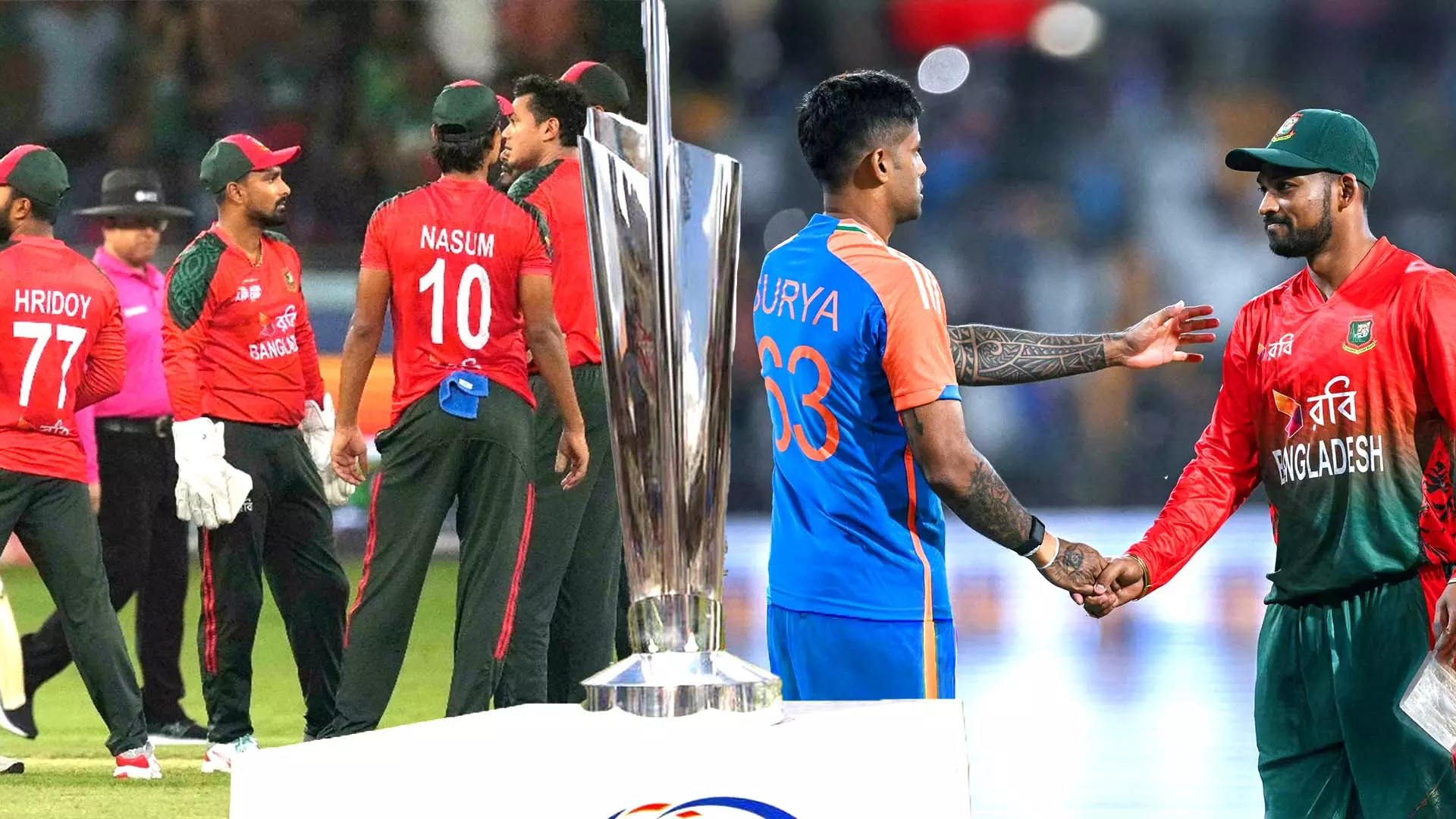
T20 World Cup row: 'Sad day for cricket, loss for Bangladesh players' | Interview
Bangladesh refuse to travel to India for the T20 World Cup, citing security concerns, defying an ICC ultimatum and pushing for a venue shift to Sri Lanka, as questions grow over their fate in the tournament and whether Scotland could step in as a replacement

The Federal spoke to K Srinath, BCCI umpire, to understand the deepening crisis around the ICC T20 World Cup after Bangladesh refused to travel to India, citing security concerns.
With the ICC rejecting Bangladesh Cricket Board’s (BCB) request to shift matches to Sri Lanka, the standoff now threatens to become an unprecedented moment in world cricket.
What is likely to happen next now that Bangladesh has refused to travel to India? Could the ICC remove them from the tournament?
The Bangladesh interim government appears to have taken a self-defeating decision. The biggest losers will be the cricketers, who could miss out on playing in a World Cup, while the Bangladesh Cricket Board stands to suffer major financial losses.
Mixing sport and politics rarely helps. If a political stance is taken for valid reasons, it may still be understandable. But this is an ICC event planned well in advance, involving complex logistics. The venues were finalised a month or two ago, and the fixtures were already announced.
The political turmoil and the reasons now being cited by the Bangladesh Cricket Board — or rather the interim government — do not add up. The claim that the BCCI was not apologetic enough for pulling Mustafizur Rahman out of the IPL makes little sense. The IPL is a franchise tournament run by the BCCI, while the T20 World Cup is organised by the ICC. The BCCI was under no obligation to apologise for asking Kolkata Knight Riders to release Mustafizur Rahman.
These two issues have nothing to do with each other. This standoff represents a huge loss not only for cricket fans worldwide but also for Bangladeshi cricketers, who risk losing a once-in-four-years World Cup opportunity.
Also read: T20 World Cup: Will Scotland replace Bangladesh?
Is there really a security threat to Bangladesh players, given that they are scheduled to play in Kolkata and Mumbai?
Playing in Kolkata would almost feel like a homecoming for Bangladesh, as the city is like a second home to them. Based on media reports and ICC statements, the threat level appears very moderate and low.
The ICC conducts a thorough reconnaissance of all venues, examining every security angle, and had already given a clean chit. Beyond that, it is unclear which advisory board or authority in Bangladesh is raising fresh concerns.
At the ICC meeting, Bangladesh managed to secure only one vote in its favour — from the Pakistan Cricket Board — while all other members voted against the request. This should have made it clear that this was their moment to remain part of the event.
It is now far too late to reshuffle groups or move all Bangladesh matches to Sri Lanka. That would require reissuing visas, reworking logistics, and changing hotel bookings. Wisdom and balance should have prevailed, and Bangladesh should have gone ahead with the tour.
There is little chance of a U-turn from the ICC. All arguments have already been examined, and reversing the decision would pose a massive logistical and legal hurdle. If Bangladesh refuses to budge, it would mark the first time in world cricket history that a full-member nation backed out of a World Cup.
Isn’t this similar to the 1996 World Cup, when teams refused to travel to Sri Lanka? Is politics interfering in sport again?
This is clearly another case of politics interfering with sport.
The Indian women’s team was supposed to tour Bangladesh before the World Cup, but pulled out due to tensions there. India and Pakistan have not played bilateral cricket since 2012 because of government interference, yet they still face each other in ICC events.
Bangladesh’s argument that the ICC allowed India to play Pakistan at neutral venues in the UAE or Sri Lanka does not hold. Those arrangements were based on consensus and formal agreements signed by all boards before the events.
When all boards — including Bangladesh — accepted those terms, objections could have been raised then. They were not. It was naive, and even foolish, to assume Pakistan’s support would be enough to change the ICC’s stand. In the end, Bangladesh received only one vote.
The real victims of this political standoff are the Bangladeshi players.
If Bangladesh pulls out, will Scotland replace them in the T20 World Cup?
From available information, Scotland is the team on standby. One team’s loss will become another team’s gain. Bangladesh was scheduled to kick off the World Cup on February 7 in Kolkata.
It is a sad day for cricket. A T20 World Cup takes place only once every two years. If this impasse continues, it does not bode well for the subcontinent — especially for teams like Bangladesh and Pakistan.
It is high time these issues were resolved. Politics and sport cannot go hand in glove; they must be kept separate.
Sportspersons are true ambassadors of their countries and can help build peace by carrying themselves with dignity abroad. Replacing Bangladesh with Scotland would mark a deeply unfortunate moment for world cricket.
(The content above has been transcribed using a fine-tuned AI model. To ensure accuracy, quality, and editorial integrity, we employ a Human-In-The-Loop (HITL) process. While AI assists in creating the initial draft, our experienced editorial team carefully reviews, edits, and refines the content before publication. At The Federal, we combine the efficiency of AI with the expertise of human editors to deliver reliable and insightful journalism.)