It is an uncharacteristic trial by fire because after having emerged as the primary political pole in Indian polity mainly by espousing the Ram temple’s cause, it is precisely among the supporters of this movement, that faith in the BJP has been badly shaken. The moot point now is whether the party’s adversaries will be able to further hammer the dent in the BJP’s credibility and convert it into a rare political victory.
This issue has roughened up the extremely important intersection of religious sentiment, governance, and institutional trust, with the lines of separation being consciously erased by the BJP and the Centre after the Supreme Court’s judgement in November 2019, which debatably directed the government to establish a body to construct and manage the Ram temple.
The government complied with the decree by establishing the Shri Ram Janmabhoomi Teerth Kshetra Trust in February 2020, a development that linked it symbiotically to the temple, its affairs, and the institutions and individuals connected with it.
Dent in BJP's credibility
Because Prime Minister Narendra Modi personally performed the three rituals which marked the watershed moments in the temple construction’s timeline – foundation-laying ceremony in August 2020, consecration of child Rama’s idol in January 2024 and the flag hoisting ceremony in November 2025, he cannot avoid being intrinsically connected with all the affairs of the temple, including the scams that have hit at its virtuousness.
These developments are likely to play a major part in the assembly elections in Uttar Pradesh and Uttarakhand, due in the first quarter of 2027, a period which will coincide with the much-delayed census enumeration and the Kumbh Mela in Haridwar.
There was some conversation within ruling party circles initially on the feasibility of advancing the polls to late 2026 as the Mela would put security forces under strain, but with the Ram temple’s financial scams surfacing, it is unlikely that the BJP would risk advancing it, as the party is greatly banking on time playing a role in minimising damage from the episode.
In UP, clearly the more important of the two states where the BJP is currently in power, the Ram temple issue hollows out the party’s claim of providing good governance and clean administration.
UP election dynamics
On these two issues, however, the Opposition’s biggest handicap is that in public perception, a significant chunk of people still remain wary of the Samajwadi Party. This is so because the BJP continues to politically milk the charge that Akhilesh Yadav’s government was a synonym for ‘mafia raj’ and that voting for the SP would mean a return to ‘special policing’ and ‘appeasement’ of Muslims.
Although in the 2024 Lok Sabha elections, the SP ploughed the image of having evolved into a party committed to the PDA demographic communities (Pichhde, Dalit, Alpsankhyak – or Backwards, Dalits and Minorities) as against the limited MY combination – Muslims and Yadavs previously, the new profile of the SP is still not universally accepted.
Further, a decade of sustained majoritarian campaigns by the BJP has made it difficult for any party to identify with inclusive politics.
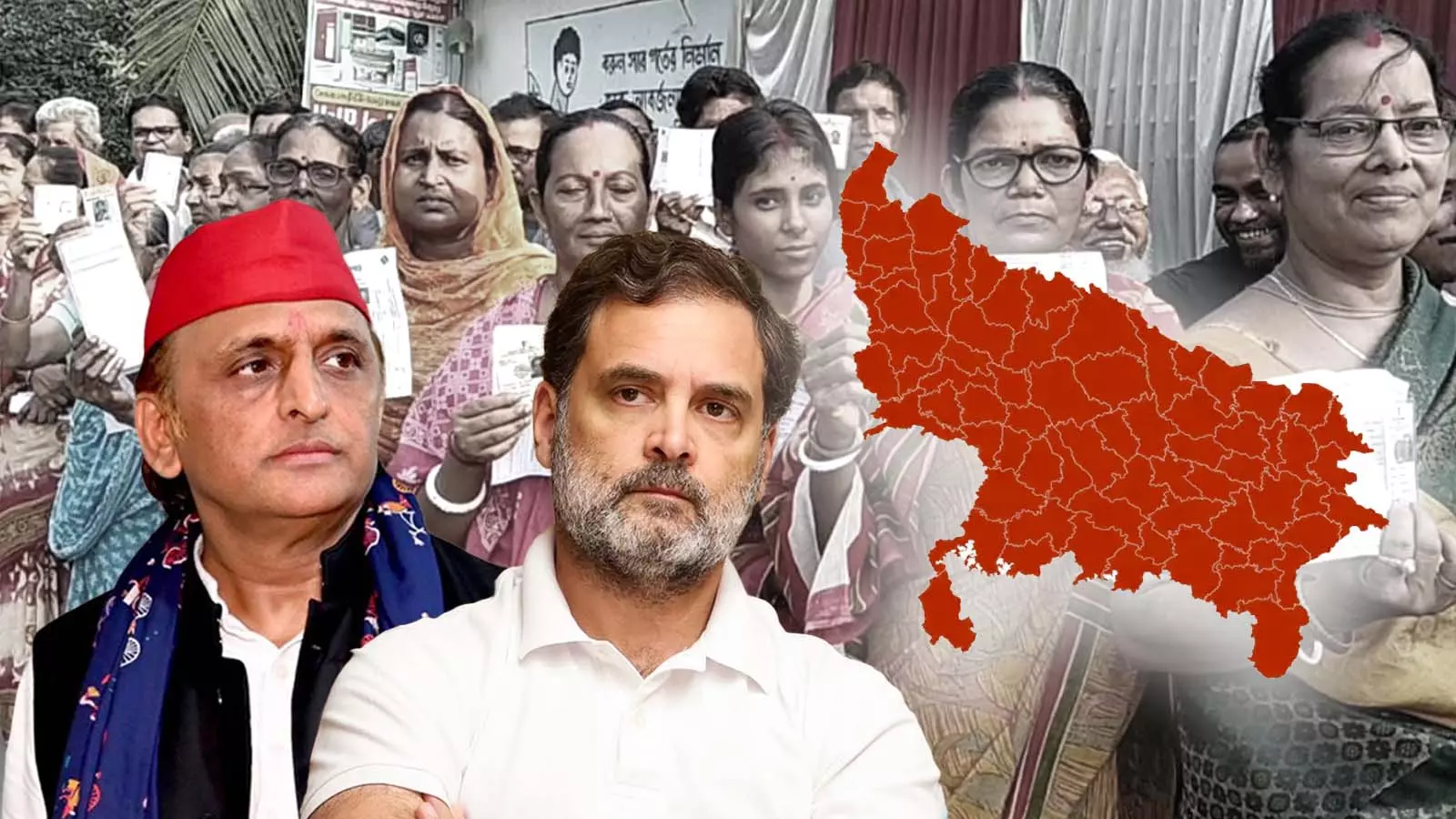
Much of the electoral imagination for 2027 in the aftermath of the Ram temple scandals is based on the SP-Congress alliance unexpectedly winning seven more Lok Sabha seats than the BJP and its allies in the 2024 Lok Sabha polls. The BJP had never been on the lower side of the electoral balance since 2014, but the party took a beating with 36 seats (BJP-33, Allies-3), compared with the INDIA Bloc's 43 (SP-37, Congress-6).
However, perusal of the vote shares of the two alliances is revealing: With a vote share of 43.69 per cent, the BJP and partners were ahead, albeit fractionally, of the SP-Cong team which polled 43.52 per cent. But in the first-past-the-post system, the latter was ahead in 223 of the 403 assembly segments (SP-184, Cong-39), while the NDA tally was 174 (BJP-162, Allies-12).
This phenomenon is a classic statistical occurrence and was due to several of BJP’s ‘star’ candidates winning massive margins, and thereby statistically ‘wasting’ votes. These candidates included Prime Minister Narendra Modi in Varanasi or Rajnath Singh in Lucknow.
In contrast, the SP-Cong alliance won a high number of seats with small to moderate margins, meaning their votes were optimised to turn over constituencies rather than stack up surplus numbers in safe zones.
The BJP will have to find a way around this in the forthcoming assembly polls because, in this time too, it will have to field several ‘star’ candidates by virtue of them being the Chief Minister, like Yogi Adityanath, or ministers in the state. The verdict in UP would clearly depend on the constituency-to-constituency campaign; the more efficient front would run away with the honours.
SP-Congress alliance
So far, even though he was not the first Opposition leader to ‘break news’, in June 2021 on allegations of inflated land purchases, as well as in the donation embezzlement in June 2026, Akhilesh Yadav has proactively raked up the Ram temple issue in his public engagements, on social media, as well as in public engagements.
Because there was little difference in the strength of the two rival alliances in the 2024 parliamentary polls, the SP-Cong combine will have to immediately get their act together and not get bogged down in pre-talks posturing, an allegation the SP has levelled against the Congress.
The SP did so when the Congress demanded 120 seats, which the SP immediately flagged as being reflective of the party’s ‘pride’ and did not take ‘winnability’ into account.
To buttress its argument, the SP cited the miserable performance of the Congress in the 2022 assembly polls when the SP and Congress were not in alliance. At that time, the Congress put up a disastrous show, winning just 2 out of 403 seats and securing a meagre 2.33 per cent vote share. However, when the ‘UP ke do ladke’ slogan was spun for the first time in 2017, the Congress share in the 403 seats was 105 seats, even though it won only 7 of them.
Both parties have declared their intention to contest the polls in alliance, but open friction plays directly into the BJP’s hands. A joint campaign has to be decided and then planned well in advance to ensure that cadre votes are transferred in each seats from the SP to Congress, and vice versa.
Planning for the UP and Uttarakhand polls, where the Congress is the principal challenger to the BJP, will have to be completed by the SP-Congress amid the BJP likely unveiling or consolidatingits portentous strategy of trying to secure parliamentary approval for the 131st Constitution Amendment Bill that was defeated in April in theLok Sabha.
BJP's agenda
At this juncture it is evident that the BJP will make another attempt to secure the passage of the combination of Bills that were moved in the special session of Parliament in April.
At that time, most interpreted the parliamentary defeat as a ‘massive’ blow to the BJP and Modi, which would trigger a major slowdown of the BJP bandwagon. However, the landslide victory in West Bengal has marked a turn for the better for the BJP, with splits in the Trinamool Congress and Shiv Sena.
By all accounts, the BJP is still about 30 short of securing a two-third majority in the Lower House. Let there be no doubt that the BJP remains intent on engineering further splits in Opposition ranks and would spare no effort and resources to trigger this.
If not in the Monsoon Session, the BJP may likely move the defeated set of Bills with some minor modifications to secure the support of a few more parties, or at least ensure that some members stay away or formally abstain during voting.
It thus is fairly possible that much before 2029 the BJP would have secured passage of Bills that permit expansion of Lok Sabha and other legislative bodies to ensure that they become further cacophonous.
Heading to one-party democracy
Besides having the planned 816 Lok Sabha members, the BJP is also intent on introducing a reservation of one-third of legislative seats for women. Alongside, the BJP also intends to establish a Delimitation Commission which would possibly freshly draw up all the seats using the Assam template.
It is worthwhile to recall that altering the boundaries, or gerrymandering of existing assembly and parliamentary seats in Assam substantially reduced the number of seats where the minority communities had considerable influence over the verdict.
To cap all these developments, the BJP’s plan for One Nation One Election may also be introduced during this Lok Sabha term, thereby completely altering the template of Indian democracy.
If all these plans become reality, India would take a decisive step in becoming a nation that is effectively a one-party democracy, with only the BJP, forming government at the Centre.
In such a scenario, the forthcoming assembly election in early 2027, especially in UP, become crucial in at least retarding the further march of the BJP towards making India an electoral autocracy or a dominant-party system.
The leaders of the SP and the Congress, especially Yadav and Rahul Gandhi, have to comprehend the onerous task ahead of them. Their decisions and actions in the coming weeks and months shall play a significant part in determining the future characteristics of Indian democracy.
(The Federal seeks to present views and opinions from all sides of the spectrum. The information, ideas or opinions in the articles are of the author and do not necessarily reflect the views of The Federal)