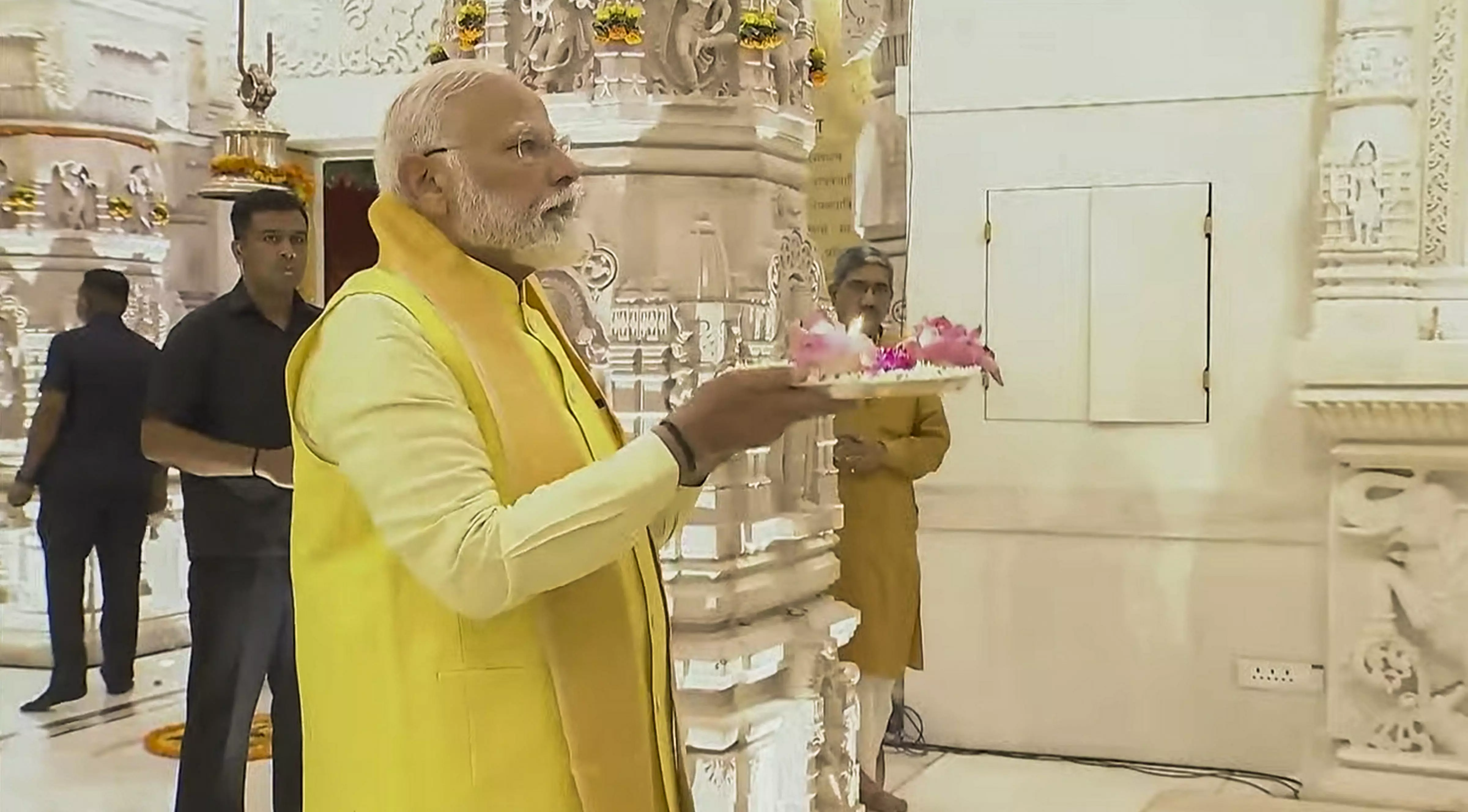
Donation row in Ram temple, once lavishly marketed by PM as marker of Hindu identity and renaissance, now threatens his ‘clean’ image, endangers BJP’s prospects in poll-bound UP
Even before the 1980s – before its transformation into the central flashpoint of Indian national politics – Ayodhya was universally respected among Hindus.
However, its status, popularity, and role in a devotee’s quest for personal salvation were quite different from how they are perceived today.
Although scripturally, the temple town almost always was pinned at the pinnacle of lists of holy places and pilgrimages during the time of the Puranas, in terms of active medieval and early-modern pilgrimage density, up until the late-20th century, Ayodhya sat in the second tier of North Indian pilgrimage sites.
None cared about Ram Lalla until…
On my first visit to the town as a journalist in the late 1980s, it appeared odd that although a national storm appeared headed for Ayodhya, the few pilgrims with clear looks of the hoi polloi, during the non-festive period, had no interest in having a darshan of the idol of Ram Lalla installed beneath the three domes of the Babri Masjid.
Among the handful trooping up to the so-believed Janmabhoomi hillock, there was no eagerness to make cash donations or offerings that caught anyone’s eyes, both of which are now in the headlines.
Also read/watch: Ayodhya theft: ‘Trust meet a sham, does little to restore confidence’ | AI With Sanket
Instead, these commoners were seen a fair distance away doing the Panchkosi Parikrama or undertaking barefoot a 5 kos (1 kos approx. 3-3.2 km) circumambulation around the ‘holy’ perimeter of the town.
Even after the demolition of the Babri mosque on December 6, 1992, the makeshift temple rarely evoked religiosity in the spiritual sense.
Thereafter, well-heeled devotees turned up occasionally with donations and conspicuous offerings. But, for the majority of people, the quasi-abandoned shrine existed as a symbol of erasure of the badge of Hindu humiliation.
When Ram became Rashtra
This began changing a few months after the constitution of the Shri Ram Janmabhoomi Teerth Kshetra Trust in February 2020, especially following the choreographed preview of the pomp and grandeur to follow, staged by Prime Minister Narendra Modi along with props that came with him.
His speech, delivered on August 5, 2020 after performing Bhoomi Pujan of the Ram Mandir in Ayodhya, was deeply layered with socio-political and nationalist imagery; Modi framed its construction as a moment of national resurgence and civilizational pride.
The script for the Ram temple’s eventual emergence as India’s most resplendent and materially rich temple, with almost inestimable resources at its disposal, was readied by top guns in the Prime Minister’s Office within weeks of the Supreme Court’s debatable judgement on November 9, 2019.
Almost three and a half years later, on January 22, 2024, Modi delivered yet another politically effervescent speech in Ayodhya, this time after consecrating the still ‘incomplete’ temple. On this occasion, he contextualised the temple as a geopolitical turning point and a pivot for India's civilizational identity.
Also read: Ram temple theft: With RSS-BJP cornered, will Congress seize the moment?
Modi said that the temple smashed the mentality of slavery among people and claimed that on this day, Lord Ram transitioned from “Dev se Desh, Ram se Rashtra (deity to country and Ram to nation)”. He also added that the day marked the beginning of a new Kaal Chakra (cycle of time).
Grand prelude, ‘renaissance’ story
Modi made his messaging more politically explicit on November 25, 2025, after hoisting the sacred 22-foot saffron flag (Dharma Dhwaj), which marked the formal, functional completion of the temple structure and underscored the transition to full-scale, continuous public worship.
On this occasion, Modi spoke again from the temple patio and described his act as the ‘Final Culmination’ of a 500-year struggle. He elevated the Ram temple from merely being a venerated place of worship to a marker of India’s civilisational resurgence by stating that the “Dharma Dhwaja is not just a flag... it is the flag of the renaissance of Indian civilization.”
The script for the Ram temple’s eventual emergence as India’s most resplendent and materially rich temple, with almost inestimable resources at its disposal, was readied by top guns in the Prime Minister’s Office within weeks of the Supreme Court’s debatable judgement on November 9, 2019.
Beliefs cemented, donations poured in
The apex court’s one of the most politically contentious verdicts till date, also empowered the government of India to establish a trust and provide the trustees with powers for “construction of a temple and all necessary, incidental and supplemental matters.”
The task of establishing the trust was completed by the Centre within the mandated three months, and almost immediately donations began pouring in. The Sangh Parivar too, through various affiliates of the Rashtriya Swayamsevak Sangh (RSS), went on a donation-seeking spree, with swayamsevaks moving from door-to-door across several parts of the country.
Also read/watch: How Ayodhya Ram temple donation row put faith and transparency to test
The aforesaid comprehensive details of the emergence of Ayodhya, and the Ram Temple as the crowning glory of the nation and the Hindu order, have been provided to enable comprehension of the extent to which the Ram Mandir Bhoomi Khareed Ghotala (Ram Temple Land Purchase Scam) and the Chanda Chori Ghotala (Donation Theft Scam) have shaken the political establishment and eroded the faith and belief of Indians.
Red-faced moment for Sangh Parivar
In the storyline that was developed by the powers that be, immediately after the demolition, these events that have emerged bit-by-bit were least expected and have shaken the RSS and all its minions – besides the Union government – to the core.
Beyond a point, staying mum will likely damage PM Modi's image. He will eventually have to explain his choice of people, especially those who have been charged and those who have been virtually forced to quit the temple trust.
Ever since the organisation was accused of being part of the conspiracy to assassinate Mahatma Gandhi in February 1948, the saffron fraternity has not been struck by any such high-voltage socio-political lightning. What makes the crisis more severe is the fact that while in the Gandhi assassination case, the RSS denied from day one its involvement in the plot, besides stating that Nathuram Godse had ceased being its member almost two decades ago, the Hindu nationalistic community, the Centre and RSS affiliates cannot deny the same in the current case. They cannot deny that a heist of such incalculable dimension (at this stage) has been committed in a temple on which none other than the Indian Prime Minister showered the aforementioned lofty words and ideas.
‘Chief Priest Modi’ stays mum
If the Babri Masjid was depicted as a Ghulami ka prateek (symbol of slavery), why can’t the people ask if the Ram temple has now been exposed as an eternal motif of corruption and an architectural complex that is proof of the sleaze, dishonesty and fraud committed in temples by individuals and organisations that manage them?
The backdrop to similar queries is provided by a disconcerting fact: in his desire to stamp his name on the temple, Modi has played a double role – of the ‘Chief of State’ and the ‘Chief Priest’.
Also read: Blame politics, not the system, for Ayodhya temple donation theft
Despite not holding any position, there is no denying that the prime minister was the one who was the de facto ‘Decider-in-Chief’ of all Ram temple matters. Since the twin scams have shaken the Ram Temple to its very foundations, several leaders, political as well as religious, have made statements either venting anger or hurling accusations at others, but Modi remains conspicuous with his silence.
By erasing the lines of separation between religion and the State, Modi may have initially boosted his political stock, but he also bound himself to the responsibility of providing a clean temple management Trust.
PM’s ‘clean’ image at stake
Beyond a point, staying mum will likely damage his image. He will eventually have to explain his choice of people, especially those who have been charged and those who have been virtually forced to quit the temple trust.
Although no one has tagged Modi’s name to any of the allegations or assumptions, there is no denying that one of his pledges – Na Khaoonga, Na Khaane Doonga (neither shall I partake in corruption, nor shall I permit the corrupt to prosper) – which paved his way to office, has been blown to smithereens by the exposure of the double-layered scam.
Predictably, the meeting of the Shri Ram Janmabhoomi Teerth Kshetra Trust launched the exercise of identifying scapegoats and overlooking systemic failures and initiating steps to make the body more representative.
The three against whom ‘action’ has been taken – Champat Rai, Anil Mishra and Gopal Nagarakatte (also known as Gopal Rao) are all longstanding RSS functionaries. In an organisation where commitment and consultation go hand-in-hand, it is highly unlikely that they turned ‘rogue’.
RSS still holds the reins
The decision to appoint another bureaucrat trustee, Krishna Mohan (retired Indian Forest Service officer) as interim general secretary to handle daily administrative tasks is little beyond fire-fighting. His induction was necessitated with the death of the VHP’s Dalit face, Kameshwar Chaupal, and being connected with the RSS helped Mohan’s cause.
Also read: Ayodhya Ram temple multi-crore donation scam: What we know so far
Quite clearly, this is a stopgap arrangement, as a hastily cobbled three-man team is tasked with identifying a Chief Executive Officer (CEO) to professionalise temple administration.
Either before this scandal broke out, or thereafter, the imprint of the government and the RSS on the Ram Temple Trust remains clear. This maintains the trend which surfaced during the course of the Ram temple agitation when the leadership remained in the hands of the VHP with a sprinkling of not-so-important Hindu religious leaders.
Conspiracy theories won’t help BJP
The Ram temple movement has been wracked by allegations of financial misappropriation from the beginning, with most allegations levelled against the VHP. The latest scandal will further the narrative that the Sangh Parivar – in this instance under the aegis of the Centre – has used the Ram Mandir agitation to add to its resources.
From the time Modi developed personal interest in resolving the Ram Temple issue in favour of Hindus and developing Ayodhya into a ‘Hindu Vatican’, it has been plagued by poor administration and questionable craftsmanship.
The Sangh Parivar’s efforts to scale down the extent of the scams will come to naught as several leaders from within the fraternity have detailed the enormity of the theft and fraud.
Also read/watch: Why was Ajay Rai stopped from visiting Ayodhya’s Ram Temple? | Capital Beat
Efforts are being made to depict the events and the trading of allegations as an anti-Hindu effort. But this is one instance when playing the victimhood card is unlikely to yield dividends.
The double-layered financial scam will make a further dent and carries the danger of harming the BJP’s electoral prospects in Uttar Pradesh, where polls are due in early 2027.
(The Federal seeks to present views and opinions from all sides of the spectrum. The information, ideas or opinions in the articles are of the author and do not necessarily reflect the views of The Federal)