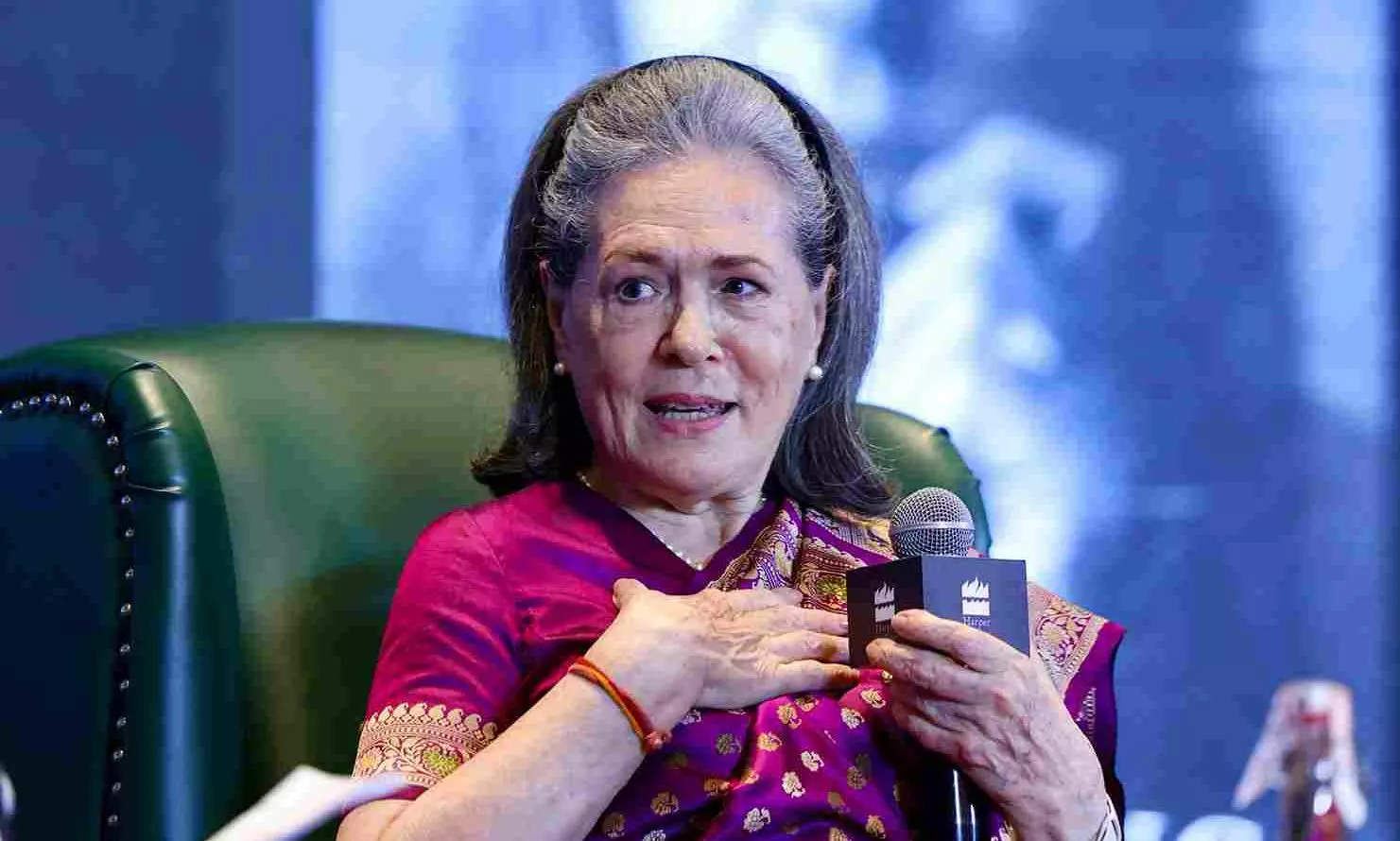
While her memoir offers a moving personal account, it leaves key questions about Rajiv Gandhi's political decisions, her own years in power and the Congress's decline unanswered
Sonia Gandhi has led an extraordinary life, and she has written an extraordinary book about that life. In its short prologue, she states, “I chose to write a personal memoir, one for which politics is the background, a kind of framework.” She reiterates the same point towards the end of the book.
She notes, “Future generations of writers on politics and economics will describe the current era and the last several decades in India from their own point of view. It would take me too long to recount in detail all I have experienced during this period. I would reiterate here that this is a memoir, wherein politics serves to frame the main narrative, which is a personal account of my thoughts, feelings, and decisions.” The book, Belonging: A Journey of Love, is indeed a detailed and very moving personal memoir.
A ringside seat to history
Notwithstanding Sonia’s assertion, and despite the deliberate attempt to keep politics entirely out of the book’s formal launch on November 16, her memoir is also political. It is here that a reader could legitimately wish for her to have ventured more deeply into her political experiences and work and all that she witnessed even if it would have taken her “too long to recount it in detail”. The obvious reason for this is that no other person has had as much experience of Indian politics, either as a ringside observer or as a participant at the highest level, as Sonia Gandhi.
Also read | How Sonia Gandhi’s memoir, Belonging, reveals the person behind the enigmatic Congress leader
She arrived in India on the morning of January 13, 1968. Thirteen days later she got engaged to Rajiv Gandhi and they got married in Delhi on February 25 of that year. She moved into Prime Minister Indira Gandhi’s house where Rajiv also lived. Rajiv and she always lived with Indira Gandhi till she was assassinated in 1984. After that Rajiv became Prime Minister. When he lost the 1989 election he became Leader of the Opposition.
Can anyone in Indian politics come even close to such a political innings, either as a player on the field or as a spectator in the pavilion, enjoying a ringside view as a family member of those batting or fielding?
When Rajiv was killed in May 1991 she kept herself formally aloof from politics but was nevertheless surrounded by it. Six years later, in 1997, Sonia formally joined the Congress and a year after that became its president. For five years she was herself the Leader of the Opposition. She led the Congress to victory in 2004 and handed over the Prime Ministership to Dr Manmohan Singh while she remained the party leader.
Since 2014 when Narendra Modi became India’s leader she has remained a MP and now her son Rahul Gandhi is the Leader of the Opposition in the Lok Sabha. Can anyone in Indian politics come even close to such a political innings, either as a player on the field or as a spectator in the pavilion, enjoying a ringside view as a family member of those batting or fielding?
Witness to turbulent years
Sonia’s book shows that she became aware of the currents and cross currents of Indian politics soon after entering the Gandhi family. She mentions again and again that Rajiv and she kept aloof from political life during the tumultuous years after 1968 which witnessed the break-up of the Congress party, Indira Gandhi’s 1971 electoral victory and the India-Pakistan war of that year which, along with the Bangladeshi resistance, resulted in the creation of a new country, the difficult years for India after that which culminated in the imposition of the Emergency in June 1975.
She deals with the Emergency years in some detail but is reticent in what Rajiv was actually telling his mother and brother, Sanjay Gandhi. All this is woven into her personal story as a backdrop. Surely, she could and should have revealed much more than she does in the book. That would have been a service to history.
Sonia Gandhi also gives an account of Indira Gandhi’s period in the wilderness after her defeat in the 1977 elections and her struggle to return to power. Her focus is on the family’s trials and tribulations during this period but she refers to what was happening politically. Indira Gandhi’s victory in the 1979 election was a remarkable achievement. Some months later Sanjay Gandhi who was fully involved in politics died in a plane crash. Despite Sonia’s opposition Rajiv entered the political arena to help his mother. He became an MP and general secretary of the Congress party.
The period from 1980 until Indira Gandhi’s assassination was marked by turmoil in Assam and Punjab. The latter culminated in the Indian Army's operation against Bhindranwale and his group, who had made the Golden Temple and the Akal Takht their base for armed action. This outraged Sikh sentiments. On the fateful day of October 31, 1984, two Sikh members of Indira Gandhi’s security detail assassinated her.
The silences in Sonia’s memoir
With her husband in politics, Sonia would surely have been privy to the developments during these years. History would be better served if she had also opened up about the political developments of that period.
Rajiv Gandhi was sworn in as prime minister the same day. Sonia vehemently opposed his decision to take up the office, but he went ahead with the swearing-in. She writes that he told her that ‘they’ wanted him to become prime minister. It is not clear who exactly ‘they’ were.
Also read | ‘She belonged to my father’: Rahul’s ‘epilogue’ completes Sonia’s story of belonging
There are numerous accounts of what happened in the hours between Indira Gandhi’s death and Rajiv Gandhi’s swearing-in as prime minister at 6.30 pm. One wishes Sonia had contributed to our understanding of what precisely transpired after Rajiv returned to Delhi around 3.30 pm that afternoon, President Zail Singh returned to India around 4.30 pm, and Rajiv was sworn in at 6.30 pm.
A major question is why the past precedent of the President first administering the oath to an interim prime minister and then waiting for the Congress Parliamentary Party to elect its leader was not followed, even if the assassination had created an inflamed situation. Four decades later, one wishes Sonia had clarified why Rajiv did not insist that the earlier precedent be followed.
As the prime minister’s spouse, Sonia was with him throughout. She mentions some developments during Rajiv’s prime ministership, including the breakdown of friendships with those friends who chose to enter politics. While they may have wanted to enter politics, it was Rajiv who brought them into it. She mentions some names but, curiously, leaves out others altogether. She believes that these friends overreached themselves. Again, it would have added to our historical knowledge if she had explained how.
The making of a political leader
More importantly, Sonia gives an indication of Rajiv Gandhi’s approach to the Shah Bano matter but does not evaluate its lasting impact on India’s polity. It is widely believed that he sanctioned the change in the status quo in the Ayodhya dispute to assuage Hindu sentiment. Sonia mentions what happened in Ayodhya but suggests that local developments there led to it. This strains credulity. Has she ever considered that, but for Rajiv’s decisions on Shah Bano and Ayodhya, the Sangh Parivar might not have gained the openings that enabled it to accumulate the power it wields today?
Significantly, and as expected, she stoutly defends Rajiv Gandhi’s integrity in the Bofors controversy. This is understandable, but she could have offered a dispassionate account of the shortcomings in his handling of the accusations made against him and, indeed, against her because of her origins. She does not mention Quattrocchi by name at all! This leaves the field open to her opponents to regurgitate all the charges against Rajiv and her.
Sonia is at her best when she delineates the differences between the Congress’s vision of an inclusive society and polity and the Sangh Parivar's exclusivist idea of India.
The 1990s were a period of intense domestic and external challenges for India. Rajiv Gandhi was assassinated by the LTTE in May 1991, when the country was in the midst of an election. This devastated Sonia, and she refused to head the Congress party. The decade witnessed the Congress's defeat in the 1996 election, the formation of United Front governments with outside support from the Congress, and, from 1998, BJP-led governments.
In 1997, Sonia Gandhi re-entered the political fray to keep alive the legacy of the Nehru-Gandhi family, particularly its opposition to right-wing forces that rejected the family’s idea of an inclusive India. Sonia is at her best when she delineates the differences between the Congress’s vision of an inclusive society and polity and the Sangh Parivar's exclusivist idea of India.
In 1998, she became Congress president and led the party in Parliament for six years. Towards the end of the Vajpayee government's tenure, Sonia formed the United Progressive Alliance, which won the 2004 elections and governed the country for a decade.
The gaps in Sonia’s political account
Sonia gives an account of why she declined to become prime minister and instead chose Manmohan Singh for the post while continuing to lead the party. It is a pity that she does not mention at all that this devalued what is the country's highest political office. She asserts that Manmohan Singh led the country well and that she did not interfere in the administration, including in government appointments. This may be generally true, but in some instances, such as the appointment of a foreign secretary, she did influence the prime minister's choice. It is difficult to believe that her closest political adviser could have acted without her clearance.
Also read | ‘The political masala you expect from Sonia Gandhi’s memoir is largely missing’
There is no account of the steps she took to rejuvenate the Congress party in the Hindi heartland. This left the party ill-equipped to handle the Sangh Parivar’s onslaught when it gathered force after 2010. She blames the media, the business elite and some institutional heads for inflaming public opinion but misses the point about the Congress’s own weaknesses. Perhaps her health did not allow her to devote the attention needed to stem the rot, creating an opportunity for Narendra Modi's rise.
Throughout, Sonia’s broad-brush approach to political events leaves the reader craving more details.
Sonia is, as expected, critical of the Modi government and Modi himself. She does not, however, introspect on why the Congress has been unable to mobilise public opinion against Modi and his government. A lament about the direction India is taking is insufficient.
One can only hope that, even as she approaches 80, Sonia will offer a fuller account of the politics she participated in and witnessed in her adopted country. No one else can do so as comprehensively as she can.
(The Federal seeks to present views and opinions from all sides of the spectrum. The information, ideas or opinions in the articles are of the author and do not necessarily reflect the views of The Federal.)