How Sonia Gandhi’s memoir, Belonging, reveals the person behind the enigmatic Congress leader
Belonging: A Journey of Love is less a political reckoning than an intensely personal act of remembrance. The memoir lays bare the loves, losses, anxieties and private tragedies behind one of India’s most scrutinised public figures. The book, however, may frustrate readers looking for revelations about the Congress, its internal power struggles or the political history Sonia helped shape.

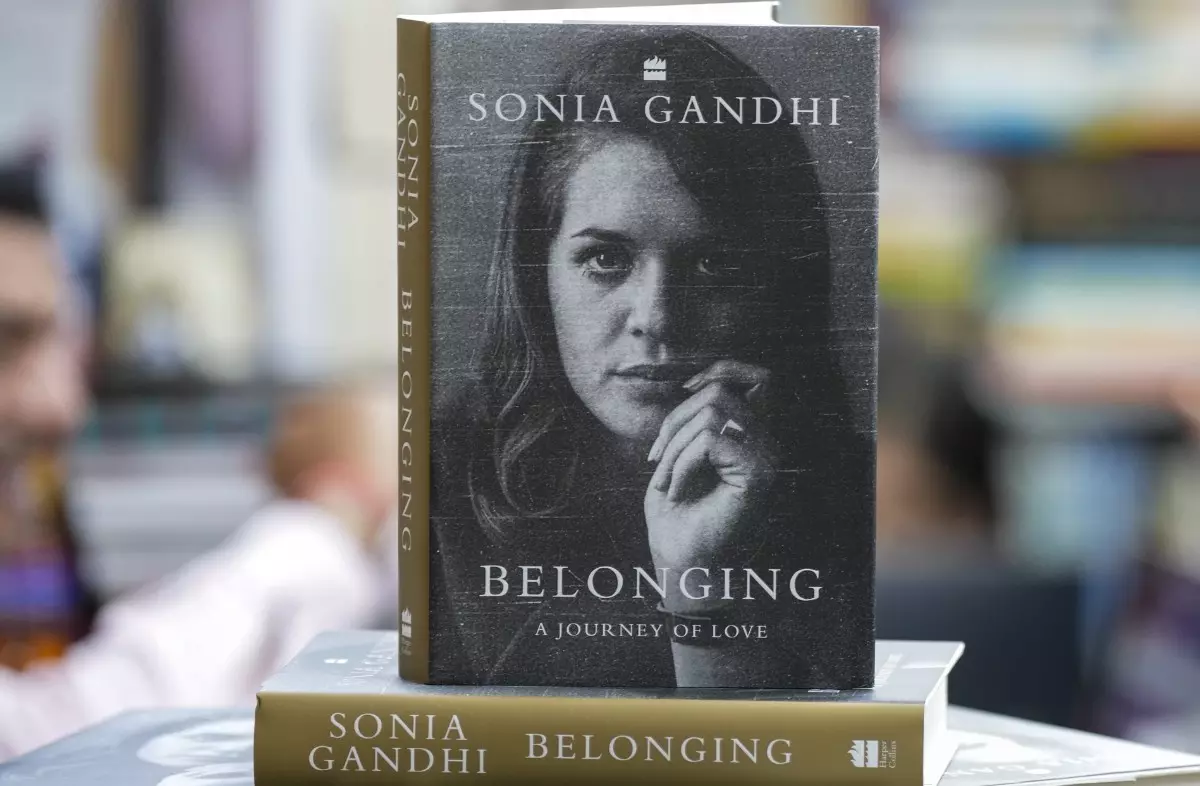
Copies of Congress leader Sonia Gandhi's newly released memoir, 'Belonging: A Journey of Love', displayed at a bookstore in Khan Market, New Delhi. Photo: PTI
“In the end, I chose to write a personal memoir, one for which politics is the background, a kind of framework,” writes Sonia Gandhi in the laconic prologue to Belonging: A Journey of Love. The more than 500 pages that follow, spanning six decades, remain faithful to that choice.
This is perhaps both the book’s greatest strength and its most significant limitation. Arguably the most anticipated memoir by an Indian politician in decades, Belonging offers an intimate portrait of a woman whose public life has been inextricably intertwined with the country’s political history. Yet, it stops well short of the revelations many readers might have expected.
For those who admire or revile her, the memoir offers neither startling disclosures nor particularly candid assessments of the individuals and defining moments of contemporary Indian history that Sonia witnessed at close quarters and, in several instances, helped shape.
Restraint, a quintessential Sonia trait, is writ large in the chapters dealing with politics. This is especially evident in the final 120-odd pages, which recount her reluctant entry into public life, her stewardship of the Congress when its political fortunes appeared irretrievably bleak, the formation of the United Progressive Alliance (UPA), and the party’s eventual electoral decimation as allegations of corruption and policy paralysis engulfed the government and Narendra Modi’s political appeal swept across the country.
Most career politicians would find it difficult to resist the temptation to reveal something of the intrigues conducted behind closed doors, particularly if doing so offered an opportunity to settle scores with rivals within the party or adversaries in the Opposition. Not Sonia.
Little insight, lesser gossip
The omissions are all the more striking given the personal attacks she and her children have endured over the decades, and her candid admission of her distaste for and mistrust of politics and politicians. Perhaps this distrust was an unintended bequest from her mother-in-law, Indira Gandhi, and husband, Rajiv Gandhi, both former prime ministers who experienced vicious political campaigns and betrayals by trusted associates.
Her reflections on power offer a glimpse into this disillusionment. Recalling Rajiv’s years as Prime Minister, she writes: “Power raises walls between people with great efficacy. That which appears to give protection within those walls often increases vulnerability instead.” The sentiment bears an uncanny resemblance to her son Rahul’s much later assertion that “power is poison”. She recalls the loneliness of occupying positions of power and the fragility of trust, describing how some of the couple’s closest friends, including those entrusted with responsibilities in government and Rajiv’s secretarial team, abandoned them when political adversity struck.
Also read: ‘The political masala you expect from Sonia Gandhi’s memoir is largely missing’
Yet, even while acknowledging that certain individuals exploited her husband and misused the family’s name, sometimes with serious consequences for Rajiv, Sonia refrains from naming names or providing details.
The same reticence characterises her treatment of controversies that shadowed the Nehru-Gandhi family: the Emergency (1975-1977), the anti-Sikh riots (1984), the reversal of the Supreme Court’s Shah Bano judgment (1986) and the Bofors scandal (1980s-’90s). These episodes are recalled less as defining moments in a turbulent political history than as difficult chapters best left behind. To some readers, this may appear less an exercise in recollection than an attempt to gloss over uncomfortable questions.
This silence on the dramatis personae criss-crossing her political life continues when Sonia relates the events of her own political career. Her elevation as Congress president in 1997, the failed attempt to form a Congress-led government the following year on the urging of an unnamed leader whom she describes as “thoroughly dishonest”, Sharad Pawar’s departure from the party over her foreign origin, her years as Leader of the Opposition and her decade as chairperson of the ruling UPA coalition are among the book’s least engaging sections.
Her decision to decline the prime ministership in 2004 and nominate Manmohan Singh receives an entire chapter. Yet, much of the account reiterates what has long been in the public domain. Even her description of the personal struggle involved in arriving at that decision, which the Congress never tires of portraying as the “ultimate sacrifice”, adds relatively little to the established narrative. Nor does she offer much beyond familiar assurances about her working relationship with Singh, dismissing allegations that she functioned as a ‘super PM’ as malicious and entirely false.
Sonia Gandhi made her Instagram debut in October with the unveiling of the memoir. File Photo
Her treatment of the Modi years is no less restrained. Despite the sustained political and investigative pressure faced by the Congress leadership, including Sonia and Rahul, the memoir offers little that is new. Apart from a few observations that may have unsettled political colleagues, including her shock at Pranab Mukherjee’s suggestion of a leadership change in the UPA government, there is little by way of fresh insight, much less the political gossip that readers looking for a tell-all account might have hoped for.
Perhaps this is understandable. With the Congress only beginning to show signs of organisational stability and political revival, Sonia may have little incentive to reopen old wounds. The G23 rebellion (2020), in which 23 senior leaders questioned the party’s leadership vacuum during her tenure as interim president, receives no meaningful treatment.
Nor does she dwell on the departures of former colleagues such as Ghulam Nabi Azad, Ashok Chavan, Jyotiraditya Scindia, Jitin Prasada and RPN Singh. Even Mallikarjun Kharge’s election as the first non-Gandhi Congress president since 1997 is dealt with matter-of-factly, although she expresses relief at having handed over the baton to the seasoned Dalit leader from Karnataka.
Indeed, her extended assessments of political personalities are largely reserved for those she admires. Arjun Singh, Ahmed Patel, Priyaranjan Dasmunsi, Madhavrao Scindia, Oscar Fernandes and Mohsina Kidwai, along with AK Antony, Ambika Soni and Kumari Selja, receive generous tributes for their contributions to her political journey.
Curiously, Sonia exercises similar moderation when writing about Narendra Modi and the BJP. Her assessment of the Prime Minister is not entirely dismissive. While acknowledging that his humble beginnings have been embellished by a “PR machinery”, she concedes that Modi “certainly worked his way to power within the RSS from an underprivileged world”.
Her criticism of him is ideological rather than personal: “Narendra Modi’s idea of India was constructed by the ideologues of the RSS… it affirmed a fundamentalism in which his faith and culture superseded all others… He was fighting for his vision of India, and I for mine: an India against hegemony, an India that stands for inclusiveness, secularism and social justice.”
Laying bare the personal
If politics is where the memoir disappoints readers seeking revelations, it is in the personal recollections that Belonging finds its voice. Those interested in Sonia Gandhi the individual, rather than the politician whose public life has invited endless scrutiny, will find much to cherish.
The shy, uncertain young woman from Italy who eventually became the matriarch of the Nehru-Gandhi family and the Congress emerges with remarkable candour. Her recollections are by turns entertaining and poignant, revealing a woman whose private life, despite its eventual entanglement with public affairs, began with a simple longing for love and companionship.
Her account of meeting Rajiv Gandhi at the Varsity restaurant in Cambridge is evocative. She describes the encounter as “un colpo di fulmine; a bolt of lightning”. The love that blossomed between Sonia Antonia and Rajiv, two individuals markedly different in their upbringing, social privilege and background, is one that seems almost improbable to be real.
The cautionary advice Rajiv received from his mother, Indira (as Sonia recalls, Indira told her son, “the first girl he had met was not necessarily the right one”), Sonia’s apprehension about introducing her parents, Stefano and Paolina, to the romance, and Rajiv’s journey from Cambridge to Orbassano in Italy (getting stranded mid-way because the car’s engine packed up) to seek her father’s consent for marriage (Stefano remained noncommittal) make for absorbing reading.
Also read: 'Just over a page for Bofors': N Ram shares views on Sonia Gandhi's 'Belonging'
Equally fascinating is Sonia’s first journey to India, undertaken alone to familiarise herself with Rajiv’s family and a life in India. It culminated in an unexpected ultimatum from Indira: the couple would have to marry before Rajiv left for pilot training in Secunderabad. Recounted with emotional depth and extraordinary detail, these episodes have the sweep of a classic romance, complete with familial anxieties and the triumph of love across continents and cultures.
This warmth and candour run through much of the book’s first half, peppered with amusing anecdotes: Sonia’s initial revulsion at curry and Indian spices; the arbitrary names given to continental dishes at VIP dinners in Indira Gandhi’s household because the in-house cook could not pronounce their original names; and an escapade with a family friend during an official visit to Bhutan with her mother-in-law, the Prime Minister, which earned her a reprimand from Indira, before both burst into laughter.
There is also the hilarious account of burly Congress politician Kalpnath Rai falling at Indira’s feet, only to find himself unable to get up, forcing her to summon help. As Sonia told The Hindu, those were times when she “laughed more”.
Copies of Sonia Gandhi's Belonging displayed at a bookstore in New Delhi. Photo: PTI
Sonia writes frankly about her early struggles to settle into an alien milieu and her admiration for her mother-in-law, without giving Indira a free pass simply because she was the family matriarch.
Her portrait of the Iron Lady is particularly perceptive. At home, Indira could effortlessly transform into a doting mother, mother-in-law and grandmother, without compromising on discipline. Sonia recalls her fiery temper, moments of self-doubt and regret during politically turbulent times, including the Emergency and Operation Blue Star (I984), and the unfathomable pain of losing her younger son, Sanjay, in a plane crash. She also recounts the bitter fallout with Sanjay’s young but “politically ambitious” widow, Maneka Gandhi, the one individual who appears to receive the full force of Sonia’s unvarnished criticism.
When Sonia recounts Indira’s assassination and describes ferrying her blood-soaked, bullet-ridden body to AIIMS, the emotional intensity is difficult to escape. The tragedy set off a chain of events that thrust the prime ministership upon Rajiv at 40, when he was neither politically mature nor willing to assume the onerous responsibility his mother and grandfather had carried for years.
For Sonia, the transition was devastating. Still largely apolitical, she struggled to cope with the sudden transformation of her family’s life. She admits to suffering from “some sort of depression… a form of what is known today as PTSD (post-traumatic stress disorder)” and recalls arguing with Rajiv for nearly a year into his premiership.
The ordeal was no less difficult for their children. Reflecting on those days, she writes: “I had transmitted my anxiety to the children.” She recalls how Rahul was deeply affected by his grandmother’s death, while Priyanka became the person to whom she turned to unburden her fears, without fully appreciating that her daughter was only thirteen. Rahul, she later learnt, “felt excluded” from the family’s emotional turmoil, while Priyanka “felt weighed down” by her mother’s distress.
It is in these raw, unfiltered recollections that Belonging brings the reader closest to Sonia, a woman whose private life has long remained an enigma.
One of the book’s most poignant revelations concerns the loss of her first child in January 1969, before the birth of Rahul and Priyanka. Sonia recounts the premature birth of a seven-month-old boy, “a tiny, perfectly formed boy, with thick, black hair and long, slim fingers”, who died within hours.
The anguish of being asked what should be done with the baby’s remains is recounted with heartbreaking detail. After considering and rejecting the available options for reasons either religious or political, Sonia and Rajiv decided to bury the child on the family farm in Mehrauli. Rajiv later returned to the hospital to tell her that he and Sanjay had buried the baby “deep under a beautiful pink bougainvillea bush”.
Equally gut-wrenching is her account of the night of May 21, 1991, when Priyanka informed her: “Papa is dead.” Rajiv had been killed in an LTTE suicide bombing at Sriperumbudur in Tamil Nadu. The loss of the man for whom she had left behind everything, including her Italian identity, came barely seven years after Indira’s assassination.
Sonia admits that she still struggles to piece together the events of that night. The chapter is punctuated by unfinished sentences and unanswered questions, reflecting a trauma that has remained with her for more than three decades.
Ultimately, Belonging is less a political reckoning than an intensely personal act of remembrance; one possibly meant to give her closure to the trials and tribulations that life has thrown at her with merciless frequency. Yes, it may frustrate readers looking for revelations about the Congress, its internal power struggles or the political history Sonia helped shape. But in laying bare the loves, losses, anxieties and private tragedies behind one of India’s most scrutinised public figures, it achieves something arguably more difficult: it makes the enigmatic Sonia Gandhi human.