‘The political masala you expect from Sonia Gandhi’s memoir is largely missing’
Sonia's Belonging is moving on grief and family but guarded on the Emergency and Bofors, with no introspection on Congress’s decline, says Puneet Nicholas Yadav

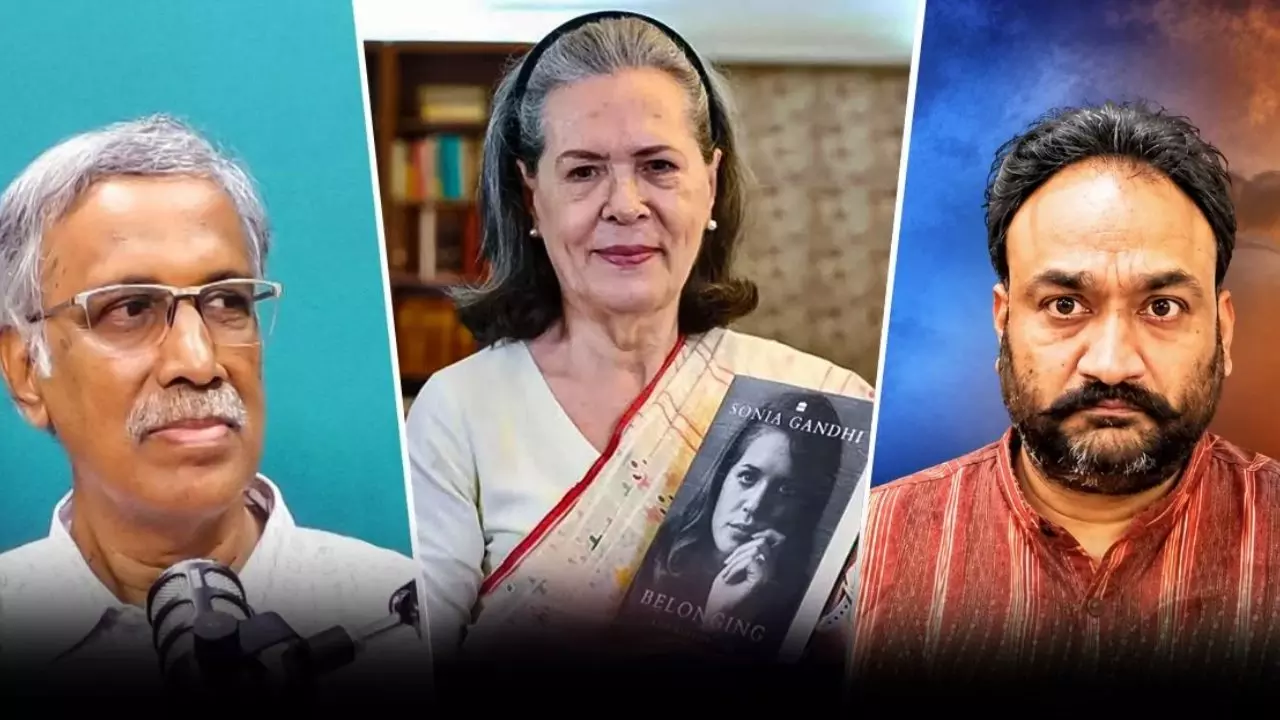
While Sonia Gandhi’s newly released autobiography, Belonging: A Journey of Love, opens up on personal grief and family rifts. It goes so far as to pin the blame for the Emergency largely on Sanjay Gandhi and to paint a bitter portrait of Maneka Gandhi. Spanning six decades, from her arrival in India to her 20-year tenure as the longest-serving Congress president, the 500-page memoir frames politics largely as a backdrop to a personal journey.
Puneet Nicholas Yadav, Political Editor of The Federal, who has read Belonging closely, says anecdotes and vignettes from Sonia's life shine through in the book and make it what a truly personal memoir. In a discussion on the book on Talking Sense with Srini, the flagship YouTube show of The Federal, he says it exercises calculated restraint on major political controversies and avoids serious introspection into the Congress party’s decline.
He examines what the book reveals, and what it conceals, about modern Indian political history.
Edited excerpts:
In the prologue of Belonging, Sonia Gandhi states that the memoir uses politics only as a background while remaining a personal account. Is this a deliberate attempt to avoid controversies and avoid offending political friends and foes alike?
I think that is absolutely the case. She has a very brief prologue to the book, and the final paragraph talks about how she considered putting down a memoir and eventually decided that it would have to be a personal memoir where politics serves only as a background to provide a framework, while everything else remains a personal story.
Throughout the 500-odd pages of the book, what comes across is Sonia Gandhi’s typical, characteristic restraint on matters that could cause controversy or fray nerves. There are just a few instances here and there where I think she really lets herself go, but otherwise, her comments on various individuals and events are very restrained, controlled, and measured.
If you read the memoirs of someone like Sheila Dikshit or Pranab Mukherjee, you will get far more insights into those episodes (like the Shah Bano case) than you will from Sonia Gandhi’s book.
Part of it reflects her personality—unlike her son Rahul Gandhi, who is impromptu and might speak off the cuff, everything with her is rehearsed and well thought out. It is very calculated in terms of just how much she wants to let out. For politicians, political writers, and readers interested in getting that side of the story, the book may be somewhat disappointing because the typical political masala you expect from a memoir by someone like Sonia Gandhi is largely missing or feels rather bland.
However, it is deeply personal in other aspects—her own life, her time with the family, and, as the book is titled, her quest and urge for belonging to India, a country that was completely alien to her but came to define her in many ways. As she sequences it, it began first as a love story, then grew into a love for the family, and finally into a love for the nation that adopted her.
While the book is tightly controlled on political matters, she writes early on about losing her firstborn within hours of a premature delivery—a tragedy that even prompted a cruel newspaper headline at the time claiming Indira Gandhi had failed to become the grandmother of a "bastard child." How does she describe that experience, and what does it tell us about the personal side of the book?
It is anecdotes and vignettes from her life like these that really shine through in the book and make it what she calls a personal memoir. When it comes to her personal memories and struggles over the last six decades—particularly her decision to marry Rajiv Gandhi and come to India—that is where she really lets everything out.
This particular incident actually appears midway through the book, and it is the kind of story very few people would know. It dates back to January 1969, when she had a premature seven-month delivery of a son who died within hours. She describes the struggle first of coming to terms with the loss of her firstborn, and then the immediate concern among family members over what to do with the child's body.
Also read | Sonia Gandhi recalls emotional dilemma over 2004 alliance with DMK
As per Hindu customs, there was the question of whether to immerse the newborn in a river—which she was completely opposed to because she could not bring herself to the idea of, as she puts it, throwing the child in the river—or to have a cremation, or a Christian-style funeral and burial. All of those options were not only painful for her to choose from, but also rife with their own political complications.
Eventually, they decided on the family's farmhouse in Mehrauli, where there was a spot beneath a blooming bougainvillea tree. Rajiv went there along with Sanjay Gandhi and buried the child. That is one of the most moving episodes of her life mentioned in the book.
These are the kinds of vignettes that shine throughout the initial chapters, where she talks about her courtship with Rajiv at Cambridge and in London, his first visit to Italy to meet her family, and her struggles to convince her own family about the marriage—which actually happened much after Indira Gandhi had already been convinced.
As she also noted in a recent interview with The Hindu, she used to smile a lot—and that is the one thing she has come to miss: the happy, carefree times of her pre-politics days before the personal tragedies of her mother-in-law’s assassination, her husband’s assassination, and other family problems overtook her life.
She had a ringside view of defining moments in Indian politics—the Emergency, Operation Blue Star, the Shah Bano case, the Bofors scandal, and the UPA era. Does the memoir add significantly to our understanding of what happened behind the scenes in the Gandhi household during these events?
That is where the book is a bit of a letdown. I am reminded of when Pranab Mukherjee came out with his three-volume autobiography, which spanned roughly the same number of decades as Sonia Gandhi’s memoir. At the time, I had the privilege of speaking to Natwar Singh, who was as seasoned and senior a politician as Pranab Da, and asked what he thought of the memoir. Natwar Singh told me how deeply disappointed he was, and that he had actually told Pranab Mukherjee that for someone who had a ringside view of history and everything that went on politically in the country, it was incumbent upon him to put out the facts honestly—yet he had not let out anything.
That is pretty much the case with Sonia Gandhi’s memoir when it comes to the major turning points in Indian political history over the last six decades. She reveals very little of what was really going on. There are flashes of things that are personal rather than political in nature. For instance, when she writes about the Shah Bano case—when there was a huge furore and divisive political discourse over Rajiv trying to appease the Muslim clergy for vote-bank politics—she recounts confronting Rajiv and asking why he was bent on taking away the rights of Muslim women.
She then drops it there, saying Rajiv told her he was trying to take care of it, withoutany detailed commentary on what transpired in Parliament or the discussions at home. In that sense, if you read the memoirs of someone like Sheila Dikshit or Pranab Mukherjee, you will get far more insights into those episodes than you will from Sonia Gandhi’s book.
Rajiv had willed that his eyes be donated upon death. When Sonia asked the doctor and whether the eye donation had taken place, the doctor responded in a very agitated state, saying, "What eyes? There is nothing left."
In fact, in the chapter on Rajiv’s prime ministerial tenure, she gives a clear hint upfront not to expect too much in terms of politics. She mentions that Rajiv worked out of 7 Race Course Road, which was his office, while they lived at 5 Race Course Road, and that she rarely went to the Prime Minister’s Office and was therefore not privy to what was happening there. Right at the outset, she signals that readers expecting behind-the-scenes details on those five years—how a government with a brute majority of 414-odd seats fell off that pedestal and failed to win even a simple majority in the next election—are not going to get it.
Even on Bofors, where she herself was directly dragged in despite not being in politics because of the Ottavio Quattrocchi connection, she offers no fresh details beyond the usual assertions that everything was disproved in court and the allegations never stuck. That was also the period when many members of Rajiv Gandhi’s so-called "kitchen cabinet"—people like Arun Nehru, Arun Singh, and friends like Amitabh Bachchan, who, depending on which side of the political divide you stood on, were seen either as having betrayed him or as having taken a principled stand—parted ways with him.
Watch/Read | Centre wary of Sonia's biography? ‘Paranoia at its worst'
Even there, she doesn't name anyone to criticise. She speaks only in generic terms about how that phase made her realise that in politics there are no permanent friendships, and that people will turn their backs on you the moment your stars are on the decline.
There is, however, a lot of mention of the Bachchan family in the earlier, pre-politics days—very fond recollections of Harivansh Rai Bachchan, Teji Bachchan, and Amitabh. Remember, this was the family Sonia stayed with when she first came to India before marrying Rajiv.
Part of it reflects her personality—unlike her son Rahul Gandhi, who is impromptu and might speak off the cuff, everything with her is rehearsed and well thought out.
She writes warmly about "Uncle Bachchan," "Teji Aunty," and Amitabh adopting her when she arrived, recalling how Harivansh Rai Bachchan’s advice stayed with her throughout her public life and how she looked upon Teji Bachchan as a motherly figure she could turn to without any inhibitions.
She even shares an interesting anecdote from right after her wedding: when she moved into Indira Gandhi’s residence, her mother saw the tiny bedroom allotted to Sonia and Rajiv and pointed out that there was barely room for a bed, let alone space for her clothes. Having already packed her bags from the Bachchans' home, Sonia went back the next morning and kept her clothes at Teji Bachchan’s house, walking across to the Bachchan household every time she needed to change.
So there are warm recollections of the Bachchans from those years, but no fresh light on the political rancour that followed over Bofors.
She was the first family member to find Indira Gandhi lying in a pool of blood after being shot by her own security guards, and years later she was in Delhi when she learned of Rajiv Gandhi’s assassination in Sriperumbudur near Chennai. How does she handle these two deeply traumatic moments?
There is a slight difference in how the two are treated, though you can sense that even now, decades later, she is still coming to terms with both losses. The way she recounts Indira Gandhi’s assassination is a stark reminder of what a shock it was to her—taking her body to the hospital, realising in the car that she was no more, being unable to say anything or know how to react, and having no shoulder to cry on because Rajiv was campaigning in Bengal at the time.
By then, Sanjay was no more and Maneka Gandhi was no longer in the household, so it was just Sonia, Rajiv, their very small children. That account is deeply emotive; the manner of writing is almost as if she is still stammering to put the whole experience into words.
With Rajiv’s assassination, it is again an extraordinarily difficult recollection. What really gave me a lump in my throat was her account of getting permission to fly to Madras, where Rajiv’s remains were being put together for the cortege to be brought back to Delhi. When she goes to the hospital, people around her struggle to tell her not to see the body because there is very little of it left to see.
She writes that everything from that moment—not just the immediate aftermath, but the next few days—remains a blur even today, and it took her a while to patch together what happened. Because Rahul was in the US at the time, the responsibility of keeping the family together fell largely on her daughter Priyanka, who was still in her teens.
She also recounts how, while the body was being prepared at AIIMS, she called for the family doctor to ask whether, like his mother, Rajiv had willed that his eyes be donated upon death, and whether the eye donation had taken place. The doctor responded in a very agitated state, saying, "What eyes? There is nothing left."
She writes in the book that it was at that moment that the full blow hit her—that there was nothing left of his face. How do you come to terms with something like that? Throughout that episode, immense trauma comes across alongside very little recollection of what actually transpired around her.
Indira Gandhi and Rajiv Gandhi clearly emerge as the central figures in the book, but what does she say about other members of the family—starting with Sanjay Gandhi and his role during the Emergency?
There is a great deal on both Sanjay and Maneka Gandhi. Many would say that she has, in a way, tried to pin the entire blame for the Emergency on Sanjay—which, for her critics, is the most convenient way to frame it. Although Maneka Gandhi has not spoken on the book yet, if she were to respond, I think that would be one of the first things she would point out: that Sanjay has been made out to be the villain not just of the Emergency, but of the household.
While Sonia includes very fond recollections of Sanjay—talking about how full of life he was, how he was always playing pranks on people, and how fond her children were of their chacha—she also writes candidly about his temperament. She recounts how, throughout the Emergency years, he assumed extra-constitutional responsibilities that were not his to execute, and how he, along with other party leaders, constantly egged Indira Gandhi on first to declare the Emergency and subsequently to keep prolonging it for two years.
Also read | Why for publishers, editing non-fiction is a challenge, more so in charged socio-political settings
For readers who have read earlier accounts of the Emergency, such as Coomi Kapoor’s book, or who are familiar with that phase of political history, her revelations may not seem particularly striking or factually incorrect.
However, for those who have either been fed Indian political history through WhatsApp or are uninitiated in that era, it may look as though she is trying to wash the family’s hands of the Emergency—absolving Indira Gandhi by suggesting she did not want it, blaming it all on Sanjay, and portraying Rajiv, who was outside politics at the time, as constantly advising caution.
She deals with that at length, writing that throughout the run-up to and duration of the Emergency, Rajiv urged ending it, and when Indira Gandhi finally decided to call elections, Sanjay—seconded by R&AW chief RN Kao—warned against it on the grounds that they would lose, whereas Rajiv insisted that ending it was the right thing to do even if they lost.
What about Maneka Gandhi? How is she portrayed in the memoir?
Maneka Gandhi is the one individual in this book who receives a very, very bitter treatment from Sonia—perhaps the only character in the entire memoir treated that way. Although Maneka’s initial introduction in the book starts with warm recollections, the narrative quickly turns to how her mother, Amteshwar Anand, was manipulative and forced Maneka to hurry up the marriage.
Although Maneka’s initial introduction in the book starts with warm recollections, the narrative quickly turns to how her mother, Amteshwar Anand, was manipulative and forced Maneka to hurry up the marriage.
She recounts a moment when Indira Gandhi, speaking to Cabinet Secretary PN Dhar about Maneka—at a time when Maneka was not even of age to contest an election—remarked, "She has already grown wings." Sonia goes on to describe how, especially after Sanjay’s demise, Maneka began hobnobbing with people from the RSS, the Jana Sangh, and the BJP simply to spite her mother-in-law.
She also writes about how, in the run-up to her final departure from the house, Maneka had already started shifting her belongings out and had confided in journalist friends before the family even knew she was leaving. Maneka was also the editor of Surya magazine at the time, which is discussed at length—Sonia writes that Maneka was selling the magazine to an RSS man, and that proved to be the final straw, after which Indira Gandhi simply could not hold it together.
Given her deep early distaste for politics and her efforts to keep Rajiv Gandhi out of it, how does she explain eventually bringing her own children, Rahul and Priyanka, into politics?
As ironic as it seems, one thread running throughout the narrative is that her coming to terms with a life in politics was tied to a sense of duty to the Congress party—not in terms of governance, but in terms of holding the party together as a tribute to her mother-in-law and her husband. That was also one of the reasons she never thought of returning to Italy.
Also read | Sonia’s RS shift leaves Congress with the critical Rae Bareli question
That is what happened in 2004, when Rahul Gandhi made his political and electoral debut simultaneously. She writes about how the Congress was really down in the dumps at that time, and nobody knew what fate awaited them. She had just put together—or was still in the process of putting together—the United Progressive Alliance (UPA), which required immense political navigation and manoeuvring, including coming to terms with difficult decisions like bringing the DMK into the fold. Having gone through that entire rigmarole, bringing Rahul into politics was framed as part of that same duty, because the party needed him.
There appears to be a striking contrast between May 1999—when Sharad Pawar and other senior leaders questioned her foreign origin, prompting her to resign as Congress president before withdrawing it for a "larger purpose"—and May 2004, when she turned down the prime ministership after leading the coalition to victory. How does she reconcile those two episodes?
It certainly seems like a contradiction that is hard to miss. Regarding what happened between 1997 and 1999, her argument is that after avoiding politics for several years following Rajiv’s assassination, she finally took the plunge from 1996 onward out of a sense of duty toward the party and her family when she saw the state the Congress had fallen into.
After putting in all that hard work through 1997 and 1998, she writes about her deep sense of hurt upon realizing that not just her political rivals, but even colleagues within her own party—specifically Sharad Pawar, Tariq Anwar, and PA Sangma—believed she did not belong here. That is where the title of the book, Belonging, plays out again.
She also recounts another episode in the run-up to the 2004 elections during a chintan shivir (strategy session), where she was already party president and slated to lead the campaign. Suddenly, after all the discussions had concluded and only the resolution remained to be drafted, she realised she was being made to wait while senior party leaders held a separate huddle. When she asked an unnamed person what was going on, she was told the seniors were discussing who should lead the Congress in the 2004 campaign.
Her coming to terms with a life in politics was tied to a sense of duty to the Congress party—not in terms of governance, but in terms of holding the party together as a tribute to her mother-in-law and her husband.
She felt deeply wounded that even in 2004 there were people in the party who had not accepted her, so she went in and firmly told them that she was the party president and she was going to lead the campaign.
Reconciling that assertiveness with her later decision to decline the prime ministership is a little difficult, though she explains it by saying that the office of the Prime Minister was never something she was after or wanted to occupy. She writes that she spent many agonizing days conflicted between the pressure to accept the post and her personal concerns alongside her children’s opposition to her taking it up. Eventually, she decided against it, even though she had led allies on the day before by saying "theek hai" (alright), suggesting she would accept.
In the book, she delivers a sharp critique of the BJP-RSS dispensation over the past decade—accusing it of damaging democracy and institutions, while expressing optimism about a return to proper governance. Beyond attacking the ruling party, is there any serious introspection on the Congress party’s own decline or its ideological shift during the UPA years?
Those questions remain unanswered in the book. Her criticism of Narendra Modi, the current government, the BJP, and the RSS is a running theme throughout the memoir. I see it as rooted in her grounding—not just in politics, but in the understanding of India she absorbed from Indira Gandhi, Rajiv, her household, and Jawaharlal Nehru’s books—where she has always viewed the RSS as anathema to the idea of India.
Interestingly, while she slams Modi over his handling of the country over the last 12 years, she also acknowledges that even though there has been a PR exercise and exaggeration around his humble beginnings, he did struggle his way up. Where she draws the red line is that he represents the RSS and the BJP, which she cannot accept.
As far as the Congress party and its own faults are concerned, however, there is no mention and no clear introspection from her on the rot that set into the party or how it was allowed to set in. Remember, Sonia Gandhi was not just any Congress president; she was the party’s longest-serving president, holding the post for 20 years, including the 10 years when the UPA was in power.
What does shine through in the chapters on the UPA years is her pride in the formation of the National Advisory Council (NAC) and the legislations that emerged from it, which represented the ideas she wanted a Congress-led government to deliver. She flatly brushes aside all allegations of "backseat driving" or acting as a "super prime minister". Without naming Sanjaya Baru, she refers to the claim in his book that she summoned files from the Prime Minister’s Office, stating there is no truth to it and noting that even Manmohan Singh’s daughter, Upinder Singh, had rubbished those claims.
While she does not go into valuable detail about the turmoil that hit the UPA, particularly in its second term, she speaks with great pride about the NAC’s achievements. She held Manmohan Singh in great esteem and recognized the importance of the liberalised economy he helped usher in from 1991 onward. At the same time, on the social front—what many would describe as left-of-centre—she wanted rights-based measures delivered, whether in education, tribal rights, or NREGA. She writes of feeling immense pride when NREGA was passed, and just as hurt when it was practically dismantled by the Modi government.
Watch the video here.