








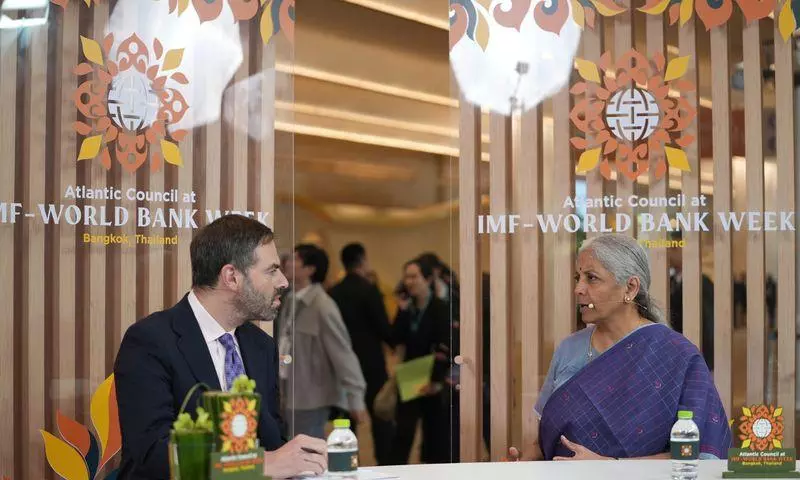
Finance Minister Nirmala Sitharaman during an interactive session with South Asia Atlantic Council Resident Senior Fellow Michael Kugelman on the sidelines of the IMF-World Bank Annual Meetings in Bangkok on Friday (Oct 16). Photo: PTI
A pro-market Finance Minister speaking the language of the Global South in Bangkok points to jobs and risk capital as India’s real worries, not the ‘top five economy’ talk
Finance Minister Nirmala Sitharaman, a staunch anti-socialist, pro-market economic right-winger at home, spoke like a spokesperson for a developmental, pro-state Third World country at the World Bank Development Committee meeting in Bangkok on Friday (October 16).
She said, rather strangely, that the bank's knowledge resources should be used to study “market failures” in supporting urbanisation, tourism, agricultural exports, and critical minerals.
The phrase “market failures”, from a free thinker like her, carries bitter and sweet ironies. She pointed out that developing economies lack risk capital, and that banks should find ways to make it available so developing economies can create jobs.
Sitharaman, of course, is speaking as India's Finance Minister, and her personal views may remain strongly anti-socialist. In an interview, she acknowledged that Prime Minister Narendra Modi does not favour unbridled free markets.
India’s identity crisis
That she spoke of inclusive growth and poverty alleviation really harks back to the 1970s, to G77 and to Third Worldism. It is quite different from the Prime Minister’s aggressive rhetoric, which demands that the situation has changed and that new economic powers like India are knocking on the door and demanding a seat at the high table of big economies.
Also Read: FM Sitharaman calls for resilient economy, urges private sector to lead investments
The position of countries like India, and of an Indian Finance Minister, is complicated, awkward and assertive at the same time. Job creation and last-mile connectivity remain challenges for a developing economy like India.
India is not too happy to call itself a developing economy. It would prefer the more positive label of “emerging economy”. But the economic challenges that India faces remain that of a developing economy.
Economy’s vulnerability
Sitharaman’s remarks in Bangkok reveal perhaps what is of real concern to the Modi government on the economic front, something that the government would avoid speaking about because it would highlight the vulnerability of the economy. The preferred mode of expression for the Modi establishment at home is the gung-ho Norman Vincent Peale-speak of vacuous positivism of India being among the top five economies, in contrast to being part of the “fragile five” under the Congress-led United Progressive Alliance (UPA) government more than a decade ago.
Of course, politics is the art of assuming different positions on different occasions.
Sitharaman can argue, and justifiably too, that as India’s finance minister, she was speaking for the Global South, and her observations should not be seen as referring to the state of India’s economy. But the truth is that India is not yet the economic power that its GDP size should reflect.
India is in an embarrassing situation: it is neither the powerful economy it wants to be nor the relatively poor one it was half a century ago. But there still remain a lot of poor people – about 17 million who are absolutely poor – and there is a pressing demand to create jobs to meet the expanding pool of those entering the job market.
Also Read: India riding on ‘Reform Express’ with conviction and clarity: Sitharaman
The high-octane rhetoric about a vibrant Indian economy favoured by Prime Minister Modi and his colleagues in the government and in the Bharatiya Janata Party (BJP) remains that – rhetoric. The sober assessment of the government and experts at home is that the economy has been resilient – meaning that India is coping well with the uncertainties of geo-political crises and that the macroeconomic fundamentals are strong, or more realistically, that it is resilient enough to survive the stresses of the fluctuating fortunes of the global economy.
India’s dilemma
India’s position in the International Monetary Fund (IMF)-World Bank (WB) set-up is relatively strong, and India is demanding a greater say in the decisions of these two remnants of the post-Second World War financial system. It does not favour breaking away from this Western-dominated institutional framework. As it is not powerful enough, not just in economic terms but also in political and military terms, India feels that it has to lead a larger group like the Global South to be influential.
Also Read: Amid rupee’s free fall against dollar, Sitharaman says it is ‘absolutely going fine’
This dilemma is not peculiar to the Modi government. It has been a feature of the Indian outlook since Nehru’s days. India is caught between its desire to be a power in its own right, and since that is not the case, to assume the role of the spokesperson of developing and less-developed countries. This makes the Indian position ambiguous. In contrast, China avoids rhetoric and keeps itself aloof from debates and discussions. It relentlessly pursues a policy of extending its influence through bilateral economic agreements that serve Chinese interests.
Time to choose a clear position
It is perhaps time for India to adopt a clear position. It can choose to represent the Global South, the world's poor. This would require India to give up its desire to join the club of the rich and powerful, like the G7. Indian policymakers consider the G20 the midway house.
The old idealism of a non-hegemonic world, which was the leitmotif of the Nehruvian worldview, would be the way forward. But the BJP-Modi establishment has nothing but contempt for anything Nehruvian, which is reflected in the bitter pronouncements of External Affairs Minister S Jaishankar. He is not alone in his contempt for the dovish Nehru. The Indian strategic community collectively favours hawkish views in the naïve belief that big boys believe in realpolitik!
Also Read: LTCG, STT under scrutiny as Sitharaman opens door to capital gains tax review
Sitharaman’s remarks at the World Bank meeting reflect more accurately Indian economic reality. India has to reckon with “market failures”, and it is a sign of economic realism.
(The Federal seeks to present views and opinions from all sides of the spectrum. The information, ideas or opinions in the articles are of the author and do not necessarily reflect the views of The Federal)
