Defence Minister weaponises falsehoods to recast Nehru as appeaser and Patel as Hindutva icon, distorting documented history of Babri Masjid post-Independence
A former university professor, decades after opting out of teaching as a career, once narrated jokes, among prohibited genres in the Soviet era, which did the round among students during his years in a Moscow university in the late 1960s.
This particular ‘joke’ was centred on an incident in a students’ hostel when inmates noticed that a Czechoslovak resident had almost taken to complete silence, or become virtually non-conversational on return from his home, weeks after his country was jointly invaded in August 1968, by the Warsaw Pact countries: the Soviet Union, Poland, Bulgaria, and Hungary.
It may be recalled that this intrusion was to quell the drive towards liberalisation in Czechoslovakia and strengthen the authoritarian regime that gained control after the invasion.
Rajnath's accusation reveals he is short of historical knowledge — in 1950, there was no need to ‘construct’ the mosque because it had not been demolished, as it was in December 1992.
To concerned fellow-hostellers asking him if everything was fine at home, the Czech student said all was well. To further queries, why he was still so uncommunicative, the young lad replied that his concern stemmed from the new syllabi that were being introduced in educational institutions.
“Even our history is being changed. On return, I will have to study our country’s new history!”
Most Indians would not have managed to relate to this ‘joke’ a few years ago, and may well have wondered what the laughing matter was in this story.
Spinning a 'yarn'
Days ago, Union Defence Minister Rajnath Singh added to the epidemic of alterations to Indian history with the wild allegation that former Prime Minister Jawaharlal Nehru wanted to use government funds for the Babri Masjid. This plan, went the yarn, which is what history has now become, was opposed by then Home Minister, Sardar Vallabhbhai Patel.
Rajnath narrated the unsubstantial falsity for two reasons: One, it would depict Nehru as the ‘original appeaser’ in Independent India. Two, it would position Patel as a valiant Hindutvawadi, or someone from whom the BJP draws its ideology.
In fact, the precise words that Rajnath used were that Patel was a "true secularist”, who did not believe in the “politics of appeasement". Insofar as Nehru was concerned, the Defence Minister stated he proposed to construct Babri Masjid "using funds from the government treasury", but Patel "opposed" this, and thus prevented (mis)use of public funds for this.
Ghost of Rao
His accusation reveals that Rajnath is indeed short of historical knowledge. After all, in 1950, there was no need to ‘construct’ the mosque because it had not been demolished, as it was in December 1992.
Eventually, when the Babri Masjid was destroyed on December 6, 1992, it was the Prime Minister then, PV Narasimha Rao, who pledged to rebuild it. Although this was not, or could not be done, a pledge to do so was made.
And, lest it be forgotten, the BJP has embraced the ghost of Rao and juxtaposed their good or kind words for him, with the Congress cold-shouldering his memory.
Actual history
What is the ‘actual’ history of the events related to the Babri Masjid that Rajnath has tried to falsify? But, before that, we must set up the backdrop that eventually altered, as is evident in today’s India, the face of political orientation, and the nature of its discourse.
Also read: Congress hits back at Rajnath: ‘No evidence Nehru wanted Babri funds’
On the intervening night of December 22-23, 1949, when there was no evidence of what Prime Minister Narendra Modi described recently as “500 years of sacrifice and pain of centuries”, a local Hindu supremacist, Abhiram Das, along with two not-so-significant activists, surreptitiously installed the idol of Ram Lalla, or the child Shri Ram, beneath the central dome of the Babri Masjid.
It is important to note that the act did not in any way damage the mosque physically, although it would alter its characteristics for 43 years, when it was eventually destroyed in full glare of the police as well as the top brass of the BJP and its affiliates within the Sangh Parivar.
Violation of mosque
In the morning, as news spread of this event, planned and coordinated by an elaborate network of local Hindu zealots aided by local officialdom, people began gathering in thousands, drawn by the publicists’ line that Ral Lalla prakat ho gaye ('the young Shri Ram has made a divine presence inside the shrine'), the aim of the local political leadership, in Ayodhya/Faizabad as well as Lucknow, was to make the development permanent.
They wanted to put a stop to the Babri Masjid functioning as a mosque as it was, with some limitations, till the night of the grossly illegal intrusion and violation of an Islamic place of worship.
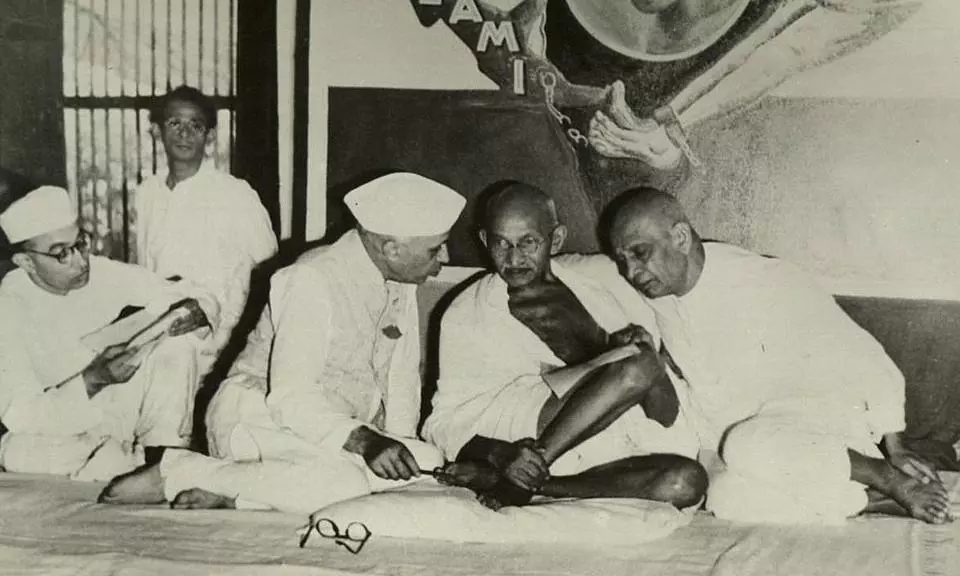
In the weeks that followed, Prime Minister Nehru and his Home Minister Patel were on one side of the divide because they were in the government and both believed in the principles of collective functioning and more. Beyond that, the two held different positions on the Ayodhya developments.
Two divergent flanks
On the other side were a horde of political leaders, from both the Congress and the twin forces of the Hindu Mahasabha and the Rashtriya Swayamsevak Sangh (RSS), along with a bevy of complicit bureaucrats led by KKK Nair, Faizabad’s deputy commissioner-cum-district magistrate.
Importantly, ranged against the Nehru-Patel combine were several senior Congress leaders, including then Uttar Pradesh Chief Minister Govind Ballabh Pant and his Home Minister Lal Bahadur Shastri.
Within days of the clandestine installations of Ram Lalla’s idol inside an ancient mosque, whose character was disputed for just 100-odd years of its more than 500 years of existence, a well-recorded chain of communication ensued between the two divergent flanks within the Congress.
It also drew several officials and other leaders of the Congress and other parties into this exchange, but at no point does any of these missives or references bear out Rajnath Singh’s allegation against Nehru.
These exchanges begin barely days after the stealthy act in the middle of the night on December 22-23.
Nehru's concerns
On December 26, 1949, Nehru dispatched a cable to the UP chief minister Pant, stating he was “disturbed at developments at Ayodhya. Earnestly hope you will personally interest yourself in this matter. Dangerous example being set there which will have bad consequences.”
Also read: RSS at 100 stands tall but is shadowed by a fraught past and fractious present
It is true that in the aftermath of Mahatma Gandhi’s assassination, Patel had acted toughly against the RSS and the Hindu Mahasabha too. But it would not be appropriate to overlook Patel’s patronage of Pant and his not-so-nuanced divergence with Nehru on developments in Ayodhya.
As a consequence, while Nehru sent the aforesaid telegram, clearly expressing his concern at the idol’s installation, Patel limited himself to a telephone conversation with Pant. However, to keep up the pressure on Pant, Nehru wrote another handwritten note to him.
There is no doubt that Nehru wanted the mosque to be restored to its original character, but for this, there was no need to expend state funds. Patel disagreed with Nehru, but not because of what Rajnath has claimed.
He followed this up with a formal letter to C Rajagopalachari on January 7, 1950, stating that Pant had called Nehru after receiving his note: “He said he was very worried and he was personally looking into this matter. He intended taking action, but he wanted to get some well-known Hindus to explain the situation to people in Ayodhya first.”
Despite his keenness on reversing the situation in Ayodhya and removing the idol from the Babri Masjid, Nehru believed in the cabinet system of governance and allowed Patel to take decisions and issue advisories to Pant on internal security matters, given that Patel was Deputy PM and also the Home Minister.
Patel's view
Patel was of the view fairly early that the status quo in Ayodhya should not be reversed and that the idol should be allowed to remain within Babri Masjid even while the mosque remained locked. This was categorically evident in his January 9, 1950, letter to Pant.
Patel wrote that the issue should be “resolved amicably in a spirit of mutual toleration and goodwill between the two communities”.
In hindsight, we can state there was little scope for an amicable settlement and, in the charged situation, within a short period after the gory Partition riots in Faizabad-Ayodhya, the Hindus would not allow the removal of the idol unless the government adopted a tough stance against those who vandalised the mosque.
Patel revealed his stance on the issue more openly by writing to Pant that he realised “there is a great deal of sentiment behind the move that has taken place (meaning installing the deity). At the same time, such matters can only be resolved peacefully if we take the willing consent of the Muslim community with us (basically indicating that the Muslims had no other option but to accept ending their demand that the shrine should be restored to its state prior to December 22)”.
Twisting history
Nehru was displeased but did little. There were several other preoccupations for him too — after all, India was to adopt its Constitution in barely two weeks. Moreover, after the horrific Partition riots, India could not risk another round of violence, which, too, was mainly directed at the Muslims.
Also read: Why PM's Ayodhya event is a statement on Sangh’s larger ideological vision, triumph
There is no doubt that Nehru wanted the mosque to be restored to its original character, but for this, there was no need to expend state funds. Patel disagreed with Nehru, but not because of what Rajnath has claimed.
There is no denying that a gulf existed between Nehru and Patel. The latter may not have been the PM, but he certainly dominated the organisation of the Congress and had loyalists in every state. This section had deep-rooted sympathies for the Hindutva sentiment, even though they did express this categorically, given that the Hindu right-wing was thoroughly discredited after Gandhi’s assassination.
Although his heart was for the restoration of the Babri Masjid, Nehru’s mind reasoned, that to win the war against religious intolerance and faith-based politics, he had to consciously ‘lose’ some battles on the way, with the one at Ayodhya being the first one.
Rajnath Singh certainly does not view history dispassionately and mainly considers it a tool to be used in its current battles.
(The Federal seeks to present views and opinions from all sides of the spectrum. The information, ideas or opinions in the articles are of the author and do not necessarily reflect the views of The Federal.)