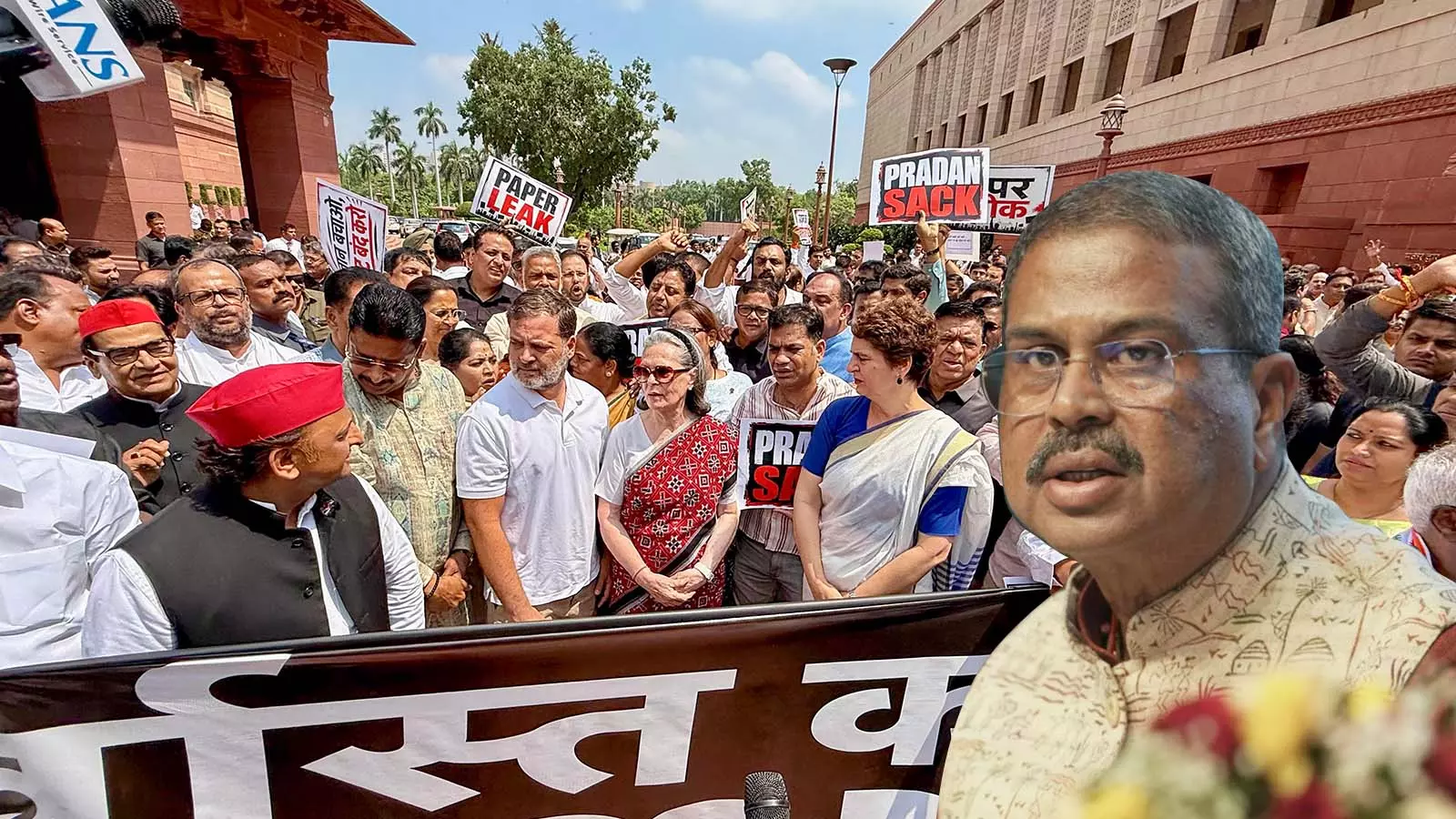
Ministerial oversight? As Opposition continues to demand for education minister Dharmendra Pradhan's resignation, a question that needs to be asked is if he oversaw the NEET examination or left it entirely to officials and the agency conducting it. Photo: PTI
As PM announces fast-track courts, new laws to placate angry youth, government's plea against 'politicisation' falls flat against core demand for Pradhan's resignation
Addressing a media briefing on July 22, JP Nadda, the minister of health and former BJP President, who has been interacting with the protesting students emphasised that their demand on the NEET papers leak and other connected issues should not be politicised.
He cautioned that no one should seek to take political advantage of an issue which was profoundly serious and which deserves serious discussion. He argued that a partisan role should not be taken.
Obviously, his message was directed at the Opposition, which is supporting the student protestors and has not permitted Parliament to function. They are, like the students, demanding that education minister Dharmendra Pradhan should resign. Nadda also gave an account of examination papers leaks in Opposition-ruled states. None of these, though, were as serious as the NEET case.
Modi's 'stale' message
In the late evening of July 23, Prime Minister Narendra Modi, in a recorded video message, conceded that the NEET paper lead was not an ordinary issue. However, he held that the main objective, following the leak, was to ensure that the 22 lakhs students who had taken the examination did not lose a year. That aim was achieved.
A fresh examination was held and its result was declared on July 19. He also stressed that earlier that day he had ordered the formation of fast-track courts. The civil servants had prepared the document for that purpose and also for stricter laws. That would be considered on July 24th by the cabinet and will be introduced in Parliament on July 27. In his message on X on July 23 morning Modi stated inter alia, “Those who try to harm the future of our youth will not be spared”.
Also read: CJP protests expose Modi's Achilles' heel: A government unused to listening
While the post on X was surprisingly stale in its bureaucratic language, Modi's video message was better but far from containing the flourish of his usual communication style. Taken together they showed a worried Modi seeking to find a way to handle what can seriously erode his popularity over an important segment of his constituency.
Modi is attempting to regain the initiative through the steps he has announced. Sonam Wangchuk has also broken his fast. Will these steps help in diffusing the situation for Modi? Till now, the issue on which neither the Modi government nor the Opposition has budged relates to the resignation of Pradhan. The student protestors are insisting on that too. Will Modi’s steps and Wangchuk breaking his fast harm Opposition unity?
Will all this lead to a discussion on the paper leak issue without the resignation of Pradhan? Should that happen, it will be another political plus for Modi.
Politicisation of youth?
Meanwhile one aspect that needs consideration is if the Opposition was unnecessarily ‘politicising’ an issue which should be above partisan politics. That has been the government’s charge.
The fact, however, is that it was Modi who subtly introduced politics during his comments which he customarily makes in front of the Parliament building before the beginning of the session. He did not refer to the papers leak at all but dwelt on the launch of a rocket into space by an Indian start up. He noted that it was the work of youth whose average age was 28. He added “I am not talking of a 56 year old youngster”.
The BJP, therefore, can hardly complain of politicisation of youth if Modi himself made a scornful remark about Rahul Gandhi. Also, clearly Modi did not anticipate that the NEET paper leak had aroused such widespread bitterness in an important section of the youth.
In matters of national security when the sovereignty and territorial integrity of the country is threatened by external aggression there is certainly no place for ‘politicisation’ of the developments. It is only when the crisis has passed that it is legitimate to ask questions of the government. However, in other instances the demand by governments that Opposition parties should not get involved in public agitations is self seeking and fatuous.
Over the decades though it has become common for all parties in power to ask those in the Opposition not to politicise issues. This never happens and cannot happen because it is natural for political parties to use issues against the government to secure political advantage. That is in the very nature of politics and it is high time that the political class gives up these senseless accusations.
Political accountability?
A significant point that the current agitation has raised is this: “what is political accountability”?
Did Pradhan's actions or inaction in handling his ministerial responsibilities lead to the paper leak? What is expected of a minister in the discharge of his/her duties? While the efficiency of civil servants and military personnel can be judged through objective factors – though not entirely — and while they are bound by conduct rules those who hold political office are not circumscribed by either.
Of course, they are accountable to legislatures and to the people but the former is seldom invoked and the latter is only at election times. What should then be the accountability expected of a minister? The Pradhan case provides an opportunity to visit this important issue.
Also read: What’s behind Modi govt’s politics of not letting Pradhan go?
The administration of the country is carried out by officials who are expected to carry out their duties in accordance with the law and the rules. In many cases they have to ensure that they do so through forming their own judgements uninfluenced by suggestions, if they are made, by others. In other instances they have to implement policies which they help craft but the political leadership has to take responsibility for the policy. It is accountable for it.
The political leadership should not seek to ordinarily interfere in the job of the officials but what it should do is to keep an oversight over the administrative apparatus. If it does not undertake that oversight it is not performing the function expected of it. Besides, if it conducts its oversight functions well it also ensures that the bureaucrats and officials are kept on their toes.
Hence, it is the function of a minister to ask questions of the officials about the steps that they are taking and the arrangements that they are making for the exercise of their duties. In addition ministers are also expected to let the officials know how the public is responding to their actions and administrative decisions.
Matter of ministerial oversight?
The question that Pradhan has to answer is if he oversaw the NEET examination? Did he ask the agency conducting it about the arrangements that were being made? Did he generally satisfy himself that adequate arrangements were being made for its safe conduct? This is not secret information. His office diary will reveal that.
If he did not discuss the NEET examination with the officials and agency concerned he obviously failed in exercising oversight. For that he has to be politically accountable. It is the preventive action that a minister suggests to officials that is important and not the corrective that has to be necessarily undertaken after a terrible NEET like paperleak.
Also read: Why CJP’s protest stands apart from previous mass movements
Naturally, no hard and fast rule for ministerial oversight can be prescribed but that it has to be undertaken is undeniable. Did Dharmendra Pradhan undertake it? He should come clean.
(The Federal seeks to present views and opinions from all sides of the spectrum. The information, ideas or opinions in the articles are of the author and do not necessarily reflect the views of The Federal)