



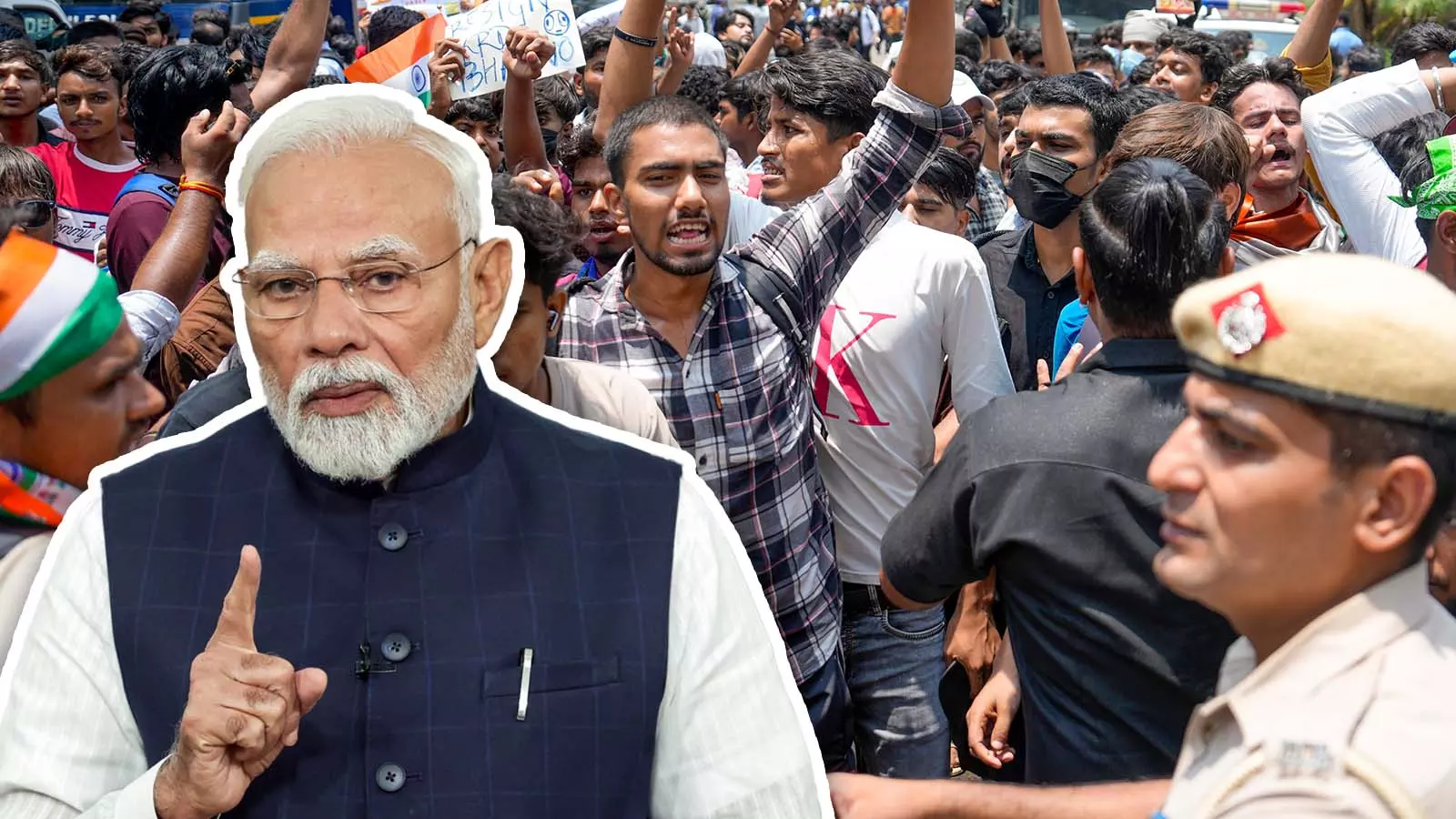
The ongoing student and youth protests over NEET exam paper leak is perhaps the biggest challenge that Prime Minister Narendra Modi has faced since assuming power in 2014.
Driven by systemic exam failures and rising AI-induced job anxiety, thousands of non-affiliated students are forcing a complacent administration to face tough economic realities
It is not yet clear what the Cockroach Janta Party (CJP) is. Is it a political party with an agenda and an organisational structure? Or is it just a social media group? Right now, the CJP's agenda is the demand for Union Education Minister Dharmendra Pradhan’s resignation, an apology from Prime Minister Narendra Modi and an enquiry into the police action — lathi-charge, tear gas — against the protesting students.
Also read: Has CJP protest revealed a chink in BJP’s armour? | Talking Sense With Srini
The CJP has a spokesperson, and they have people to represent the outfit in talks with the government. Two of its representatives met Union Health Minister J P Nadda on July 20. Then there is the participation of the educationist and environmentalist from Ladakh, Sonam Wangchuk, who was on an indefinite hunger strike because he backed the CJP's cause and extended his support to thousands of protesting students who joined the "Chalo Sansad" march and faced the brunt of the police lathi charge and tear gas.
Then there are three members of the All-India Students Association, affiliated to the CPI-ML (Liberation) — Neha, Ameen Amitoj and Manish Kumar — who also fasted supporting the CJP's demands, despite not being its members, like Wangchuk.
Then there are the thousands — 10,000 according to conservative estimates and much more according to others — of students who seemed to have risen like a huge wave and who joined the march to Parliament. It is these young people, the majority of them students, and they are not NEET aspirants or victims, who radically changed the situation, making everyone sit up, including the supremely complacent Modi government.
It seems that this rage goes beyond the NEET paper leak and the demand for Pradhan's resignation. It is now being acknowledged, much reluctantly, that all is not well with the Indian economy, and that there are no jobs, and it is the anxiety and fear over the lack of jobs that is fuelling the anger of the youth.
It is these thousands of protestors, not affiliated either to the CJP or to any other political or student organisation, who created the sensation.
Pro-Modi media, intelligentsia stunned
The media — television news channels — who have been very supportive of Prime Minister Modi, much to the annoyance of the Opposition parties and other independent dissidents, and members of the Modi intelligentsia — comprising intelligent and educated individuals with right-wing political sympathies and free market-oriented economic beliefs — have been taken aback by the sudden surge of the nameless, faceless thousands, whose anger and agony is visible.
Also read: From slaps, social media ridicule to threats: Police brutality under fire amid CJP protests
It seems that this rage goes beyond the NEET paper leak and the demand for Pradhan's resignation. It is now being acknowledged, much reluctantly, that all is not well with the Indian economy, that there are no jobs, and that the anxiety and fear over the lack of jobs are fuelling the anger of the youth.
This can be called the AI anxiety syndrome because the popular understanding is that increasing adoption of AI means that there are fewer jobs in the market. Of course, there is as yet no statistical evidence to back the claims of job losses. There are as yet no figures either to prove or disprove the issue of joblessness and loss of jobs.
With or without statistical proof, the anger, anxiety, fear and rage of the youth are real. They have filled the air in Delhi and in many other cities across the country. This is something that cannot be dismissed as a figment of the imagination of the critics of Modi.
All not well with economy
That all is not well with the economy, that the economy is not as robust as it appears to be with its average seven per cent GDP growth in the last decade — the biggest growth rate among major economies — has always been a proposition rooted in shaky ground. The statistical macro number kept too many uncomfortable details in the dark. The all-is-well-with-the-Indian-economy chant that the prime minister and Union Commerce Minister Piyush Goyal have been repeating ad nauseam has failed to keep the uncomfortable dark details of the economy.
The anger of the thousands of youngsters, and the silent millions nursing the same sentiment, is much too large to either hide or ignore. The only man who was striking the cautionary note has been the Chief Economic Advisor, Anantha Nageswaran.
Modi, BJP need to come out of feel-good bubble
The Modi government and the ruling Bharatiya Janata Party (BJP) will have to break out of the feel-good, feel-high bubble that it has created, and they will have to look at the hard facts of the economy. And this includes the education sector. Digitalising the examination system would appear to be an easy solution. PM Modi is a great enthusiast of technology and of digitalising.
Also read: Why CJI’s dismissal of CJP protest crackdown plea exposes gaps in suo motu rules
Education is about institutions, content, who the teachers are and who the students are. Robots cannot teach and learn in a frictionless factory shop floor. The economy cannot grow and flourish without fixing education, and it would involve engaging with individuals and groups of individuals. It means debate and discussion, differences in points of view, and the willingness to live and function in the world of uncomfortable diversity and compromise.
Modi and his ministers not best in people skills
Modi is not comfortable dealing with people, whether it is the political opposition, or protesting farmers or students. He is happy to address anonymous and amorphous crowds at election rallies and generate AI-like slogans, targets and ideas. And he has no colleague either in the government or in the party with people skills.
While Union Parliamentary Affairs Minister Kiren Rijiju is incapable of engaging with Opposition parties in Parliament, Nadda and Minister of State in the Prime Minister’s Office Jitendra Singh have been fumbling in dealing with students and opposition leaders sitting on a dharna.
Modi is not comfortable dealing with people, whether it is the political Opposition, or protesting farmers or protesting students. He is happy to address anonymous and amorphous crowds at election rallies and generate AI-like slogans, targets and ideas.
Singh’s narration of how he went to meet Congress and Samajwadi Party leaders holding dharna outside the prime minister’s residence showed that he had to continuously contact his leaders in government, and he had no elbowroom of his own to deal with the situation.
Also read: NEET protest: Funding row overshadows CJP's demands as Wangchuk begins fast
The explosion of youth protest this week has exposed Modi's Achilles' heel. The economy is in a critical state, and the prime minister’s centralised system of the chain of command is dangerously inefficient.
The comfortable election victories in 2014 and 2019 have made Modi and the BJP complacent, while the 2024 polls' shock treatment — the BJP reduced to a minority party — has been ignored. Engineering defections to beef up numbers is politics as usual, but it does not make the party and government any stronger.
(The Federal seeks to present views and opinions from all sides of the spectrum. The information, ideas or opinions in the articles are those of the author and do not necessarily reflect the views of The Federal.)
