


‘CJP’s decision to suspend agitation a tactical mistake’
Author and policy expert Pushparaj Deshpande says protesters should have used the momentum to push for deeper structural reforms in education

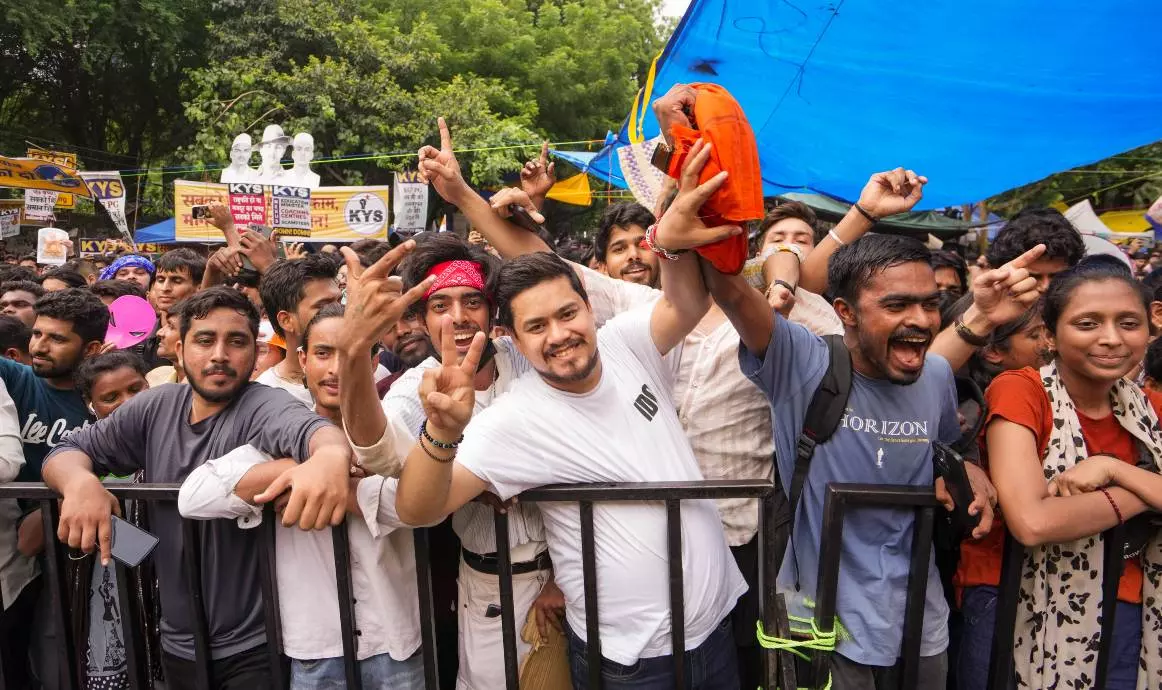
Dharmendra Pradhan's resignation may have marked a major political breakthrough for the nationwide NEET protest movement, but the Cockroach Janta Party (CJP)’s decision to call off its agitation has triggered a fresh debate over whether the protesters surrendered their momentum too early. Author and policy expert Pushparaj Deshpande calls the CJP’s move to suspend the agitation and return for talks after four weeks as “tactically unsound”. He instead advises protesters to stay put at Jantar Mantar and continue pressing for accountability from the government.
‘Movement should continue’
Deshpande says the CJP should have cashed in on its advantage after forcing a major political concession instead of retreating.
Using a football analogy, he compared the situation to a team nearing the opponent's goal but choosing to stop play before attempting to score. He said that no individual or organisation had the authority to unilaterally conclude a movement that had evolved into a nationwide public campaign. Every young Indian concerned about education had become a leader of the movement, and the protests should continue both online and offline until broader reforms were secured, he asserted.
Also read: ‘After Pradhan’s exit, protecting students from retaliation next big challenge’
The policy expert’s comment came during a discussion in The Federal’s Capital Beat programme.
Symbolic victory
Describing Pradhan’s resignation as a historic political moment, Deshpande argued that it marked the first time in over a decade that Prime Minister Narendra Modi had been compelled to remove a minister under public pressure.
According to Deshpande, the government acted not out of democratic accountability but because it found itself cornered by a movement that had expanded beyond organisational boundaries.
He argued that the protests had cut across caste, class, religion, gender and regional divides, evolving into what he described as a genuine people's movement with demonstrations taking place in around 100 cities across India.
He said that the agitation had grown far beyond the CJP itself, and that millions of young Indians had become stakeholders in demands for broader reforms in the education system.
Also read: Minister's resignation, PM's midnight reels: Why CJP protest is a rare political spectacle
Rather than ending the agitation after Pradhan's resignation, he said the protesters should have used the government's concession to push for deeper structural reforms in education and accountability for police action against demonstrators.
Movement at crossroads?
Deshpande’s argument comes in response to the fact that the government is yet to fulfill three remaining demands of the protesters – ₹1 crore compensation for the families of students who died by suicide, assurance of no action against student protesters, and a public apology from the RAF and Delhi Police for action against protesters.
CJP’s founder Abhijeet Dipke’s public announcement to withdraw the protest after Pradhan’s resignation, has left the agitation at a crossroads, posing questions over the fulfilment of the pending demands.
The government has not provided any written guarantee on the pending conditions and had instead sought additional time till July 28, creating uncertainty over whether the movement had actually concluded.
Also read: ‘Don’t make me a hero, country ruined by making one person a hero’: Dipke after Pradhan quits
Warning that the government could regroup if protests dispersed, Deshpande urged demonstrators to remain at Jantar Mantar and continue pressing for accountability from senior leaders, including Union Home Minister Amit Shah.
He maintained that the resignation represented only the first breach in the government's political armour and that abandoning the protest at that stage would weaken the leverage protesters had painstakingly built over weeks.
Pradhan's ouster: tactful move
Interestingly, Pradhan’s resignation has let loose a spate of social media messages and reactions by senior BJP leaders and followers deifying him and his tenure and describing him as a transformative education minister.
Deshpande argued that the statements reflected an attempt to protect the government's political narrative rather than acknowledge public anger.
Also read: From JP to CJP: How Delhi remains the epicentre of India’s power-shifting protests
He claimed the resignation appeared less like an act of accountability and more like a tactical response to mounting political pressure.
He warned that celebrating Pradhan's tenure immediately after his resignation risked undermining whatever goodwill the government hoped to generate through the move. He said that public praise for the former minister would only reinforce perceptions that the resignation was a political necessity rather than an admission of responsibility.
