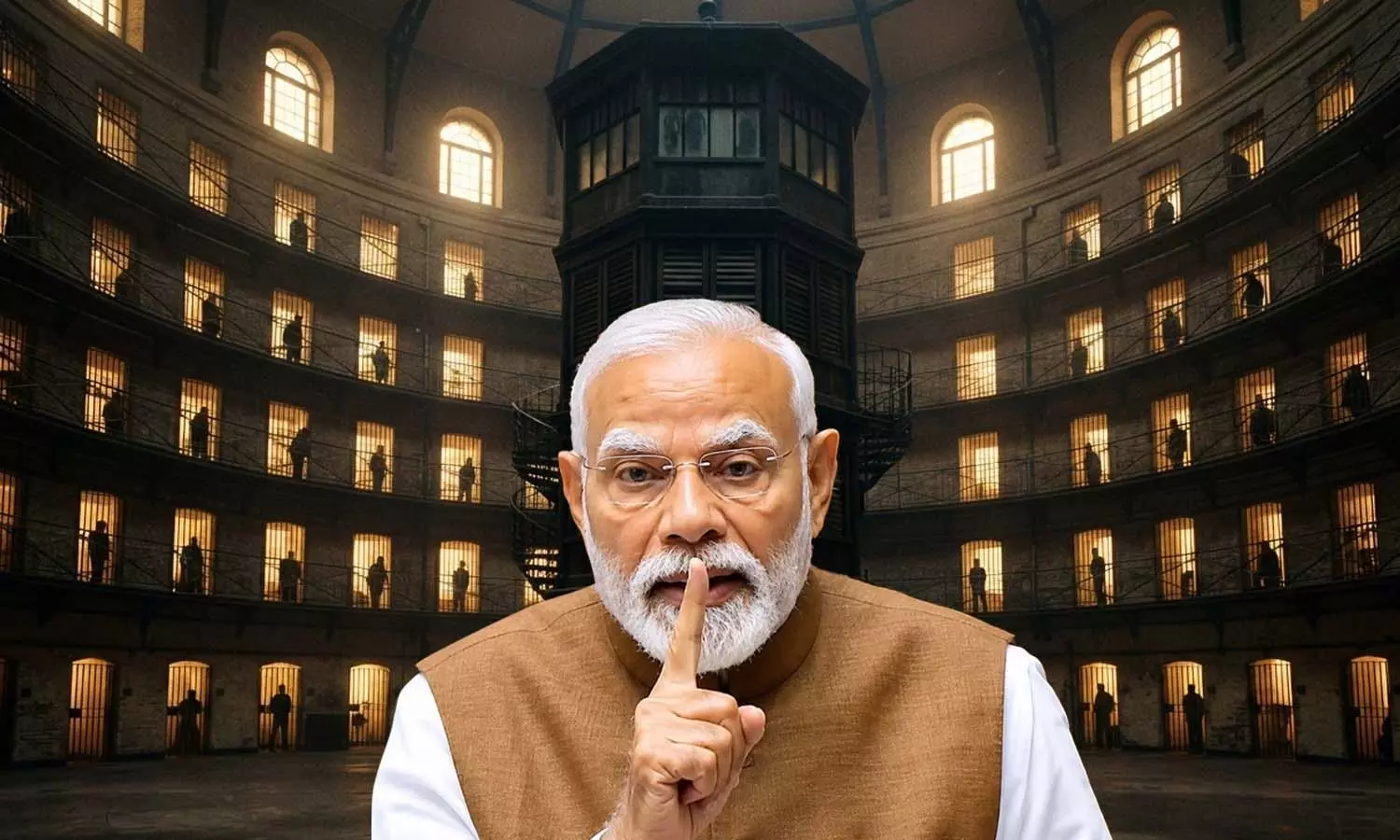
Modi’s “Dimagi Naxal” label is more than a political slur. It seeks to stigmatise dissent, foster self-censorship, and recast protest as a threat to national security
At an immediate level, Prime Minister Narendra Modi’s use of the political phrase “Dimagi Naxal” to negatively brand his adversaries—whether in other parties, the civil society, academia, legal fraternity, media and the students’ and youth activists, or across other demographic and professional groups—is evidence of a bare cupboard of political phraseology.
But on a deeper-than-rhetorical level, his decision to reuse the phrase—while addressing CRPF forces in Bastar, Chhattisgarh, on Diwali Day—he first uttered from the ramparts of the Red Forest in Delhi on Independence Day this year, serves as a deliberate polemical lexicon or pejorative framing designed to imprison public imagination, criminalise dissent, and systematically quell the waves of public agitations witnessed across India over the past several months.
The framing of political adversaries and protesting citizens as “mental subversives”, serves as a mechanism for restraining societal thoughts, emotions or ideas within “permissible” limits as set by the State or Hindu majoritarian forces.
Traditional authoritarianism vs ideological authoritarianism
To be able to precisely comprehend the manner in which the “Dimagi Naxal” label imprisons the thinking of people across the board, one has to look beyond security barricades and tear gas used recently against protesters across India, into the realm of psychological architecture.
Also read: Modi, Gen Z protests and INDIA bloc: ‘BJP’s moral halo is gone,’ says analyst
Traditional authoritarianism, for instance the one presided over by Indira Gandhi during Emergency, imprisoned the body but left those detained in jails to interact with one another and draw up imaginations of the future.
In contrast, ideological authoritarianism—as being witnessed now—seeks to lock up various categories of thought, especially those which are at variance or divergence with those which are State-backed. The intention is to stifle thinking, especially collective imagination and articulation.
Projecting dissent as a contagious cognitive disease
Few in India, especially once the term has been used as a disparagement, understand what is Naxal or Naxalism. However, from the time Manmohan Singh dissed this as the “greatest internal security threat” to India, the idea, ideology and its practitioners, are seen as extremists out to topple legitimate State power. This regime has been even more miserly with its causative factors.
Modi’s coinage goes beyond the coat lapel-pin that “Urban Naxal” was. The new denigration not just delegitimizes dissent as an alternative, but projects it as a contagious cognitive disease or a contaminated neural state.
Also read: Why Modi's 25 years in power mark the biggest consolidation of power in Independent India
Since June-July, when initial responses to Chief Justice of India Surya Kant’s uncalled-for labelling of unemployed youth and students as “cockroaches” began crystallising into street protests, their demands and grievances, along with the voices that the Opposition parties marshalled into protest sites, were strategically pathologised.
Repeated use of slurs like “Dimagi Naxals” for people who use their constitutional right to protest and articulate their thought is little but an exercise at imposing psychological lockdown. The intention is that before any citizen once again steps out to join a procession, they must evaluate the cost of dissent and the risk to their existence.
Foucault’s panopticon
The message broadcast with the “Dimagi Naxal” slur, almost 20 days after Modi buckled down on the demand for Dharmendra Pradhan’s resignation, was that if any member of the public sympathised with the protesters, shared their views, or reasoned like they did, their minds were infected. The intention was clear: Enable the creation of an invisible, internal panopticon where citizens police their own thoughts out of fear of state-sanctioned branding.
It is necessary to mention that in his tellingly titled Discipline and Punish, Michel Foucault drew the reader’s attention to how modern power moves away from physical torture or adopting restrictive policies towards internal surveillance.
Also read: Sonia recalls Gujarat riots relief camp, how a father's plea left her speechless
In the notion of the panopticon that he drew, Foucault painted a picture of prison inmates who never know if they are being watched at a particular instant or not. Consequently, they assume being monitored at all times. The State thereby require no guards or police; they occupy spaces within the minds of people.
Inverting the narrative
One of the biggest achievements of Jantar Mantar 1.0 in July was that the fear of staging protests disappeared as the lot saw that Modi was as vulnerable as any other mortal leader and could be made to yield before public pressure. Modi created the concept of “Dimagi Naxal” to reverse this process and reintroduce fear at protesting.
More than anyone else, Modi would be aware of the structural factors for discontent among people. The worry is that this sense of dissatisfaction or disgruntlement should not overflow from democracy’s underbelly in the form of mass mobilisation.
Faced with such a situation, the State seeks strategies to invert the narrative and this can be best done by dubbing adversarial ideologues and activists as deceitful manipulators who use the youth as pawns in an intricate, foreign-backed exercise where the objective is to bring about “regime change”, as if working to defeat an incumbent in a democracy is a subversive activity.
Melodramatic battle for national security against a cerebral enemy
In the backdrop of his inability to find solutions to everyday worries of the people—from joblessness, to rising cost of living, fear of being unattended on the doorstep of a crippling ailment and so on, the notion of Dimagi Naxals becoming a new pandemic shifts the national conversation away from policy failures or administrative crackdowns.
Also read: PM Modi warns of ‘dimagi Naxals’ after declaring armed Naxalism eliminated
The BJP wants people to shift their gaze to a melodramatic battle for national security against an invisible, cerebral enemy. This can be done when the imagination of devious conductors of disharmony and treason lurking around every corner is instilled among people. The widespread existence of “Dimagi Naxals” is thereby trumpeted from the highest pedestal in control of the State.
The intention is clear: Implant a chilling effect among the academia, civil society, media and others who are habituated to disagreeing with power, to such extent that they and their forums are forced into self-censorship.
Defending the nation against fifth columnists
Knowing well that in most movements, the cadre is relatively less politicised, the intention is to create two categories among those not with the ruling party—the Dimagi Naxals and the others. The intention is to isolate those in leadership processes, like by use of State power and devious administrative and quasi-judicial means, as has been temporarily done in the case of the “recognisable” leaders of the Cockroach Janata Party, or by repetitive use of the Modi-coined pejorative.
Framing adversaries as “Dimagi Naxals” also carries the advantage of being free and justifying taking harsh steps against them because of their allegedly treasonable characteristic. Every action can be defended and rationalised—the nation has to be defended against fifth columnists.
Also read: SIR row: Why is BJP out on the streets to ‘save democracy’?
Repeated use of slurs like “Dimagi Naxals” for people who use their constitutional right to protest and articulate their thought is little but an exercise at imposing psychological lockdown. The intention is that before any citizen once again steps out to join a procession, they must evaluate the cost of dissent and the risk to their existence.
Behind the use of disparaging labels is the intent of broadcasting that dissent is not an enshrined right in what was labelled once as the nation’s “only Holy Book”. Instead it is projected as an unacceptable hazard to national security and stability.
(The Federal seeks to present views and opinions from all sides of the spectrum. The information, ideas or opinions in the articles are of the author and do not necessarily reflect the views of The Federal.)