







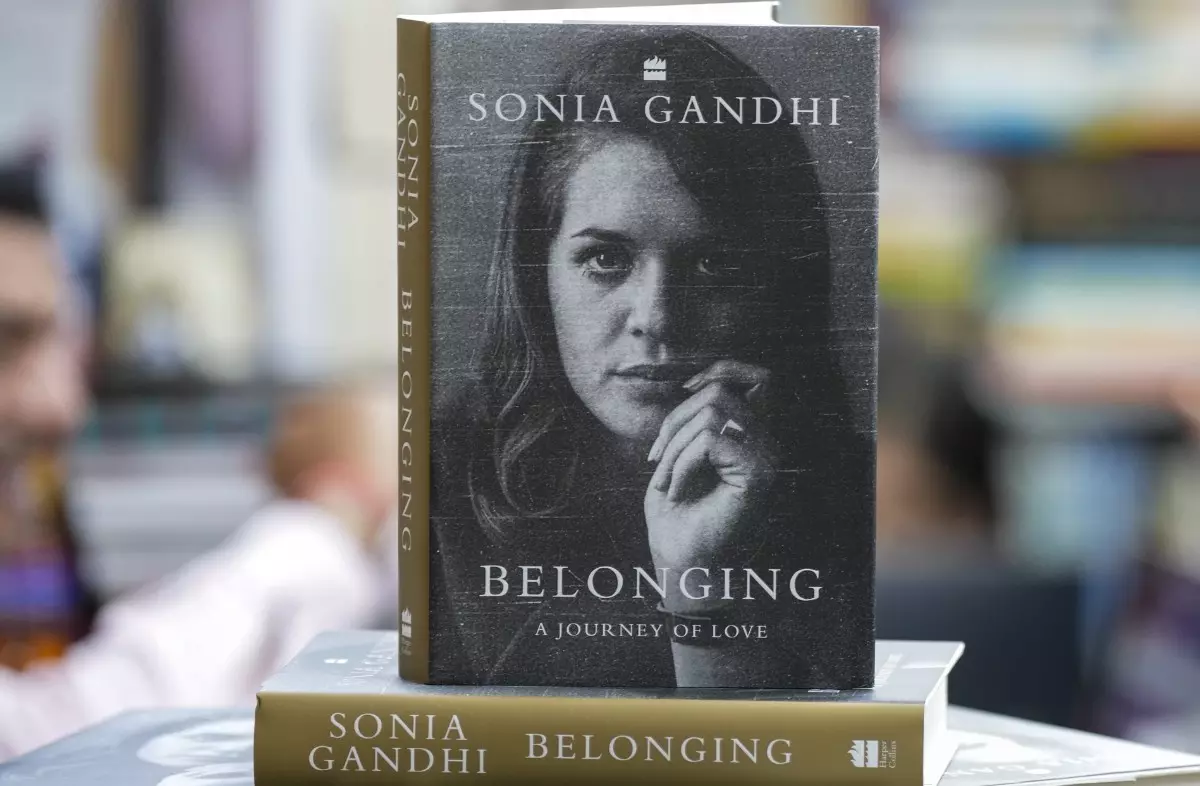
Copies of Congress leader Sonia Gandhi's newly released memoir, 'Belonging: A Journey of Love', displayed at a bookstore in Khan Market, New Delhi, Tuesday, November 10. PTI
Sonia recalls Gujarat riots relief camp, how a father's plea left her speechless
In memoir, the former Congress president describes visiting riot-hit Ahmedabad in 2002 and says Vajpayee was expected to dismiss Modi

Former Congress president Sonia Gandhi, in her just-published autobiography 'Belonging', has described the most "wrenching" moment of her years as Leader of the Opposition: a visit to a relief camp in Ahmedabad after the 2002 Gujarat riots, where a father begged her delegation for help.
In her memoir, Sonia writes that the violence was triggered when four coaches of the Sabarmati Express were set on fire, killing 59 pilgrims. The train was returning from Ayodhya carrying Hindu kar sevaks. She notes that the cause of the fire remains disputed, but that the turmoil which followed spread across many parts of Gujarat, and the victims were overwhelmingly Muslim.
Visit to Ahmedabad
She says the Congress watched the televised carnage in horror and tried to get help to colleagues in Gujarat who were calling in desperation. The administration, she writes, failed to respond. She adds that the riots were said to have been fuelled by the "fanatical fringe" of the BJP and RSS, the Bajrang Dal. Narendra Modi was chief minister at the time.
Also read: ‘Modi avoids eye contact’, ‘Indira cried after Op Blue Star’: Sonia Gandhi in memoir
She later joined an all-party parliamentary delegation that was cleared to visit Ahmedabad by a reluctant BJP government. Sonia describes a chilling atmosphere, with groups of young men shouting anti-Muslim slogans on the streets. The administration presented a report she found devoid of any feeling. The delegation was then herded into a bus "for security reasons" and taken to relief camps housing survivors.
Sonia says she mumbled words of sympathy
At one camp, crowded with traumatised men, women and children, a tall, emaciated man held up his young daughter, her face gaunt and dazed. He told the delegation she had been raped repeatedly, then broke down, pleading: "Main kya karun, kya karun? Kuch karo, kuch karo" (What am I to do? Do something).
Sonia writes that she stood in a state of stupor, gripped by horror and unable to offer more than a few mumbled words of sympathy.
She also writes that Prime Minister Atal Bihari Vajpayee was widely expected to dismiss Modi, but that pressure from within his party reportedly compelled him to desist. She notes that the US, UK and some European governments declared in 2005 that they would not grant Modi a visa, and that Modi later became prime minister.
The memoir also recalls a heated joint session of Parliament over what she calls a draconian Bill (Prevention of Terrorism Act (POTA), 2002), later repealed in 2004. Sonia says she felt she had gone too far in criticising Vajpayee, a veteran leader.