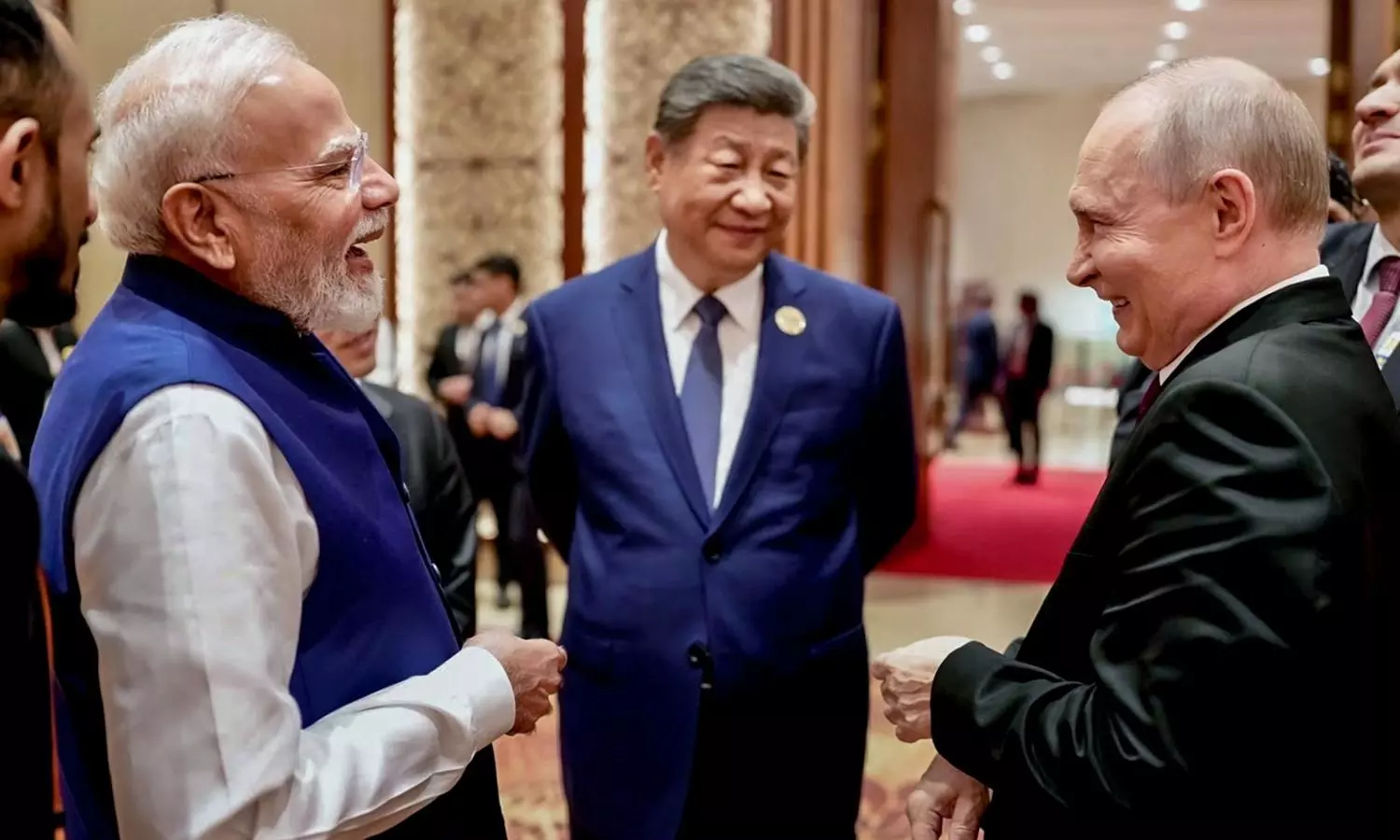
Prime Minister Narendra Modi with Russian President Vladimir Putin and Chinese President Xi Jinping on the sidelines of the 18th BRICS Summit last week, in New Delhi. (@narendramodi/X via PTI Photo)
From currency settlements to customs cooperation, India has a chance to deepen intra-bloc commerce while easing reliance on an unpredictable Trump-led Washington
BRIC was formed in 2006 to give a greater voice to the then-emerging economies — Brazil, Russia, India and China. South Africa joined later, and the configuration became BRICS.
China pushed for its expansion. It now has 11 members and 10 partners. It has become unwieldy, and the acronym itself has lost relevance. Consequently, as Ambassador TS Tirumurti and former sherpa of BRICS has observed: “BRICS has strayed quite far from where it started”.
I shall leave the politics of BRICS to foreign policy pundits and focus primarily on trade — an issue on which there is some convergence among the BRICS countries.
An anti-US economic bloc
US President Donald Trump recently suggested that the US could cut off commerce entirely: “We could do tremendous good for ourselves by just not trading with countries.” God Bless America if they wish to do so.
All BRICS countries, except for Iran, have close trade relations with the US. India more so, since it exports a wide range of goods and has a trade surplus with the US. Any decision by the US to harden its tariffs will impact BRICS-India more so.
It would be self-defeating to make BRICS an anti-US economic bloc, and India should resist any attempt to reduce BRICS to this.
Intra-BRICS trade
The focus should be on increasing intra-BRICS trade and reducing vulnerability to US unpredictability. Per a UNCTAD report, trade between BRICS members has grown rapidly, driven by strong complementarities. Thus, it crossed $1.17 trillion in 2024.
The dependence on intra-BRICS trade varies across bloc members, with Brazil, Russia and Indonesia being most dependent, and other countries less so. Nevertheless, intra-BRICS trade accounted for over 30 per cent of their total exports.
Also read | BRICS New Delhi Declaration: A diplomatic win, but little else
The report also shows that there has been a decline in tariffs. This is despite substantial differences in trade policies.
However, the increase in trade does not do justice to the enormous potential and, as the report ibid points out, there is an urgent need for targeted strategies to deepen trade ties and bridge the gaps. These include institutional and regulatory differences, institution and capacity gaps and geopolitical factors at play.
The currency question
The Delhi Declaration 2026 recognises this in several paras across its 140 paras. It highlights the trade-restrictive practices that have disrupted global trade and the need to work together across disciplines like trade facilitation, capacity building, enhanced connectivity, and access to technology in order to maintain the smooth flow of global trade.
Six ways to make BRICS count
♦ Deepen local currency settlement (rupee-rouble, real-yuan trade)
♦ Expand BRICS Pay to bypass SWIFT dependency
♦ Integrate UPI-style cross-border digital payment systems
♦ Launch joint Customs Enforcement Operations against smuggling
♦ Explore bilateral or bloc-wide free trade agreements
♦ Strengthen New Development Bank–funded infrastructure projects
Closely linked with the increase in trade, leading to less dependence on the US market, is the need to build on local currency settlement (rupee-rouble, real-yuan) and cut exposure to the US dollar. So, while an alternate reserve currency leading to de-dollarisation is unlikely to materialise for a long time, the dependence on the dollar and SWIFT system of settlements can and should be reduced.
In this regard, BRICS Pay is a concept designed to move to an alternate system of settling payments where national payment systems are linked directly, thus moving away from SWIFT as contemplated in the Kazan Declaration.
Digital payments integration
This should be pursued vigorously — as research papers have highlighted, transactions settled in this manner will also lead to a substantial reduction in costs. The New Development Bank (NDB), which has already financed several infrastructure and sustainable development projects, also has a role to play.
Prime Minister Narendra Modi has also spoken of UPI integration for cross-border digital payments. Brazil runs a similar domestic instant payment digital system, PIX, successfully. This needs to be pursued vigorously. It will be a win-win for all countries.
Also read: SCO and BRICS, yes, but is it time for India to revive SAARC?
A corollary to increasing trade is the need for ease of doing business, with speedy customs clearances being the key. The Delhi Declaration acknowledges the need for deepening customs cooperation among BRICS countries.
Customs enforcement ops
The BRICS Customs Centres of Excellence, which are in Xiamen, China and Palasamudram, Andhra Pradesh, would need to encourage regular training for BRICS customs officers.
Similarly, the BRICS Authorised Economic Operators (AEO) programme finds a mention in the Delhi Declaration. The AEO programme is a voluntary trusted trader programme which recognises entities with a strong compliance record. Customs administrations across borders mutually recognise each other’s AEOs as being risk free; there is a commitment for speedy clearance for such entities. With speedy clearance comes the risk of evasion.
India should explore the possibility of a BRICS free trade agreement. China is the powerhouse in the bloc and India has been wary of China’s ability to exploit any free trade agreement.
Hence, the Declaration also recognises the need for a ‘Customs Enforcement Operation’, based on mutually identified cross-border smuggling trends, shared priorities and operational feasibility and building on the experience of the first Joint Customs Enforcement Operation to improve operational coordination and address mutually identified and emerging customs threats.
A BRICS agreement on cooperation and mutual assistance in customs matters has been agreed upon in principle and would need to be formally signed. This is awaiting the validation of the administrations of several member countries.
Indian Customs has independent mutual assistance agreement with Russia, Iran, the UAE, China and Saudi Arabia and should increase the number of such agreements. What this ensures is a framework for exchange of information and cooperation.
Ultimately, BRICS should focus on WTO-consistent trade, and raise their voice against and desist from weaponisation of trade.
Confrontational policy against US
India should explore the possibility of a BRICS free trade agreement. China is the powerhouse in the bloc and India has been wary of China’s ability to exploit any free trade agreement. It may be recalled that India had backed out of the Regional Comprehensive Economic Partnership (RCEP) precisely for this reason.
Till such time as we do become confident of a bloc-wide trade agreement, India should explore individual agreements with the BRICS countries. In any case, the aim should be to reduce, if not remove, intra-trade chokepoints, move towards local currency settlements, promote trade, and make BRICS more meaningful than what it is now.
So, while BRICS need not adopt a confrontational policy against the US, it should be conscious that where they to put up a united front, nobody can trifle with them. After all, it accounts for nearly 50 per cent of the world’s population, 40 per cent of global GDP, and approximately 25-26 per cent of global trade.
Indian Customs has independent mutual assistance agreement with Russia, Iran, the UAE, China and Saudi Arabia and should increase the number of such agreements. What this ensures is a framework for exchange of information and cooperation.
Given the sheer disparities across politics, strategic interests, economies between the BRICS nations, consensus-building necessarily must be done brick by brick. Thus, progress on the theme of the 18th BRICS meet of building resilience, innovation, cooperation, and sustainability can happen only if these are predicated on patience with a clear roadmap.
As Modi mentioned in his closing remarks: “The world now expects from us not merely ideas and commitments but concrete results”.
(The Federal seeks to present views and opinions from all sides of the spectrum. The information, ideas, or opinions in the articles are of the author and do not necessarily reflect the views of The Federal.)