Emerging Pak-Saudi-Turkey axis could leave India strategically isolated if current domestic political signalling continues, with little help from other nations
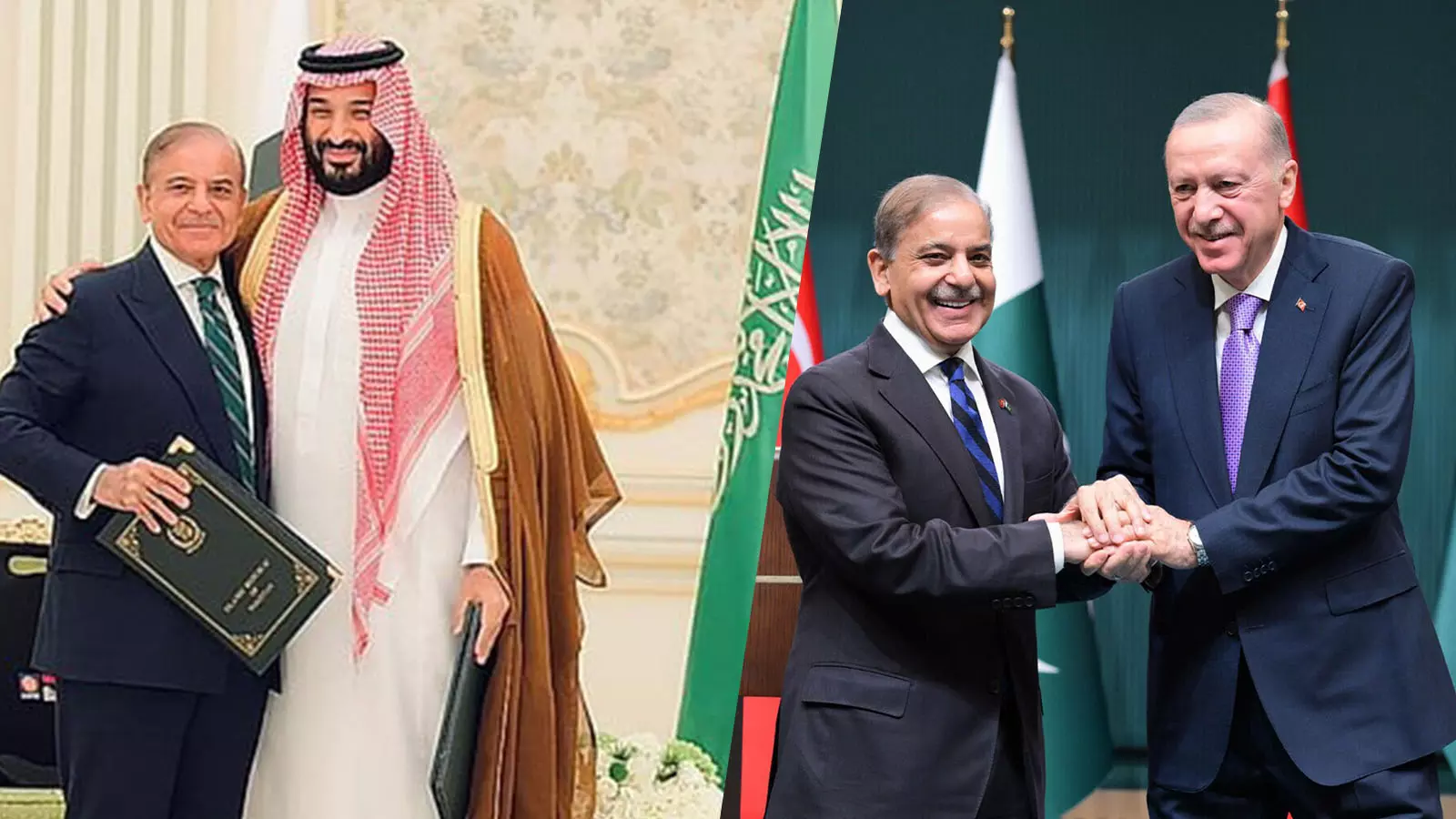
Recently, a new organisation is said to have been formed by three powerful Muslim countries to safeguard their interests in West Asia. According to both global and Indian media reports, Pakistan, Saudi Arabia and Turkey formed an alliance. This alliance has been described by the media as the "Islamic NATO".
Though Turkey was already part of the North Atlantic Treaty Organisation (NATO), where Europe, the US and Canada are in alliance, as a security military bloc of all these nations, it has now joined a religion-based alliance as well. Turkey’s army is the second biggest after America in that alliance.
Counterview | Why a Saudi-Pakistan defence pact doesn't imply an 'Islamic NATO'
Religion-based alliance
Turkey joining a religion-based defence alliance with Pakistan and Saudi Arabia is a major global development, and this will have huge implications for India and Israel. The Islamic NATO is expected to operate with Saudi money power, Turkey’s army power and Pakistan’s nuclear power.
The "North Atlantic" in NATO refers to the geographical location of the Western hemisphere. In the Middle Eastern alliance of Islamic Treaty Organisation, religion plays a central role going beyond the national interests of these countries.
Historically, whenever Islam as a religion is challenged, Muslims tend to join together as a united force. There are predictions that even Kuwait, Qatar and other Muslim nations in South Asia, like Indonesia, Bangladesh and Malaysia, may join this alliance in future. Now that Iran is in a major civil war situation, only the future will tell how its history will unfold.
No more neutrality
Ever since the Kashmir issue was reshaped following the abrogation of Article 370 by the BJP/RSS government as part of their long-standing demand during the rule of other political parties, and it was made into a Union Territory, not only Pakistan, but other West Asian Muslim countries seem to have moved away from their neutral stance on the Kashmir issue.
The BJP/RSS aggressive deployment of religious language by targeting Indian Muslims in elections, and their opposition to the term "secular" in the Preamble of the Constitution, has given rise to a feeling of a Hindu-Muslim clash in the making.
Also read: In today’s global cacophony, India’s challenge is to act with quiet steadiness
Well-known American political scientist Samuel P Huntington predicted that future conflicts would arise in the domain of religion, in what he called the Clash of Civilizations. Are we leading to a Hindu-Muslim conflict in future?
The RSS/BJP anti-Muslim campaign started in the 2014 elections, with a strong attack on the Congress — which handled the Kashmir issue and the Muslim people’s developmental issue with a democratically accommodative stance — as "Muslim appeasement".
This campaign continued for the past 11 years. Of late, the Islamic world started perceiving this campaign as anti-Islam. The Islamic world seems to have reassessed its relationship to Pakistan and India in this background.
Post Operation Sindoor
Operation Sindoor seems to be a turning point. Notwithstanding who won that four-day war, it changed global alliances. The Muslim world stood by Pakistan for the first time in this war.
During the 1965 and the 1971 wars, India could successfully isolate Pakistan by using India’s secular position in the global arena. At that time, the Muslim countries were convinced that it was basically an issue between these two countries and religion was not in the centrality of those wars.
The "Sindoor war" changed the narrative. The RSS/BJP government used the brutal killing of tourists in Pahalgam to attack the terrorist camps in what India calls Pakistan Occupied Kashmir (POK) and Pakistan calls "Azad Kashmir". These two are opposite perceptions of the partitioned countries.
During the Congress regime too, the same antagonism between the two countries existed. But the strong secular image of the non-BJP regimes could keep the rest of the West Asian Muslim nations away from Pakistan.
Anti-Muslim rhetoric in India
There is no doubt the RSS/BJP government pursued a massive global campaign against Pakistan harbouring terrorists. But, at the same time, the anti-Muslim political rhetoric continued within India in an aggressive tone by all RSS/BJP leaders, including Prime Minister Narendra Modi and RSS head Mohan Bhagwat.
They, along many other leaders, went on talking about Muslim appeasement by the Congress. At the global level also, they took up the campaign that Sanatana Dharma was/is Vishwa Guru.
Also read: Rising religious violence signals collapse of moral restraint in India and South Asia
Several NRI meetings in Muslim and Christian countries were organised with a religious nationalist vision. Added to this, the campaign by RSS/BJP leaders that the word "secular" must be dropped from the Preamble of the Constitution seems to have given an impression that they are targeting Islam as a religion.
It is here that a global view seems to have formed that the biggest democracy in the world will become a fully Hindu theocratic nation. Since there are Muslim countries around India with theocratic and unstable dictatorships, they have always envied the Indian democracy with a stable electoral system.
All religious nationalisms hate democracy as a system. The RSS/BJP seems to be falling in a trap by attempting to centralise religion in the state structure.
Israel-Palestine's recent war
The Middle Eastern Muslim countries have a long-standing conflict with Israel. They have not forgotten the 1967 war between Israel and the Muslim countries of that region.
Also read: How de-secularisation may slowly steer India away from electoral democracy
The recent Israel attack on Palestine as a response to the October 7, 2023 terrorist brutality on Jewish people was a genocidal war. It was just a one-sided war, except with minor losses to Israel.
These two factors seem to have led to the formation of the Islamic NATO by powerful Muslim countries.
The threat to India
The threat, however, is a bigger one to India. In terms of religious ideology, Muslims and Jews came from common Abrahamic (Ibrahamic) roots. In future, they could resolve that conflict without converting it into a religious global war. Already, they have signed an accord called the Abraham Accord.
Even if that accord does not work, Israel will have the massive support of the Christian world, as the Judo-Christian tensions have almost disappeared. The 56 Muslim countries have common organisations like the Organisation of Islamic Cooperation (OIC) and the Muslim World League (MWL) to them in the event of a major religious war.
There are not many Hindu nations — neighbouring Nepal may not join India in case a religious war breaks out. China will not back us given the history of rivalry. Beijing also wants democracy in India to be dismantled because a thriving neighbouring democracy influences its youth to aspire for a similar democracy.
Time for caution
The current situation demands that the ruling RSS/BJP be extremely careful in handling the rising global religious nationalism. If they keep attacking the basic secular structure of the Constitution by constantly deploying anti-secular and anti-Muslim rhetoric, the Indian path to survival and development will enter into a risky position.
This was the reason why the framers of the Constitution inscribed a deeper principle of secularism. The word "secular" in the Preamble is only an outward expression of that hidden secular structure. If they constantly attack it, the religious Muslim theocratic states will certainly take advantage of that discourse.
As a nationalist working for the expansion of secular productive nationalism, not religious nationalism, I wish the RSS/BJP would take this new development seriously.
(The Federal seeks to present views and opinions from all sides of the spectrum. The information, ideas or opinions in the articles are of the author and do not necessarily reflect the views of The Federal.)