Religious ideology is being used to manipulate elections and weaken secularism; this raises concerns of a shift towards authoritarianism, as seen in Pakistan
The state and religion worked as one functional unit in ancient and medieval times under the leadership of priests and kings. In India, for example, the Chandragupta Maurya’s state was established as the first-ever non-secular monarchical empire, with Kautilya as its Hindu head priest, and Chandragupta as the king.
But the powers of Kautilya, including emoluments, were more than the king's. Chandragupta was expected to rule according to Kautilya's advice. In fact, this was the first Hindu theocratic monarchical state in ancient India and also the world.
Chandragupta was known as a Shudra, as he was Mura, a Shudra woman’s son. However, we have no authentic information about his caste background. But we have authentic information about Kautilya, a Brahmin, and the author of the book Arthashastra (3rd century BC). Arthashastra suggests such a non-secular state mechanism for future generations to sustain the Brahminic social order.
Pope and the King
In Europe, a similar pattern emerged after the Catholic Holy See State was established in the late ancient times. The Pope was like Kautilya, controlling every king of the European state, and the king was supposed to function under his guidance.
This control was broken only after the Protestant rebellion of Martin Luther and the emergence of the Protestant Christian denomination. The first-ever revolt against the Pope came from Henry VIII (June 28, 1491 - January 28, 1547), a British monarch.
Also read: How Rajnath rewrites Ayodhya, twisting Nehru-Patel’s role in 1949
This revolt of Henry VIII could be compared to King Ashok’s revolt against Brahmin priestly Hinduism with his Buddhist vision. However, he did not separate religion from the state but subordinated Buddhism to his suzerainty. Exactly like how Henry VIII subordinated the Anglican Church through the establishment of the institution of Archbishop, similar to the Pope of the Holy See State.
The Archbishop could never direct the state policy in Britain.
Secular democracies
Gradually, the same Britain evolved into a secular democratic state, separating religion from the state, creating the idea of a secular state where even that one Protestant religion operating in the nation has no role in running the democratic institutions. This led to the emergence of many secular democratic states in the Euro-American continents.
Modi, who calls himself OBC and blames colonial rule for everything, would not have had the right to educate himself but for colonial rule, even in Gujarati, though it was exploitative in nature.
However, the Muslim world did not allow such secular democracies to emerge. Therefore, democracy as a modern political system did not stabilise in the Muslim world except in very few nations.
In the Eastern world, only India adopted the secular democratic constitution in 1949. By then, it had a more complicated, multi-religious society because several religions and political forces had entered India during the late medieval and modern periods, influencing and even subordinating the Hindu-Buddhist, Sikh, and Jain religious forces.
Particularly, Islam and Christianity made India a more complicated multi-religious nation. Both Islam and Christianity have a political history. The Indian Muslim rulers also established theocratic monarchical rule and ruled large parts of India for centuries.
Christianity and colonial rule
Christianity has its political relationship with colonial rule, though it arrived here symbolically in the 1st century AD itself. In view of this social complexity, the modern Indian thinkers had to carefully study the secular democracies of the West.
Historically, after the emergence of Christianity as a powerful religion, the Western nations became, by and large, ‘one religion’ states. Their secularism was basically a new mode of separating state from religion, as democracy was settling down.
Also read: Why PM's Ayodhya event is a statement on Sangh’s larger ideological vision, triumph
But India was/is a multi-religious and multi-caste country. It had to address both caste and religious conflicts. Its secularism had to be different. Both Dr BR Ambedkar and Pandit Jawaharlal Nehru seemed to have understood this complexity more than any other Indian thinkers.
The Indian democracy that worked stably for 75 years is on the path of de-secularisation after the RSS captured state power.
The freedom struggle evolved a new idea of a secular democratic state in the process of decolonising India. From 1947 to 2014, India functioned as a secular democracy.
It is true that Indian democracy was not evolved but it was created with the will of the people. Ambedkar, Nehru and Sardar Vallabai Patel played a key role in the process of establishing such a secular democracy. Mahatma Gandhi gave moral strength to that process.
De-secularising democracies
The 21st century witnesses a strange process of de-secularising global democratic states. Some are doing this quite rapidly, while some are doing it very slowly and haltingly. The Republicans in the US and conservatives in Britain and other European democracies are slowly de-secularising their democracies.
Within institutions, de-democratisation begins with the appointment of persons of one ideology under the command of the religious leader. For 11 years, the head of the RSS has been playing that role.
India is the only stable democracy surrounded by the Muslim theocratic monarchies and unstable Islamic democracies and Buddhist-Communist dictatorships, or monarchies, or democracies.
The Indian democracy that worked in a stable manner for 75 years is on the path of de-secularisation after the RSS captured state power. The Indian state and its institutions are becoming de-secularised with fundamentalist fervour because the Kautilyan-Manudharmic ideology is central to them.
The Indian education system is being brought under the grip of these ancient thinkers and other Sanskrit religious texts.
Also read: RSS at 100: Hindutva is an ideological camouflage for its Brahminical core
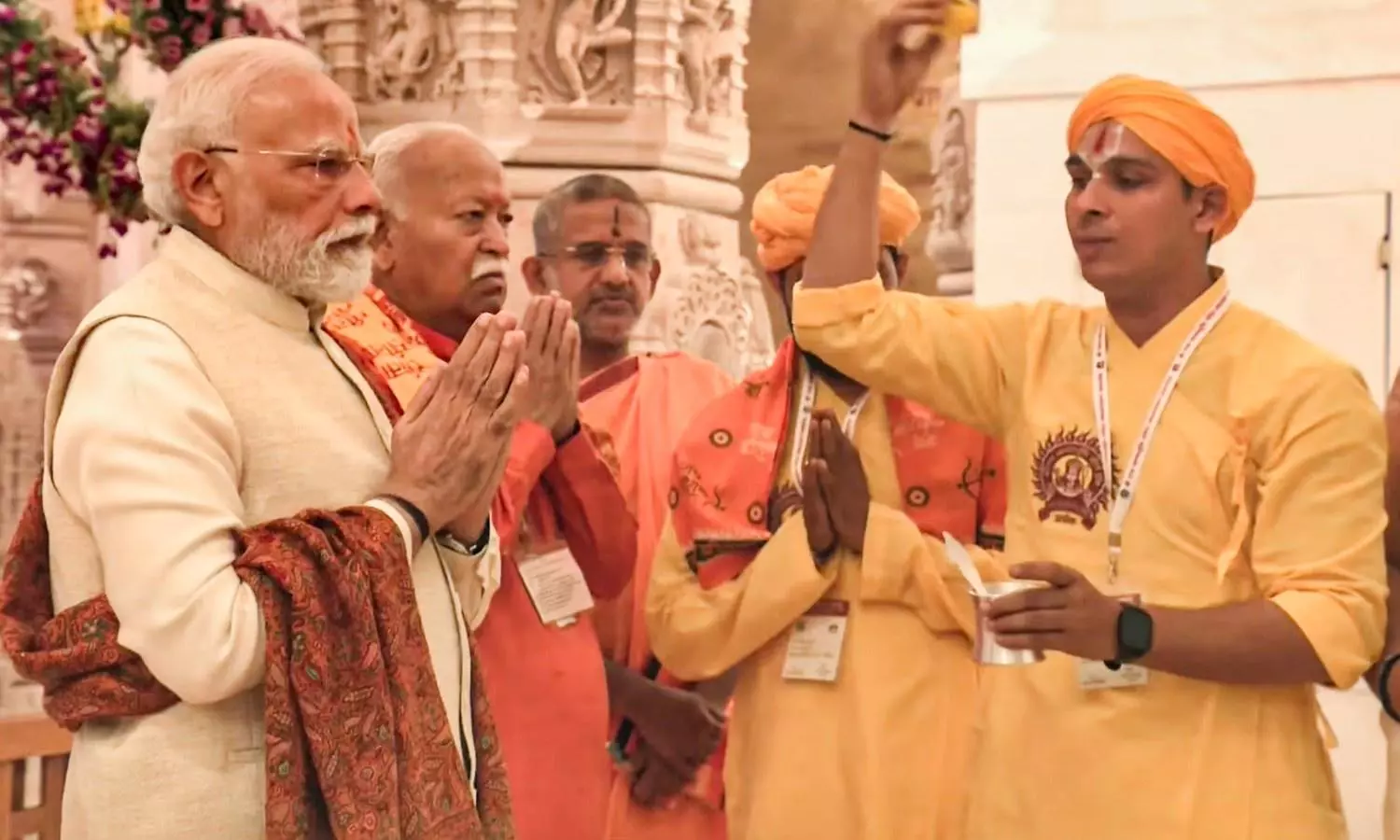
The process started during the Atal Bihari Vajpayee regime from 1999 to 2004, somewhat cautiously. Now, RSS chief Mohan Bhagwat, as a sort of Hindu head priest, and Prime Minister Narendra Modi, as the elected 'modern Chandragupta' with an OBC tag, are de-secularising every institution and the whole democratic set up by creating structures of deep fundamentalist state institutions.
De-secularisation is easier
Since religion and state worked as one unit for a longer time in human history, separating religion from the state was a difficult process. It needed a laboured theory of such a possibility.
Niccolo Machiavelli (1469-1527), in his masterpiece The Prince, first proposed such a separation. But it took a long and difficult process to make the state’s administration secular, while ensuring that individuals who followed a religion in their personal lives could still work in state institutions in a secular manner.
India had no history of such theoretical discourse as the vast Shudra/Dalit/Adivasi productive masses, who were kept outside the structures of organised religion — present Hinduism — had no right to education before the British established the colonial structures.
Ambedkar, Patel and Nehru
There was no theoretician from them to see through the prism of religion what would happen to them. Fortunately, Ambedkar emerged and saw through the danger of establishing a Hindu Rashtra. Sardar Patel, the only top Shudra leader, was not a thinker like Ambedkar, but was concerned about the Muslim question.
Nehru too was worried about the complexity in the context of the two-nation tussles. Understanding the complexity of the colonial state needed deeper education in modern world history and the power of English to compete with colonial rulers in developing new ideas for the future of India. The RSS kind of inward-looking knowledge in Sanskrit or Hindi would not have grasped the importance of secularism and democracy in those days.
Modi, who calls himself OBC and blames colonial rule for everything, would not have had the right to educate himself but for that colonial rule, even in Gujarati, though it was exploitative in nature. His ancestors were not allowed to educate themselves before colonial rule got established, even in the local language.
Unfortunately, under his leadership, the de-secularisation of the Indian state is taking place with a vengeance.
Religion as an institution does not allow dissent. It is an institution of faith, not reason.
During the freedom struggle, a learned atmosphere was created to understand the secularisation process as many of our freedom fighters got educated in the West. Particularly, Gandhi, Nehru, Ambedkar and Patel were conscious that democracy as a political system would not survive if the Kautilyan model of theocratic state was allowed to come into existence once the British left India.
That very idea of establishing a secular state in India was resisted by Brahminic pandits who thought that it was a British idea.
De-democratising institutions
Whether in India or in Western democratic states, de-secularisation often goes hand in hand with weakening democracy, where power becomes concentrated in the hands of one person. That person's vision is derived from religion, not from the point of view of people’s welfare and future. Peoples’ rights are subordinated to duties.
Within institutions, de-democratisation begins with the appointment of persons of one ideology under the command of the religious leader. For 11 years, the head of the RSS has been playing that role.
The scope of contending ideas and evolving policies, based on discussion and disagreement and by evolving a consensus or with a dissenting minority, still continuing to implement majority decisions in a democratic manner, is not allowed.
De-democratisation kills dissent in every institution. Of course, policy decisions are also influenced by the individual from a socio-religious point of view. A de-secularised state or institution does not allow discussion and dissent in any policymaking.
Religion as an institution
Religion as an institution does not allow dissent. It is an institution of faith not reason.
In India, this has been happening for the past 11 years. In America, this is happening during Donald Trump’s regime more consciously. There, the religious ideology is not very brazenly allied with state power as of now.
Already, mass protests have started against the de-secularisation trend in America. But in India, there are no such mass protests because it is a caste-divided society.
De-democratisation of institutions manages the election process of the governing forces. The entire election system, to start with, gets manipulated through religious ideology itself. Once the anti-secular forces capture state power, the direction is to slowly move out of the election system itself. In the process, like in Pakistan, the military dictators can emerge by using the same religious ideology in the very process in India, too.
India is going through a difficult phase, while being amidst non-secular dictatorships, by pushing itself into a de-secularised democracy as of now. Once de-secularisation is deep, it will move into a phase of deep de-democratisation. Those who are in agreement with de-secularisation as a historical necessity in a multi-religious nation cannot see the possibility of de-democratisation.
Many do not want to see.
(The Federal seeks to present views and opinions from all sides of the spectrum. The information, ideas or opinions in the articles are of the author and do not necessarily reflect the views of The Federal.)