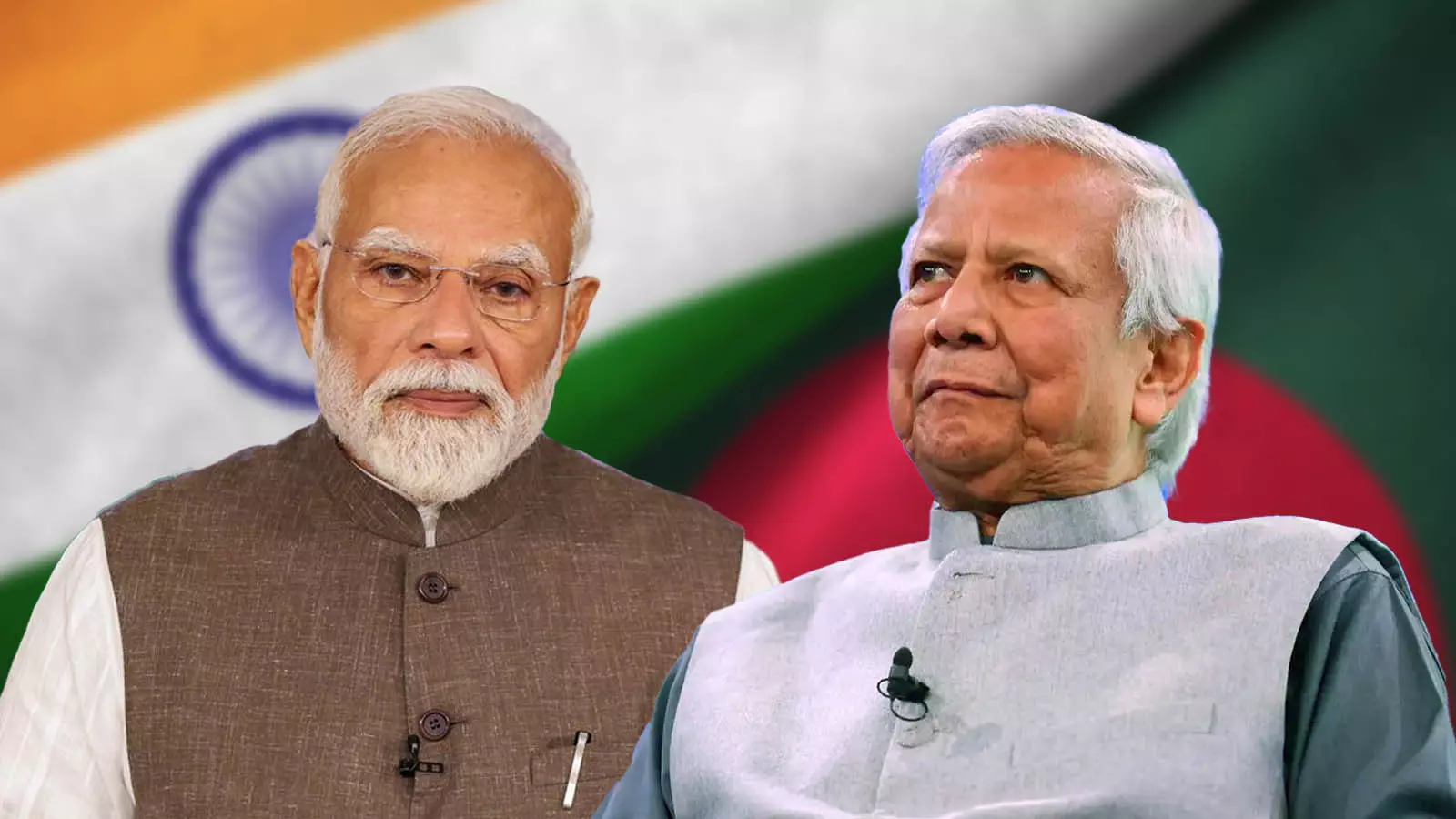
India and Bangladesh under their respective leaders, Prime Minister Narendra Modi and Chief Adviser Muhammad Yunus, have found it difficult to maintain peaceful ties.
India must show great patience and not use coercive strategies unless it is left with no option but to do so
India's ties with Bangladesh are going through their most challenging phase. This period began with the fall of Sheikh Hasina’s Awami League (AL) government in August 2024. Hasina came to India, which has permitted her and her family to live here. The interim administration in Dhaka, led by Muhammad Yunus, abandoned the AL’s policy of close cooperation with India.
Along with other anti-AL parties and groups, it demanded that India should not give shelter to Hasina. Following the imposition of a death sentence against her in November by Bangladesh's International Crimes Tribunal, the Yunus administration has demanded that India should extradite Hasina to that country so that she can face justice.
Also read: India-Bangladesh trade row hits Bengal jute mills, mill workers hard
Naturally, India cannot do so without losing credibility in the neighbourhood and beyond, because it will show that this country does not stand by those with whom it has had close ties in their time of need.
India’s policy seems to have rested on the premise that the elections will take place and that it will thereafter begin the task of repairing ties with Bangladesh with its new political reality. India has been correctly aggrieved with the negative attitude shown by the Yunus administration towards its security concerns.
The Hasina issue will remain a sticking point between the two neighbours. What India should do is to continue to give her and her family permission to live on its soil but not allow her to conduct any politics from here. New Delhi should convey to Dhaka that it is for its people to conduct their affairs as they deem fit and that it will respect their choices. This message can be emphatically given even today when passions are running high on both sides of the border.
Chaos before Bangladesh elections
While national elections have been scheduled for February 2026, the overall situation in Bangladesh deteriorated with the shooting of Sharif Osman Hadi in Dhaka on December 12. He died of his wounds in a Singapore hospital on December 18. Hadi gained prominence in the anti-Hasina demonstrations and rioting, which began in July 2024, eventually leading to her resignation.
Also read: Bangladesh media under attack, editors say ‘right to stay alive’ at risk
He was the founder and spokesperson of the Inqilab Mancha. Hadi was avowedly anti-Indian. His death has fanned these sentiments further. During the demonstrations, a factory worker, Dipu Chandra Das, was accused of blasphemy by a mob in Mymensingh and killed on December 18, the same day Hadi died. Later, his body was hung and burnt. Around the same time, there were angry protests against the Indian Assistant High Commissioner’s office in Chittagong. For safety reasons, India suspended issuing visas in Chittagong.
The anti-India emotions expressed by the demonstrators have naturally caused resentment in New Delhi. Besides, Das’s death has caused anger, particularly in the Sangh Parivar groups such as the Vishwa Hindu Parishad (VHP) and the Bajrang Dal. They have demonstrated in front of the Bangladesh High Commission in Delhi. Bangladesh virtually accused India of not providing security to its representations in this country and has suspended issuing visas.
The present state of India-Bangladesh ties once again draws attention to the diplomatic structure that India should have in pursuing its relations with its immediate neighbours. In this context, it would be wise to turn to British India’s relations with Afghanistan.
Both countries summoned the other's high commissioner. These diplomatic moves are vitiating the atmosphere further. It is necessary for Dhaka to take a realistic view, but Yunus has not shown any consideration to India’s concerns since the time he became head of Bangladesh's interim administration. He is now not taking any steps to quell the sentiment in Bangladesh against India. On its part, the Narendra Modi government has allowed the VHP and the Bajrang Dal to demonstrate in front of the Bangladesh High Commission in New Delhi.
The foremost question regarding Bangladesh’s political situation is whether the elections will be held in February. If the current unrest continues, it is difficult to see how they can take place. There are extremist Islamist groups that want to take advantage of the situation to ensure the postponement of the election. They rule Bangladesh's streets and spew venom against India.
Also read: Bangladesh unrest: Anti-India protests, election uncertainty, Jamaat’s rise test Delhi's options
The Jamaat-e-Islami, which also has an anti-Indian agenda, has not so far indicated that it wants the elections to be postponed. The Bangladesh National Party (BNP), which is led by Begum Khaleda Zia, would, in all likelihood, want the election. While Khaleda is ill, her son Tarique Rahman has just returned to the country after 17 years in exile abroad. Naturally, it will take him time to assess the situation. Bangladesh’s security forces are not showing any inclination to take matters into their own hands. They are letting the Yunus administration handle them.
India waiting for post-poll scenario
India’s policy seems to have rested on the premise that the elections will take place and that it will thereafter begin the task of repairing ties with Bangladesh with its new political reality. India has been correctly aggrieved with the negative attitude shown by the Yunus administration towards its security concerns. This has been demonstrated by the development of its ties with Pakistan. Pakistani army generals have visited Bangladesh. It is obviously for Bangladesh to decide how it wishes to view its relationship with Pakistan.
However, India’s concerns are valid because, in the past, the BNP government allowed anti-India groups to live on its territory and also develop a close nexus with Pakistan’s Inter-Services Intelligence. Bangladesh was therefore used as a base against India. Hasina’s government showed concern for Indian sensitivities and did not allow countries like Pakistan to use its soil against India.
International focus on Bangladesh
Islamic countries such as Turkey and Qatar are taking great interest in Bangladesh's affairs. So is the United States. It is unclear, as yet, if they would also like the February election to be postponed. It is also unclear whether the US is advising the Yunus administration and the army to rein in the anti-Indian groups that are ruling the streets. It is widely believed that the US was not unhappy with Hasina’s fall. Some go so far as to suggest that it helped the demonstrations against her.
Also read: Bangladesh’s violence has a design: How Yunus and Jamaat’s interests converge
The US and the major powers should advise the Yunus administration that Bangladesh’s interests demand that it doesn't not alienate India. Indeed, a simple look at the map shows that Bangladesh cannot isolate itself from India. While it has resisted economic integration and full connectivity with India, the sections in that country that believe that Bangladesh can trouble India in its north-eastern region in cooperation with anti-Indian countries such as Pakistan, will only harm the country in the future.
They should know that India has the capability to defend its interests. As for India, it must show great patience for the present and not use coercive strategies unless it is left with no option but to do so. That stage has not been reached as yet.
How British India handled Afghanistan
The present state of India-Bangladesh ties once again draws attention to the diplomatic structure that India should have in pursuing its relations with its immediate neighbours. In this context, it would be wise to turn to British India’s relations with Afghanistan. There were broadly two schools of thought in British India on its dealings with Afghanistan. The first held that its policies should be those of ‘masterly inactivity’. That meant keeping itself away from the internal affairs of the country and dealing with whoever was in power in Kabul.
At the same time, it was necessary to monitor their activities and make them aware of British India’s red lines. If these were crossed, then punitive action would follow.
Also read: 'Real concern is Pakistan or outfits like Lashkar or Jaish using Bangladesh to attack India'
The second school favoured a ‘forward policy’ which ensured that Kabul was governed by a ruler who was installed, if necessary, by British India by force of arms. This naturally meant actively intervening in the internal affairs of the country. On the two occasions British India followed the ‘forward policy’, it came to grief.
India should also make it clear to its neighbours (Pakistan is an exception) that it was for their peoples to decide their own matters, but they should be conscious of India’s red lines. These red lines would be both on security and the rule of law and not on mob rule. This would mean that India deals with countries and not personalities and avoids projecting favourites. This would also mean letting other major powers know that it would counter their moves in the region but hopes that they would let it evolve as its countries make their independent choices.
This diplomatic structure would pose difficulties, but it should be attempted. And, this policy would mean that India’s neighbourhood policy is firmly under diplomatic control. Is it so currently? At a time of this great tension with Bangladesh, External Affairs Minister S Jaishankar has been in Sri Lanka. How should this be interpreted?
(The Federal seeks to present views and opinions from all sides of the spectrum. The information, ideas or opinions in the articles are of the author and do not reflect the views of the views of The Federal.)