Subir Bhaumik interview
'Real concern is Pakistan or outfits like Lashkar or Jaish using Bangladesh to attack India'
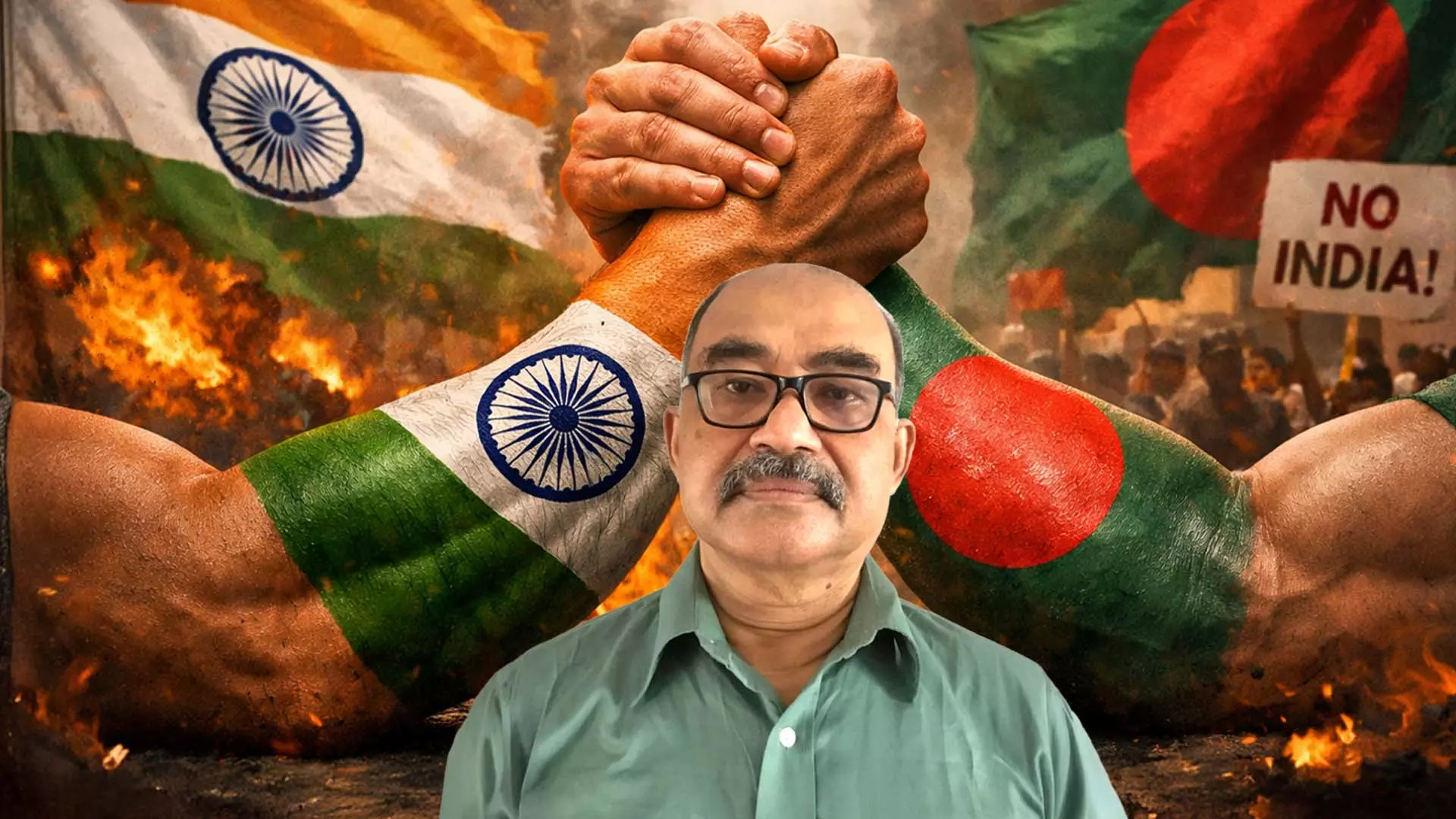
Journalist Subir Bhaumik discusses with The Federal the closure of Indian visa centres in Bangladesh, Dhaka's growing links with Pakistan and Turkey, and the potential security threats to India's Northeast

The Federal spoke to senior journalist Subir Bhaumik, a long-time observer of Bangladesh and the Northeast, to unpack the sharp downturn in India-Bangladesh relations. From street protests in Dhaka to larger regional realignments involving Pakistan, China, and Turkey, the conversation examines why the situation matters for India’s security and diplomacy.
Tensions between India and Bangladesh have escalated with the closure of India’s visa centre in Dhaka. What does this rise in tension signify, and why was the visa centre shut?
The visa centre was closed entirely for security reasons. What triggered this was an attempted political assassination about four days earlier. An Islamist leader, Osman Hadi, who was heading Islami Chhatra Manch, was shot in the head. He is now in Singapore, flown there by air ambulance, and his condition is serious.
Also read: India’s multiple diplomatic crises: Shyam Saran on how New Delhi is coping
After the fall of the Sheikh Hasina government, a number of Islamist groups have surfaced and become very active in Bangladesh’s political scene. It is quite obvious that the interim government led by Muhammad Yunus, despite his Western liberal façade as a Nobel laureate, has been patronising and backing these Islamist groups.
The moment the attack on Hadi happened, the Islamist groups began spreading stories that the assailant had escaped to India. This was followed by violent demonstrations in several places, with demands to shut down the Indian Embassy. The Indian High Commission had to be guarded heavily by local policemen as well as Indian security personnel.
These groups announced a march to the Indian High Commission. There was clear anticipation of large-scale violence, including vandalism, especially targeting the Indian visa centre, which is located some distance away from the high commission. In fact, several places were vandalised, including the Indira Gandhi Cultural Centre.
Also read: Bangladesh: Hasina gets 5-year jail term in land scam case
This vandalism fits a pattern we have seen since the fall of the Hasina government. Radical Islamists and anti-Hasina elements targeted Indian institutions because they see India as the principal backer of the Awami League. These Islamist groups are also very close to Pakistan.
Over the last few months, Pakistani military delegations, cultural delegations, and even Urdu poets have been visiting Dhaka. The irony is that Bangladesh’s freedom struggle was rooted in the Bengali language movement against the imposition of Urdu. Today, Urdu cultural events are being welcomed. This growing proximity with Pakistan corresponds with a sharp rise in anti-India sentiments.
How can India deal with this diplomatically?
India has to make it absolutely clear that the security of its missions is of paramount importance. Attacks on diplomatic missions or visa centres cannot be tolerated. This has already happened — the Indira Gandhi Cultural Centre was vandalised, and visa centres were attacked.
People in Bangladesh are desperate for Indian visas. Medical visas are crucial because many Bangladeshis come to India for better healthcare. They travel not just to Kolkata but across India, including southern cities like Vellore. For education, shopping, and treatment, Bangladeshis form the single-largest segment of foreign visitors to India.
Also read: India ramps up defence as Bangladesh-China threat grows around Siliguri corridor
If the government in Dhaka cannot protect a foreign mission, it reflects very poorly on that government. No matter what political tensions exist, fundamentalists and hotheads cannot be allowed to endanger diplomatic facilities.
India cannot, of course, use military force in such a situation. But it must insist that all international conventions governing diplomatic intercourse be respected. At the same time, India has to use very strong language to convey that it will not tolerate any anti-Indian activity from Bangladeshi soil.
There have already been reports of Islamist radicals crossing into Murshidabad during recent riots in West Bengal. Bangladesh cannot be allowed to become another Pakistan, where the soil is used for terror activities against India. This has to be conveyed very clearly.
For his own good, Yunus must get a grip on the fundamentalists who are running amok. Bangladesh today is witnessing what many there describe as “mob justice.” People are arrested or attacked without due process. Hasina herself was tried by what can only be described as a kangaroo court, with not a single defence witness. This erosion of justice has turned Bangladesh into what I call a vendetta republic.
Also read: Pakistan-Bangladesh axis emerges as India falls out of Dhaka's favour
Anti-India sentiment may offer Yunus and his Islamist allies some short-term political benefits, but if it spins out of control, it will severely damage Bangladesh itself.
With elections expected in February, there is concern that anti-India sentiments may be deliberately provoked to benefit parties like Jamaat-e-Islami. How realistic is this assessment?
This assessment is absolutely correct. With the League barred from contesting the elections, the political field has been fundamentally distorted. Yunus claims the election will be inclusive, but how can it be inclusive without the League, which led Bangladesh’s freedom struggle and ruled the country for half of its post-independence history?
You cannot imagine elections in India without the Congress. Parties lose elections, but they are not banned. In Bangladesh, that is exactly what has happened.
The Bangladesh Nationalist Party (BNP), the other major mass party, is now trying to capture the nationalist space by invoking the ethos of 1971. BNP founder Ziaur Rahman was a freedom fighter and a sector commander during the Liberation War; so the party is positioning itself to attract liberal Bengali nationalist voters who traditionally supported the League.
Jamaat-e-Islami, which historically never received more than 8-10 per cent of the popular vote because of its opposition to Bangladesh’s independence, now believes it can do much better. Its cadres sided with the Pakistani Army during the 1971 atrocities, a historical truth that most Bangladeshis remember.
Today, Jamaat is attempting to mobilise voters by whipping up Islamist sentiment, and at the core of that strategy is anti-India rhetoric. One Jamaat leader has even claimed that five million jihadis are ready to counter India if it dares to act against Bangladesh.
Also read: A theatre of justice: Why the Sheikh Hasina verdict fails the law
The central narrative they are pushing is that India sheltered Hasina and is refusing to hand her over so that she can be executed. They want to complete what they see as the “unfinished agenda” of 1975, when much of Sheikh Mujibur Rahman’s family was assassinated.
This is also happening amid reports of Bangladesh increasing military presence near India’s Siliguri Corridor, or the ‘Chicken’s Neck’. Some protesters have even spoken about cutting off India’s Northeast. How serious are these threats?
I do not take these protesters very seriously in conventional military terms. If they attempt anything of that nature, they will face consequences. India is a major military power, and Bangladesh does not pose a conventional military threat.
However, Bangladesh can be a serious nuisance in other ways. Before 1971, East Pakistan was used as a launching pad for insurgent activity in India’s Northeast. Naga and Mizo rebels were backed by Pakistan, using bases in East Pakistan.
Today, with growing proximity between Pakistan and Bangladesh, that danger could return. Hafiz Saeed’s close associates have reportedly visited Bangladesh, delivering sermons in mosques. The real threat is asymmetric warfare, similar to what India faces from Pakistan.
You could see attacks like 26/11 in Mumbai replicated in places like Kolkata, or strikes on air bases such as Bagdogra or Hasimara using small teams of infiltrators and handheld missiles. These are real threats, not conventional invasion scenarios.
Also read: Is India caught in Bangladesh storm with Sheikh Hasina's death sentence?
Bangladesh’s military leadership knows its limitations. They are cautious even in confrontations with Myanmar or rebel groups like the Arakan Army. Some retired Bangladeshi officers talk loosely about grabbing the Northeast during an India-Pakistan conflict, but that is fantasy.
People in Assam, Manipur, and Tripura do not see Bangladesh as a friend. The political discourse there revolves around illegal migration from Bangladesh. No one in the Northeast is waiting to welcome Bangladeshi troops.
The real concern is Bangladesh being used by Pakistan or non-state actors like Lashkar-e-Taiba or Jaish-e-Mohammed to launch terror attacks inside India and then retreat. That would drag India and Bangladesh into conflict, which would directly benefit Pakistan.
Beyond Bangladesh, there are concerns about a wider axis involving Pakistan, Turkey, and China, including reports of a Chinese-developed air base near Lalmonirhat. How should India view this?
Lalmonirhat is indeed being revamped as an air base. I do not think the Bangladesh Air Force would be foolish enough to deploy frontline aircraft so close to the Indian border. Those assets would be extremely vulnerable.
However, the base could be used as a drone hub, especially for Turkish drones that Bangladesh is acquiring. The involvement of a Chinese company in upgrading the base is a concern. China may not directly back terrorist activity — it values the Indian market too much — but it can certainly use such facilities for intelligence gathering.
Also read: Sheikh Hasina death sentence: Can India refuse extradition? What treaty says
The Siliguri Corridor is extremely sensitive for India. If China were to exert pressure from Doklam while also having intelligence or logistical presence in Bangladesh, India could face a worst-case scenario of being squeezed from both sides.
Turkey is another emerging problem. Under Recep Tayyip Erdoğan, Turkey has been trying to position itself as a leader of the Islamic world after failing to join the European Union. India has responded by leveraging economic pressure — Indian tourism to Turkey has dropped dramatically.
India must remain mindful of a potential two-front challenge, both in conventional terms and through asymmetric warfare. The danger is not a coordinated war, but terror attacks launched from the east to destabilise India and draw it into conflict.
Is this the moment for India to recalibrate its diplomatic options in the neighbourhood?
Absolutely. India must recalibrate and keep all options open. The criticism that India put all its eggs in one basket by backing the League is oversimplified. India tried to engage the BNP-Jamaat government between 2001 and 2006. Tarique Rahman was welcomed in Delhi and met Indian business leaders.
Also read: Bangladesh on the edge: Why fragmentation looms and what it means for India
Yet during that very period, 10 truckloads of weapons were intercepted in Chittagong, destined for ULFA (United Liberation Front of Asom) leader Paresh Baruah, with the knowledge of BNP leaders and security officials. Those responsible were later jailed after Hasina returned to power.
India made genuine efforts under Atal Bihari Vajpayee to broaden engagement, but those efforts failed because elements in Bangladesh chose hostility over cooperation.
Ultimately, India will deal with the government of the day in Dhaka. If that government seeks friendship, India will reciprocate. If it is hostile, India will respond accordingly. Indians are not fools.
(The content above has been transcribed from video using a fine-tuned AI model. To ensure accuracy, quality, and editorial integrity, we employ a Human-In-The-Loop (HITL) process. While AI assists in creating the initial draft, our experienced editorial team carefully reviews, edits, and refines the content before publication. At The Federal, we combine the efficiency of AI with the expertise of human editors to deliver reliable and insightful journalism.)