Low-profile appointment draws attention to how decision-making has moved away from collective structures within Sangh Parivar to a narrow, powerful centre
The ‘talking points’ listed by politicos, scribes and commentators in the wake of the abrupt announcement of a new BJP working president have been chiefly restricted to the ‘personal domain’. This has resulted in little or no discussion on a major malaise that continues to afflict post-independence Indian politics, barring short interspersed periods – a lopsided relationship between the government and ruling party of the day.
Instead of forging balanced ties, wherein those in government recognise the role of the sangathan or organisation in catapulting them to power, more often than not, the party structure has been completely hegemonised by the one, who wields almost absolute control over levers of political and administrative power.
Likewise, there have been a few contrasting exceptions where the party apparatchik considered that those holding constitutional positions, were mere proxies because party bosses were the ones who controlled the organisational ‘machinery’ which had innate capacity to influence voters, a characteristic that even the most charismatic of leader needs.
Asymmetrical relationship
In an ideal democratic polity, the political party is the vehicle of permanence, while the government is transitory and the two must be mindful of the concerns and limitations of the other. Leaders in government should not forget that they hold the ‘chair’ for a mandated period.
If they occupy the other chair too, either on their own – dispensing with the principle of ‘one-person-one-post’, or through a stand-in, the party structure will lose its independent distinctiveness and crumble because of becoming synonymous with the State.
Also read: Why did BJP pick 45-year-old Nitin Nabin as BJP working chief?
If the term of those in government gets shortened, either due to inversion of the numerical equation in the legislative body, or for political incompatibility within the treasury bloc, the party structure alone has the capacity to prepare grounds for a comeback.
In an ideal democratic polity, the political party is the vehicle of permanence, while the government is transitory and the two must be mindful of the concerns and limitations of the other.
The primary reason for this asymmetric relationship between the government and the ruling party in India is that the structure of Indian political power and governance evolved out of a long drawn anti-colonial struggle.
On India securing Independence, the first government emerged out of the national movement – it is important to recall that the first council of ministers that Jawaharlal Nehru constituted in 1947, was ‘national’ in character, owing to leaders from outside the Congress party being drafted into it.
As the movement ‘led’ by the party metamorphosed into the government, those in the government mistakenly assumed that they were ‘still’ the party.
Party's diminishing power
Like the Congress, BJP leaders asserted, contentiously, that the party’s emergence was in the wake of the ‘second’ Independence movement, a phrase used to denote the Ram Janmabhoomi.
Whether or not the demand for building a Ram temple in Ayodhya could be likened to the freedom struggle is debatable. Undeniably, however, the BJP emerged from the fringes of Indian polity in the last years of 1980s and early 1990s, chiefly by championing the issue.
Although the Ram temple and other hardline Hindutva articles of faith were put in the backseat during the BJP’s first stint in power (1998-2004), Prime Minister Narendra Modi’s assumption to office was the result of promising an astutely-balanced comprehensive package containing ‘development’ as well as Hindutva.
The BJP’s AB Vajpayee government was numerically short and the PM was not in a position to deliver on exclusivist Hindutva promises. Consequently, he had to weather intermittent pressure from the BJP and often, other RSS affiliates too, adopted positions critical of the government.
Also read: 'Blessing of the party': Nitin Nabin thanks BJP for national working president role
In the run-up to the 2014 elections, the BJP retained a semblance of this distinctive identity but once Modi became PM, the voice of the party became progressively quieter.
Diminished party leader
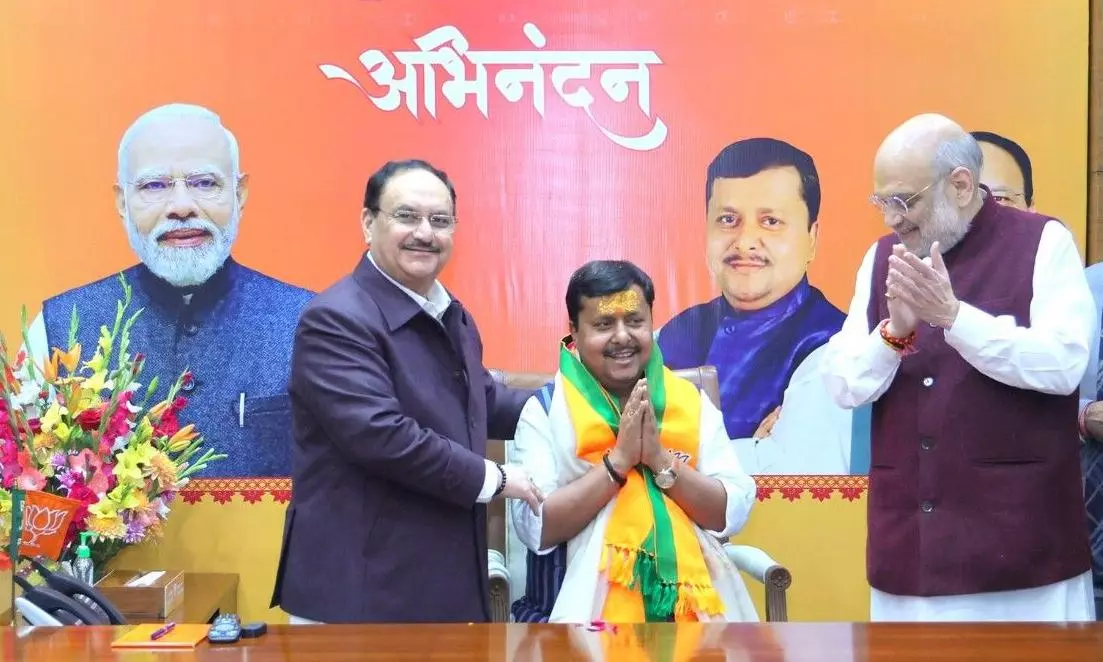
It is no surprise that Nitin Nabin is the most diminished party leader to have assumed the office of the president (I am presuming that his formal ‘election’ to that position, expected next month, is a mere formality). Undeniably, in the Modi era, the party president’s stature within the party has progressively shrunk.
Undeniably, Nabin’s stature, at least at the moment, is several steps below that of the outgoing party president and even several organisational leaders.
Even though neither Amit Shah, nor JP Nadda were party stalwarts when they assumed the office, in 2014 and 2019 respectively, they were head and shoulders more senior and better known within the party than the present incumbent.
From the beginning, Shah as party president made it clear that the party’s primarily role was to act as cheerleaders for Modi and accept what was already decided. However, the party president and his office had a distinctive identity, primarily because of Shah’s stature, that stemmed primarily from his proximity to Modi.
Shah, Nadda and Nabin
This distinguishing individuality of the party president during Nadda’s tenure was diminished mainly because his position in the Modi-led organisation (and government) was subservient to that of Shah.
Undeniably, Nabin’s stature, at least at the moment, is several steps below that of the outgoing party president and even several organisational leaders.
In his career so far, Nabin would have also been in awe of several veteran leaders holding various ministerial positions and were considered as potential party president, especially after Modi’s failure to lead the party to its third consecutive parliamentary majority despite undertaking a ‘guarantee’ for it.
Also read: Bihar Minister Nitin Nabin appointed BJP national working president, likely to succeed Nadda
Shah’s appointment in 2014 was primarily aimed at easing out party veterans who controlled it till then and replace them with Modi loyalists. Thereafter, Nadda’s elevation in 2019 was to enable Shah’s induction into the government and establish him as de facto number two in the regime, even while ensuring that Modi had his proxy as party chief.
Most centralised regime
Likewise, Nabin’s installation has little to do with organisational renewal, urgently required, especially after the ‘drift’ since Nadda’s term was sequentially extended without due procedure being followed, and more about tightening the grip of the Modi-Shah duopoly. It is a matter of time before another round of ‘purge’ is enacted, this time using Nabin’s new name-tag.
Quite unlike the Vajpayee years, when the party apparatchik and Sangh Parivar elders often put a spoke in the government’s wheels, the BJP organisational structure today resembles the Congress apparatus, especially during the Indira Gandhi and Rajiv Gandhi years.
If the infamous example of sycophancy, “India is Indira and Indira is India”, uttered by the Congress president during Emergency, Dev Kant Barooah is a prime instance of fawning in the Congress years (Nehru and even PV Narsimha Rao too controlled both government and party, for several years, also formally), there are examples galore of similar toadying in the Modi era.
Sonia-Manmohan duopoly
Sonia Gandhi, it must be appreciated, attempted to create a party-government duopoly with Manmohan Singh as PM. This was structurally done by the creation of the National Advisory Committee, which was formally provided an official status.
The move recognised the party as the vanguard and was aimed at ensuring that the government did not ‘stray’ from the promises that secured the mandate by voting out the BJP-led coalition.
But the NAC was labelled super-cabinet and Sonia Gandhi as its chairperson was pigeonholed as super-Prime Minister. By that logic, Modi should be labelled as not just ‘super’ BJP president, but also as the holder of all positions in government and the party, because this is the most centralised regime that India has seen.
History shows that the Congress party structure took time to regain its identity and resurrect its organisational network after being under control of domineering prime ministers. In the same manner, historians of the future will pass judgment on whether a similar fate befell the BJP too in the after-Modi era.
(The Federal seeks to present views and opinions from all sides of the spectrum. The information, ideas or opinions in the articles are of the author and do not reflect the views of The Federal.)