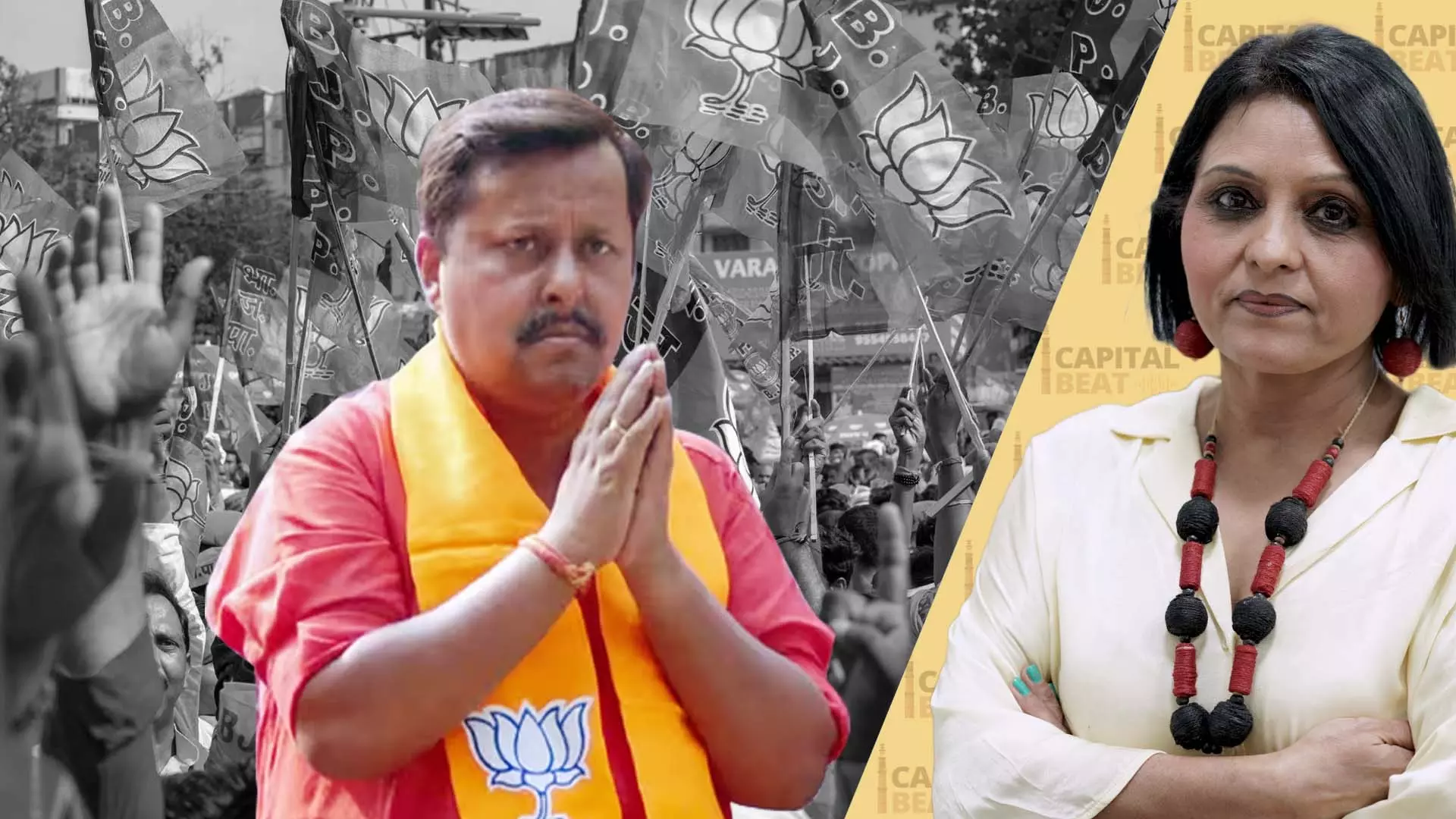
Nitin Nabin is a five-time MLA
Why did BJP pick 45-year-old Nitin Nabin as BJP working chief?
Nitin Nabin’s appointment is unexpected even for Bihar-based journalists tracking BJP corridors

Analysts Amarnath Tewary and Vivek Deshpande discussed the BJP’s decision to appoint Bihar minister Nitin Nabin as the party’s working president in a Capital Beat episode, amid expectations that he could be elevated as national president next. The panel also flagged parallel organisational changes in Uttar Pradesh and Bihar, and debated what the move signals about decision-making inside the BJP and the RSS-BJP equation.
The discussion centred on Nabin’s profile as a five-time MLA from Bihar, his organisational track record, and the surprise element of a relatively low national-profile leader being moved into a top party role.
It also examined how the appointment fits into a recent pattern of leadership picks that were not widely anticipated in political and media circles.
A surprise elevation in BJP’s top rung
Amarnath Tewary described the appointment as unexpected even for Bihar-based journalists tracking BJP corridors. “There was no murmur at all… it came as a shock yesterday evening for all of us.”
Tewary outlined Nabin’s political entry after the death of his father Navin Kishore Prasad Sinha, a seven-time MLA from Patna West, and traced his rise from a 2006 by-election win to repeated victories from the Bankipur assembly constituency.
Tewary cited Nabin’s 2025 win margin, stating that Nabin defeated his RJD rival Rekha Kumari by around 51,000 votes, describing it as one of the largest margins in Bihar.
Profile points highlighted in the discussion
Tewary called Nabin an “organisation man,” referencing roles in the Bharatiya Janata Yuva Morcha and the ABVP, and said he has handled ministerial portfolios in the Nitish Kumar cabinet.
There was no murmur at all… it came as a shock yesterday evening for all of us
Tewary also pointed to Nabin’s caste identity as a factor discussed in Bihar politics, stating: “He comes from upper caste… they are just 0.61% in the total population of Bihar.”
Tewary described Nabin as “non-controversial” and “very humble,” and relayed a personal interaction: “He immediately picked up [the] phone… and said, ‘Thank you, sir. Thank you.’”
The Modi–Shah dominance theme
On internal power, Tewary framed the BJP’s command structure in blunt terms: “It is a well-known fact that in the BJP only two persons hold the command, Amit Shah and Narendra Modi.”
Vivek Deshpande characterised the development as continuity rather than rupture: “In a sense it denotes status quo… it is the duo of Narendra Modi and Amit Shah who will continue to hold the reins.”
Deshpande emphasised that Nabin was not widely known outside Bihar: “Someone completely unheralded… not even nationally known… suddenly… he becomes working president.”
The RSS question raised on the panel
Deshpande repeatedly returned to whether the RSS was fully on board, saying the delayed appointment had been linked to an RSS–BJP tussle over the president’s post and that “we do not yet know whether this has been done with the consent of the RSS.”
He also flagged Nabin’s background as not necessarily a traditional shakha trajectory: “He belongs to the ABVP but he doesn’t belong directly to the RSS… whether he is… a grassroots RSS guy… nobody knows.”
Deshpande framed the move as possibly “testing the waters,” suggesting the party may gauge reactions in the Sangh Parivar before making a final presidential elevation.
Bihar, Uttar Pradesh, and the organisational churn
The discussion referenced leadership changes beyond the national post, including the appointment of Pankaj Chaudhary as Uttar Pradesh BJP president, which the host framed as another “Amit Shah’s man” pick.
He belongs to the ABVP but he doesn’t belong directly to the RSS… whether he is… a grassroots RSS guy… nobody knows
Tewary also brought up a Bihar organisational change, stating: “The BJP has changed its state president as well in Bihar,” naming Sanjay Saraogi, MLA from Darbhanga Sadar, as the new state BJP president replacing Dilip Jaiswal.
Tewary argued that choosing a leader from Bihar for a national role carries a political message after a major Bihar victory: “After an astounding victory in Bihar… [a] BJP chief who is also from Bihar… the party is trying to send a message.”
Limits of the party president’s autonomy
Tewary downplayed the independent authority of party presidents, arguing that in practice decisions flow from top leadership. He drew comparisons to other parties and leaders, naming Nitish Kumar, Lalu Prasad Yadav, and the Congress leadership structure.
Deshpande countered that a national-level party presidency is “a completely different ball game” than surprise chief minister picks, and warned against equating state-level “shock treatment” selections with a national organisation post.
Succession talk and internal unease
Deshpande addressed speculation about leadership succession and Amit Shah’s ambitions, while stressing the centrality of Modi’s electoral appeal: “It is Modi’s overwhelming personality cult… Amit Shah knows… without Narendra Modi… it is impossible… to get the kind of success.”
He also projected potential friction: a “45-year-old person… will now talk down to… top leaders… in their 60s and 70s,” adding that it may not be “a welcome situation for many.”
Tewary, when asked about reactions inside Bihar BJP, described “body language” suggesting discomfort but said leaders would not go on record against the decision.
The content above has been transcribed from video using a fine-tuned AI model. To ensure accuracy, quality, and editorial integrity, we employ a Human-In-The-Loop (HITL) process. While AI assists in creating the initial draft, our experienced editorial team carefully reviews, edits, and refines the content before publication. At The Federal, we combine the efficiency of AI with the expertise of human editors to deliver reliable and insightful journalism.