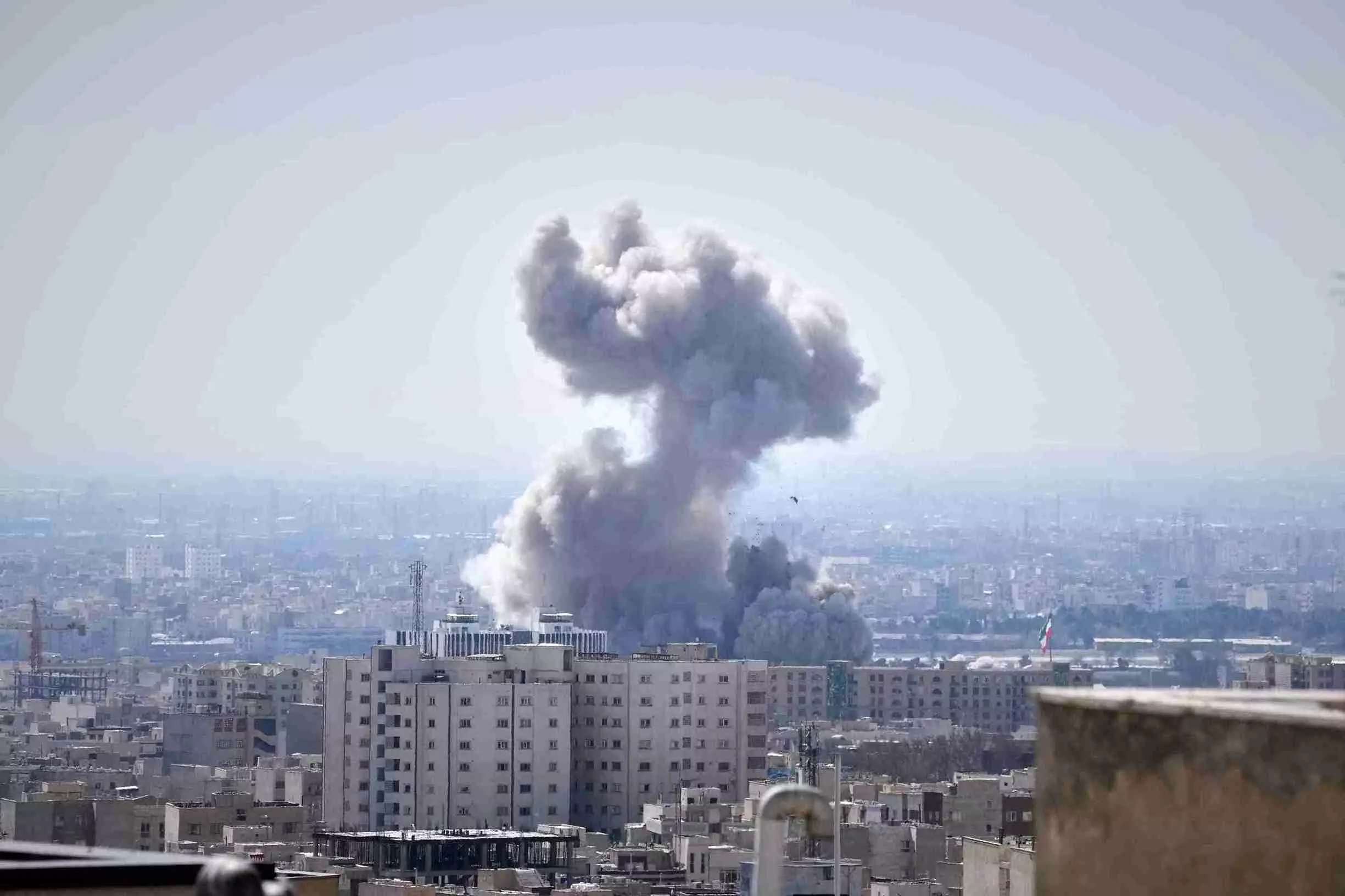
Gulf nations, including Saudi Arabia, should ideally have been in a position to force shut and evict US military bases from their land for their own safety
In 1967 and 1973, when Egypt, Syria and Jordan, backed by other Arab nations, went to war with Israel, Iran was not part of it. Over five decades later, the tables have completely turned with Iran finding itself at war with Israel, while none of the others is.
This strange twist, ironical as it is, among other things holds within it the key to understanding the current predicament facing the Middle-East, or West Asia.
Also read | Why China may benefit from a short conflict in Iran
If today Israel is able to freely attack Iran with no fear of retribution from any other nation in the region it reflects the stark story of how the Arabs over the last seven decades have failed in their fight to protect the rights of Palestinians and committed strategic errors, including falling into an existential trap set by the United States.
Roots of regional conflict
Israel, on the other hand, since its unilateral announcement as a fledgling, independent nation in 1948 has managed to entrench and consolidate itself controversially in what was once the territory of Palestine, in its entirety. Moreover, 75 years later the Jewish state has all but snuffed out the possibility of a Palestinian nation, envisaged as one of the two countries under the UN Partition Plan of 1947.
In a conflict situation like the one the world is witnessing now, it is necessary to reiterate why Israel and Iran are at war. The issue is intertwined with the Palestinian-Israeli conflict. Iran, after the 1979 revolution, has been a vocal and aggressive votary of an independent Palestinian state and has questioned the legitimacy of the Israeli nation.
By the time of Iran’s Islamic revolution in 1979, the Arabs had already fought the two key wars of 1967 and 1973. The Arabs were not only unsuccessful in defeating Israel, but also lost out on much of the territory that was already with the Palestinians (including East Jerusalem), all of which was occupied by Israel.
After the second defeat in 1973, for all practical purposes the Arabs never went to war with Israel and the territory that was lost could never be retrieved. All that was left of a possible Palestinian state was Gaza Strip and the West Bank. Even this was, for all practical purposes, occupied by Israel though there was a modicum of autonomy, largely for the sake of appearances.
Arab realignment and fallout
The Palestinians, who since 1948, had solely depended on the big Arab powers like Egypt, Iraq and Syria to get back lost territory were, for all practical purposes, left in a lurch. The Arab nations no doubt absorbed thousands of Palestinian refugees displaced from their homeland, provided asylum, gave citizenships and even logistical support for resistance groups, but none of it helped regain lost territory from the Israelis.
The Arabs, who were backed by the Soviet Union, shifted allegiance to the United States after the 1973 fiasco, concluding that it would be difficult to defeat US-backed Israel militarily. Egypt, under Anwar Sadat, was the leader of the pack, signing a peace deal with Israel in Camp David presided over by then US President Jimmy Carter.
Since then a slew of peace talks for the last more than five decades have yielded little for the Palestinians. But Israel used the time and the negotiations to make itself more presentable, change the narrative to project itself as the victim fighting to survive amidst hostile Arab states, all the while leveraging its proximity to Washington to emerge as a strong military power.
Also read | When your 'best friends' start a war, silence is not diplomacy
The US, all along donned the role of referee – but covertly neutralising the Arab nations, softening them with sops, marketing itself as an aspirational democracy, and providing the rulers attractive trade deals. The Gulf nations proved particularly vulnerable as all of them – Saudi Arabia, Qatar, UAE, Kuwait, Bahrain and Oman – were all monarchies, ruled by dynasties.
Deepening regional fault lines
From the point of regional security, the Gulf nations including Saudi Arabia should ideally have been in a position to force shut and evict the US military bases from their countries and ask Trump to stop attacking Iran in view of their own safety.
But, five days into the war, they have not been able to pressure the US. Nor are they able to convince Iran not to fire on them as Tehran holds the view that the military bases are US territory. In short, the Gulf countries have turned out to be the weakest players, unable to intervene effectively to end the fighting that is threatening their safety and credibility.
Over the years, successive US administrations have effectively used long-standing fault lines to create a divide between the Arab world and Iran, which is not Arab but Persian. The other important fault line is the Shia-Sunni divide within Islam. Iran is the leader of the Shia sect while most of the others in the region are Sunni-dominant like Egypt and most of the Gulf states. The Syrian government, which would have stood up for Iran, collapsed in 2024 when Bashar al-Assad, a Shia president, was ejected from power by a former Sunni militant backed by a joint US-Israeli operation.
Iran, meanwhile woke up to a new reality after the Islamic revolution in 1979. From a Shah-run country that was friendly to Israel and the US, it did an about-turn, making no secret of its hatred for the two erstwhile friends – US and Israel. With the Arabs no longer interested in military action against Israel, Iran took up the mantle.
Gulf caught between rivals
Iran’s hatred for the US, reflected by the 1979 hostage crisis resulted in a total break in relations that prevails to this day. The Islamic regime, insulated from the direct machinations of the American deep state, continued to remain hostile to Israel – with all governments in Tel Aviv viewing it as the single biggest threat to the Jewish state.
US Presidents, over the years, however desisted from obliging Israel to attack Iran. But the Netanyahu-Trump relationship ended this hesitation, resulting first in the 12-day war last June, followed by the latest conflagration.
The ongoing missile strikes against Iran and Tehran’s retaliation in its neighbourhood has therefore triggered a piquant situation in which the Gulf countries, particularly, have not only been caught in the cross-fire but also find themselves paralysed.
Also read | How Iran war will stoke inflation, even if oil supplies do not dry up
On the one hand, all of them are close allies of the US, including housing topnotch American military bases. On the other, with the exception of the Saudis, the rest share friendly ties with Iran.
Conflict deepens Palestinian plight
As for the other Arab nations like Egypt – for a brief while they looked like emerging from the shadows of the US during the so-called Arab Spring uprisings between 2010 and 2014. But that didn’t catch on, and a messy status quo was restored in most of these countries.
The ongoing missile war too will sooner or later die down. And, from the looks of it, though Iran has retaliated strongly to US-Israeli aggression, it will likely end in a stalemate with neither side gaining anything appreciably.
The real losers will again be the hapless Palestinians. Having already suffered a genocidal assault by Israel in Gaza that halted with a ceasefire last year, their chances of an independent state stands to further recede. Worse, it may even pose a challenge for the Palestinians to hold on to their existing shadow of a state in the West Bank and whatever remains of Gaza.