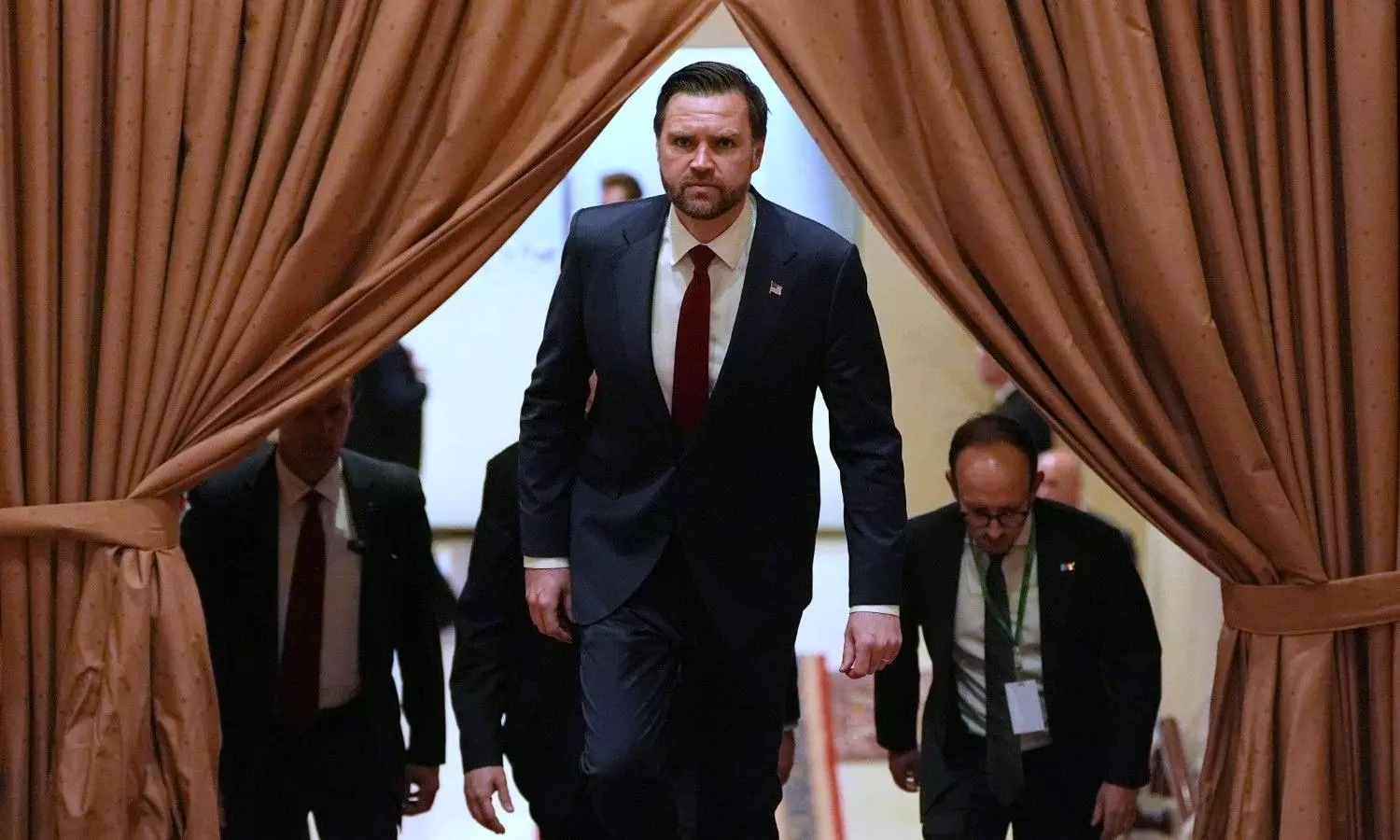
With the ceasefire expiring next week and Iran unmoved on nuclear enrichment or the Strait of Hormuz, the Islamabad talks have left the world no closer to peace
US Vice-President JD Vance and his negotiating team left Islamabad on Sunday (April 12) morning after 21 hours of talks with the Iranian delegation led by Speaker of National Assembly Mohammad Bagher Ghalibaf.
Prior to his departure, Vance briefly addressed the media. He said that there had been substantive discussions between the two sides and the US had made it clear where it could accommodate Iran and where it could not.
His final remarks indicated that the road to discussions had not been closed. He said, “We leave here with a very simple proposal — a method of understanding that is our final and best offer. We will see if the Iranians accept it”.
Vance on nuclear issue
The nuclear issue was the only specific matter Vance mentioned. What he stated on this most important issue needs to be quoted in full.
Also read | Pakistan's Vishwaguru moment? It's a narrow escape, not ceasefire
“We need to see an affirmative commitment that they will not seek a nuclear weapon and they will not seek the tools that will quickly enable them to achieve a nuclear weapon," he said. "That is the core goal of the President of the United States and that is what we tried to achieve through these negotiations."
He went on to say “...the enrichment facilities that they had have been destroyed. But the simple question is, do we see a fundamental commitment of will from the Iranians not to develop a nuclear weapon — not just now, not just two years from now, but in the long term. We haven’t seen that yet. We hope that we will."
Process not over yet
Both Vance’s concluding remark as well as the last sentence in his comment on the nuclear issue imply that the process of negotiations is not over for the United States. This is even if Vance put its “final and best offer”, even in ‘take it or leave it’ terms.
What next for US, Israel, Iran and the world?
♦ Ceasefire holds until April 21-22, for now
♦ Iran unlikely to give up Hormuz, its strongest card
♦ Nuclear commitment remains the US's non-negotiable demand
♦ Pakistan and other states will continue back-channel intermediation
♦ Risk of ceasefire collapse grows if either side sees delay as advantage
♦ Israeli pressure on Trump could trigger fresh strikes on Iran
♦ India has reasons to be worried
Interestingly, the term “final and best offer” is more used in commercial transactions rather than diplomatic negotiations. Does this indicate that for the Trump administration diplomacy has become akin to real-estate transactions?
Iran on the defensive
The Iranians, expectedly, blamed the US for the failure of these talks. The Spokesperson of the Foreign Office Esmael Baghei reportedly indicated that the talks had included the Strait of Hormuz, nuclear issue, reparations for conflict damage, end of hostilities against Iran and its proxies as well as end of sanctions.
He also asserted that Iran had defended its rights. The phrase ‘defend its rights’ is generally used to refer to Iran’s right to nuclear enrichment for peaceful purposes as inherent in the Nuclear Non-Proliferation Treaty (NPT). Iran is a signatory to the NPT as a non-nuclear weapon state. It signed the treaty in 1968.
The Iranian media on the basis of ‘sources’ is claiming it is now for the US to make the first move. This posturing is not to be taken seriously because intermediation by Pakistan and others that have a vital interest in avoiding a wider and more intense war will continue.
What about peace?
What are the prospects of peace in the light of the US and Iran not reaching an agreement in Islamabad? The ceasefire declared by the US extends till April 21-22. Hence, unless either side or Israel break it there is no immediate danger of the resumption of the bombing of Iran and its strikes on targets in the Arab Gulf states.
Also read | Is the US a military state camouflaged as democracy?
Great tension will, however, continue with the focus likely to be on the opening of the Strait of Hormuz and the end of Israeli strikes on Lebanon. It is difficult to see how Iran can fully open the strait for maritime traffic. This is their main card and they cannot simply throw it away.
Without it, the Iran conflict will become simply another US-Israel operation against a country. The world will express sympathy for Iran but will do nothing more. For the region, including India, in addition to the Strait of Hormuz, Iran’s action against the Arab Gulf states is a matter of very great consequence — there are nearly 1 crore Indians living in the Gulf states.
Styles of diplomacy
One of the points highlighted by the breakdown of the Islamabad talks is the different styles of diplomatic negotiations of the US and Iran. Under Trump, the US pursues what can be best described as diplomatic blitzkrieg.
The Iranian traditional diplomatic style is nuanced and unhurried. It follows the path of equivocation and sometimes even double-talk. It cannot easily handle ‘take it or leave it’ methods.
Besides, it is now uncertain who is taking final decisions in Tehran. Is Supreme Leader Mojtaba Khamenei well enough to take vital decisions, after consultations — even a Supreme Leader has to consult, especially if he has been newly appointed — which will involve major concessions?
What to expect
What will certainly happen is that both in Washington DC and in Tehran there will be intensive discussions on the next steps. This will happen even as sharp and vitriolic rhetoric will continue against each other and certainly Trump cannot be restrained.
Watch/Read | Trump-Iran ceasefire raises doubts despite talks of peace in region | AI with Sanket
The real issue is if the ceasefire has led to a weakening of Iran's will to carry on the struggle. Often, a break does that but in Iran the clerical system of the Vilayat-e-Faqih will keep references to shahadat (martyrdom) alive to prevent a reduction of popular will to carry on the struggle.
In cases of a pause or breakdown in talks amid a ceasefire, the danger is that one of the sides and even both can consider that time is of advantage to the other and then the ceasefire breaks down. If that happens, then the temptation for Iran to launch strikes against the Arab Gulf states oil and gas facilities and civilian areas will be great. That may lead to a situation of mayhem and chaos.
Intermediation is key
On the other hand, Trump, urged by Israel, will respond by attacking Kharg island and Iran’s power producing facilities. To avoid this development it is essential that the intermediation role of sober states is launched in addition to that undertaken by Pakistan.
Naturally, the world is disappointed that the talks in Islamabad did not yield results. It will continue to be on edge and its economic woes will continue and also deepen.
It will be prudent for India to prepare for a longer war while hoping for a shorter one. It is also necessary for the government to be more purposeful in preparing for how to handle chaos in the Gulf States should that unfortunately come about.
(The Federal seeks to present views and opinions from all sides of the spectrum. The information, ideas, or opinions in the articles are of the author and do not necessarily reflect the views of The Federal.)