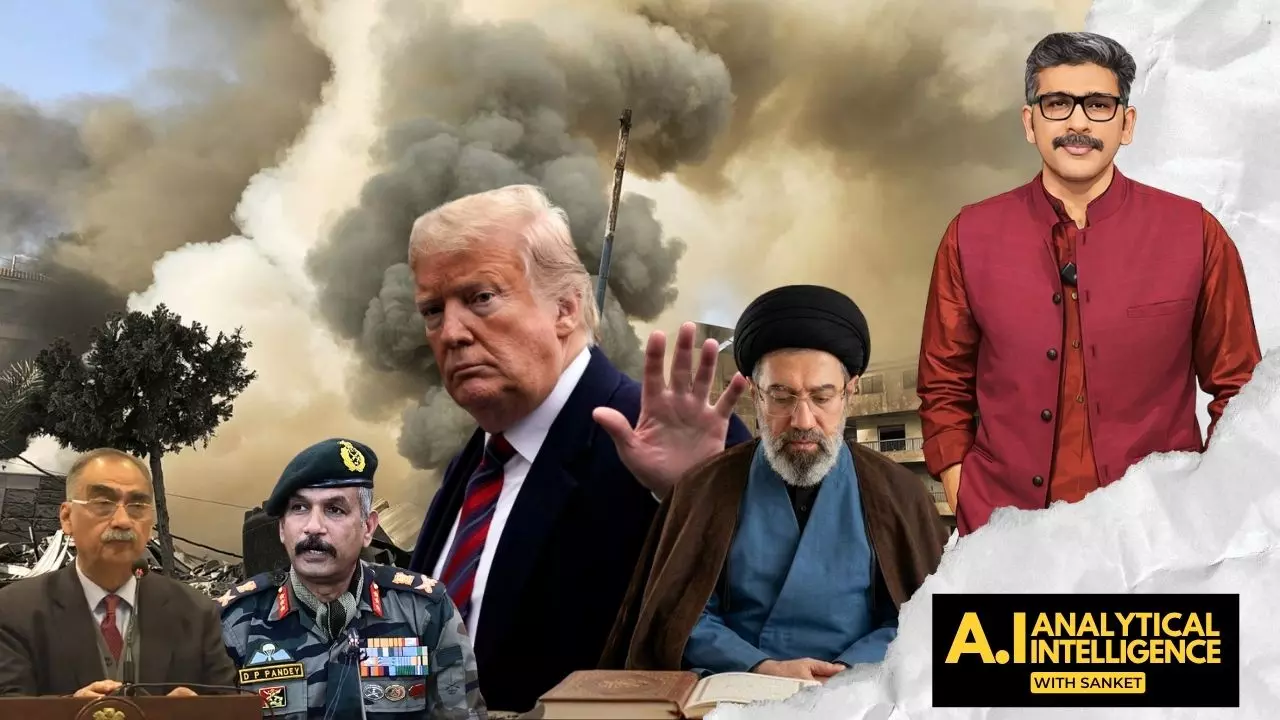
Trump-Iran ceasefire raises doubts despite talks of peace in region | AI With Sanket
Experts doubt Trump’s Iran ceasefire, citing conflicting demands, strategic tensions, and uncertainty over Israel’s role in shaping Middle East stability

“This ceasefire is great for the world, but very disquieting for the region,” said Lt Gen DP Pandey, summing up the uncertainty surrounding the latest geopolitical development between the United States and Iran.
As global attention shifts to the sudden ceasefire announcement by Donald Trump after weeks of escalating tensions, questions remain about whether this marks a genuine step toward peace or merely a temporary pause in a deeper conflict.
The Federal spoke to Lt Gen DP Pandey and former Ambassador Vivek Katju to unpack the implications of this fragile truce, the competing demands from both sides, and the broader geopolitical stakes.
Conflicting narratives
Lt Gen Pandey pointed out that both the United States and Iran are projecting the ceasefire as a victory. While the US claims it has achieved its strategic objectives, Iran has responded with a 10-point demand list that includes contentious issues such as uranium enrichment and control over the Strait of Hormuz.
Also Read: Doomsday averted, but can Iran war be settled across the table?
He argued that these demands are unlikely to be acceptable to Washington, making the ceasefire inherently unstable. According to him, the situation reflects not resolution but a pause amid unresolved tensions.
Pandey also highlighted that the US entered the conflict without full preparedness, citing lack of congressional sanction and insufficient resources to sustain a prolonged war.
Strategic undercurrents
Expanding on the geopolitical context, Pandey suggested that the conflict is less about Iran and more about countering China’s growing influence. He explained that energy routes and supply chains, particularly oil flows to China, are central to US strategy.
He noted that disruptions in regions like Iran, Venezuela, and Russia directly impact China’s energy security. In this framework, even a partial disruption serves American interests.
At the same time, he emphasized that Iran’s military infrastructure, particularly its underground facilities, remains largely intact, limiting the effectiveness of US strikes.
Limits of military gains
Pandey acknowledged that while certain capabilities, such as ballistic missile systems, may have been degraded, they have not been eliminated. He warned that ideological motivations within Iran remain strong and cannot be dismantled through military action alone.
He stressed that groups like Hamas, Hezbollah, and the Houthis may have been weakened but are far from neutralized. This, he said, underscores the temporary nature of any ceasefire that does not address underlying political and ideological drivers.
According to him, the US may have reached a point of “endurance fatigue,” with limited appetite for a prolonged conflict.
Ceasefire realism
Former Ambassador Vivek Katju offered a more measured perspective, suggesting that the ceasefire should be taken seriously, at least in the short term. He argued that the US has limited options and that continuing the conflict may not serve its immediate interests.
Katju noted that while Trump may have preferred a decisive outcome, Iran’s resistance has forced a shift toward negotiation. He added that even Israel, despite its strong influence, may have to align with Washington’s current approach.
He also observed that global opinion, particularly in response to Israel’s actions in Gaza, has somewhat shifted, potentially influencing US decision-making.
Pakistan’s role
Addressing the role of Pakistan as a mediator, Katju acknowledged the irony but emphasized the pragmatic nature of international diplomacy. He stated that both Iran and the US view Pakistan as a convenient channel for communication.
He pointed out that global perceptions of Pakistan differ from India’s perspective, especially in diplomatic contexts. This allows Islamabad to play intermediary roles despite its controversial reputation.
Katju stressed that such arrangements are driven by necessity rather than endorsement.
Tough negotiations ahead
On the issue of the proposed peace frameworks, Katju clarified that the Iranian 10-point plan should be seen as an opening position rather than a final agreement. He noted that demands such as uranium enrichment, control over Hormuz, and removal of US assets from the region are significant sticking points.
He emphasized that negotiations will be complex and time-consuming, with both sides likely to recalibrate their positions. According to him, the current ceasefire provides a window for dialogue rather than a definitive resolution.
Katju also highlighted the impact of global oil markets and domestic political pressures in the US, particularly ahead of elections, as factors influencing the push for peace.
Trust deficit persists
Both experts agreed that trust remains a major issue. Pandey questioned whether the US and Israel can be relied upon to uphold the ceasefire, while Katju pointed to Trump’s unpredictable rhetoric as a complicating factor.
Also Read: Shades of violence: India, Western powers, and global conflicts
Katju dismissed extreme statements about ending civilizations as unrealistic, noting that civilizations are rooted in cultural and historical continuity rather than physical infrastructure.
He argued that while dramatic rhetoric may serve political purposes, it should not be taken literally in assessing long-term outcomes.
Uncertain future
As the two-week ceasefire unfolds, the situation remains fluid. While there is cautious optimism about the possibility of de-escalation, both experts warned that the underlying issues remain unresolved.
Pandey described the ceasefire as part of a larger strategic game, suggesting that the coming weeks will reveal deeper intentions from all parties involved.
Katju, meanwhile, emphasized the importance of sustained dialogue, noting that even temporary pauses can create opportunities for longer-term solutions.
The content above has been transcribed from video using a fine-tuned AI model. To ensure accuracy, quality, and editorial integrity, we employ a Human-In-The-Loop (HITL) process. While AI assists in creating the initial draft, our experienced editorial team carefully reviews, edits, and refines the content before publication. At The Federal, we combine the efficiency of AI with the expertise of human editors to deliver reliable and insightful journalism.