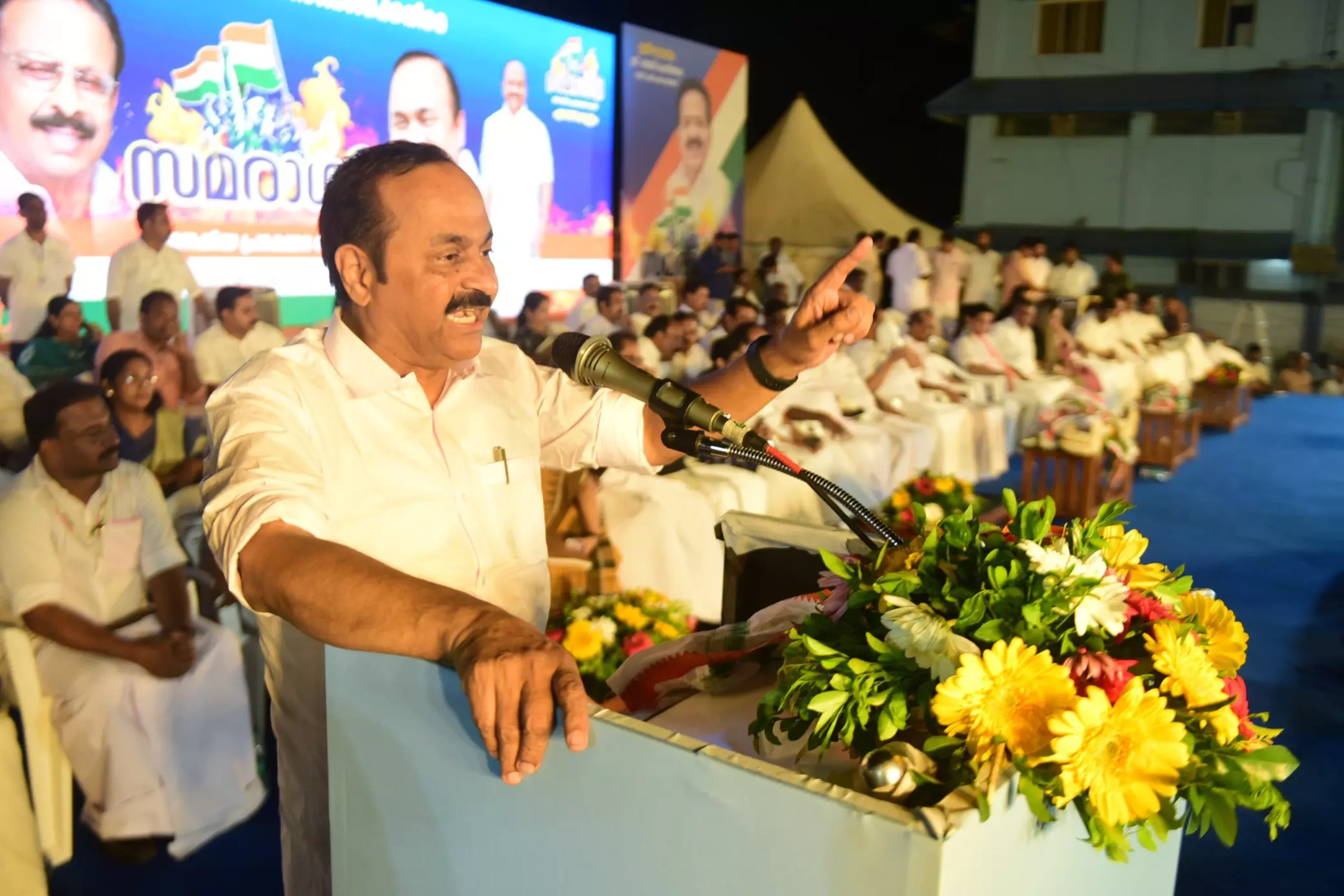
Opposition Leader VD Satheesan has repeatedly predicted 100+ seats for Congress, but most pre-poll surveys point to a neck-and-neck race between UDF and LDF.
A loss for the UDF could fragment its minority coalition for good, while the LDF would likely survive defeat and return stronger to the fight
There is a line of thought that holds that the forthcoming assembly elections in Kerala would be existential for the state's Communists. If they lose, they would be marginalised as their counterparts were in West Bengal and Tripura after losing elections in these erstwhile Left bastions. The line of thought also holds that the BJP has emerged as a principal political presence in these states, displacing the CPI(M).
This kind of reasoning is a little too facile. Even if the Communist-led Left Democratic Front loses in the elections scheduled for April 9, it will remain a vibrant political force, perhaps even emerge stronger, rid as it would be of the flotsam dragged along in the wake of power. There is a good reason why Kerala would be different from West Bengal and Tripura.
Why Kerala is not West Bengal
The Communist movement in Kerala democratised Malayali society to a maximum extent possible, even as the caste system survives and religion-based mobilisation thrives in the larger national polity. The Communists organised practically all sections of society — industrial workers, workers in traditional occupations such as spinning coir out of the fibre of coconut husk, agricultural workers, tenant farmers, students, teachers, and civil servants.
Also Read: Kerala elections | Congress-Left 'cross-voting' may not hold as campaign turns bitter
The Communists carried out land reforms, first through legislation during their brief two-year tenure in office from 1957 to 1959, and later by mobilising people on the ground to enforce land ceilings, turn tenants into owner-cultivators and distribute surplus land.
The Communist roots run deeper
Kerala's Communists came out of the Congress Socialist Party, and it was in their political DNA to work among the people, awaken their sense of self-worth and entitlement to human dignity. The redistribution of wealth and associated social and economic power that came about with land reforms helped the Communists mobilise people not as dumb masses but as individuals aware of their democratic rights and determined to organise, to use collective strength to secure those rights in practice.
Also Read: Why a Left defeat in Kerala would be good for Indian democracy, and the Left itself
Such was the power of this political agenda that all other political parties of the state were forced to accept it as their own, after initial revolt and rebellion, and eventually compete with the Communists to organise people to secure and exercise their democratic rights.
The Communists also carried forward the dynamic of social reform started in the decades of the late 19th and the early 20th century, with particular emphasis on mass education. Democratic awakening meant that people demanded better healthcare, road connectivity, access to clean drinking water and other amenities.
A shared democratic agenda
All this was unique to Kerala. The Communists had not hegemonised the social agenda in either West Bengal or Tripura, as they had in Kerala. It is true that the Communists implemented tenancy reform in West Bengal as well. However, by and large, the Communists played patronage politics in West Bengal and Tripura. If the people stayed with the Communists, their government would look after them — this was the bargain.
Also Read: Pinarayi Vijayan releases LDF report card, says 97 pc of 2021 poll promises fulfilled
Politics in Kerala is like a football match. Both sides play the same game; each side has a vociferous fan following and cheerleaders, one side wins, the other loses, but the game itself remains firmly entrenched in the people's minds. The Sangh Parivar and radical Islamists play a different game, and inveigle people into it, with modest success here.
Where the two fronts diverge
Yet, there is one big difference between the Congress-led United Democratic Front and the Communist-led Left Democratic Front. The state's religious minorities are more aligned with the UDF than with the LDF. Muslims have allegiance to the Muslim League and to the Congress, Christians to the Congress and assorted factions of the Kerala Congress.
Defeat that could break the UDF
If the Congress were to lose the assembly elections for a third time in a row, the minorities might be tempted to desert the Congress. In the face of the growing assault on minority rights from the Sangh Parivar across India, Kerala's minorities also need protection.
They might either turn to the Left for the defence of their rights, or even try to make peace with the Sangh Parivar. Even many Congressmen might be tempted to desert a party led by a witless wonder who refuses to take accountability for leadership failure time and again. This would result in the effective disbanding of the UDF, even if the Congress does survive as a truncated force.
Defeat in the forthcoming elections would be an existential threat for the UDF, but not for the LDF. Were the LDF to lose, it would continue to champion the state's common democratic agenda as the opposition. It could also cleanse itself of some of the corrupting influences of power and emerge stronger--to fight the next electoral battle with greater vigour.
(The Federal seeks to present views and opinions from all sides of the spectrum. The information, ideeas or opinions in the articles are of the author and do not necessarily reflect the views of The Federal)