







How coconut shells have sparked trade boom in coastal Karnataka
Charcoal made from coconut shells is used in water-purification units, hotel barbecues and grills, electric grids and various other industrial processes

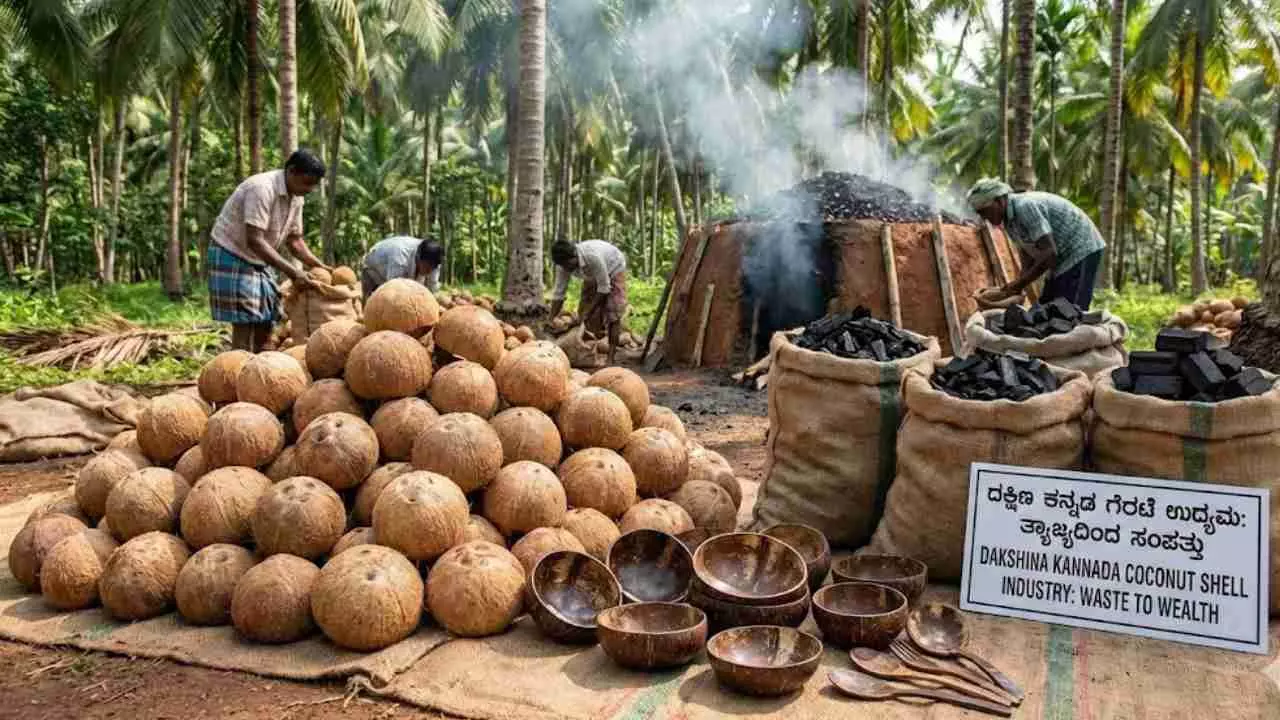
Not long ago, coconut shells had few takers even if offered for free. While the drupe’s water, pulp and oil have always been used extensively for various purposes, its woody outer layers were mostly rendered useless. But it is not the case anymore.
The shells are now seeing a growing commercial demand, so much so that they have become ingredients of booming industries worth lakhs of rupees. In fact, from coastal Karnataka to Kerala to Tamil Nadu, the coconut-shell trade is bringing in a quiet economic transformation.
Also read: Karnataka, not Kerala, is India's coconut capital
In Karnataka’s Dakshina Kannada district, for instance, discarded shells, which were once treated as kitchen waste, have evolved into a steady source of livelihood. They have even found themselves in interstate trade and transactions.
Prices head north
According to Sharif, owner of MS Traders in Puttur, a town in Dakshina Kannada, even a year ago, coconut shells were sold to a factory in Kerala at prices ranging from Rs 25 to Rs 100 per kg.
“This year, prices are steadily rising and could touch Rs 150. Fresh shells fetch better rates. Earlier, coconut husk was used for fibre, cocopeat and related products, but demand for those has reduced. Shells, on the other hand, are in demand now,” he told The Federal Karnataka.
Basheer, who operates a lorry fleet named Coal Express, says that during peak season, 10 to 15 loads of shells are collected every week across Dakshina Kannada. “All of it is sold to factories in Kerala at competitive prices. During the monsoon, prices fall because shells absorb rainwater and become heavier. Dry shells without moisture are always preferred,” he said.
Also read: Echoes of ‘Republic of Bellary’ as mining feud turns violent again
In coastal Karnataka, where coconuts are a kitchen staple, shell collection has increased sharply. Collectors go door to door, buying shells at ₹1-1.50 apiece. These are later sold by weight to coconut trading shops.
Kumaran, who hails from Madurai in Tamil Nadu, collects shells in the Padil-Bajal area of Mangaluru. He earns at least Rs 2,500 a week from this work alone.
Demand in charcoal industries
SK Hussain, a coconut trader from Kerala’s Kasaragod (the district borders south Karnataka), coconut shells were earlier sold in small quantities to handicraft artisans. The scenario has changed with the growing number of charcoal industries, and even businessmen from other states express interest in buying the shells.
Also read: Why Silicon Valley Bengaluru is emerging as a ‘coriander hub’
“With the rise in charcoal factories, demand has grown rapidly. Now, not only farmers but even households that use one or two coconuts a day collect shells and sell them once a month. I know of at least six charcoal factories in Kerala. Traders from Tamil Nadu also enquire about shells. Today, shells are given almost the same importance as coconuts,” he told The Federal Karnataka.
Coconut farmer Krishna Bhat said they have been selling shells only for the past few years. “Earlier, we used to pile them up and burn them into ash, or struggle to find space to store them. Now, when we break coconuts to sell copra (dried coconut kernel), the shells are sold as well. It is truly a case of turning waste into wealth,” he said.
Also read: Yelahanka razing: Relocation row deepens as Kerala politics enters the frame
In older times, household items made from coconut shells were popular. Ladles, cups and decorative items have been in demand for decades. Since shells do not decompose easily, they are also used around plant bases in gardens to help roots spread freely.
Charcoal used for exports
While handicraft use remains limited in scale, the major demand for the shells today comes from charcoal production. Charcoal made from coconut shells is used in water-purification units, hotel barbecues and grills, electric grids and various other industrial processes. India exports such charcoal mainly to African and European countries, and it is also sold through online platforms.
Also read: After 36 years, Karnataka weighs reviving student union polls
According to Bhat, this is why the coconut is often called Kalpavriksha (wish-fulfilling tree).
“Every part of the coconut is useful. When shells are burnt, they produce very high-quality carbon, which is used across industries as carbon or charcoal. In recent decades, shells are being processed using modern machinery, resulting in better-quality charcoal and higher demand,” he said.
(This story was originally published in The Federal Karnataka.)
